




Texas Hold'em Poker Tutorial Articles
Poker Range Intuition is a key ability to improve the speed and accuracy of decision-making in Texas Hold'em. This article analyzes how to train Range intuition through hand review to build a fast and stable decision-making system.
Poker Range Intuition It is the core ability to transform complex logic into quick judgments, and it is also one of the biggest differences between advanced players and ordinary players.
Many players mistakenly believe that expert players "play cards by feeling," but in reality, those intuitive judgments are the result of long-term training and refinement.
When you develop the right range mindset, your decision-making speed and accuracy will improve significantly.
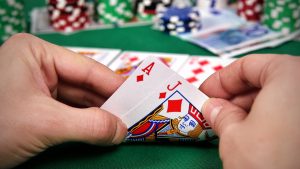
1. The analysis is too slow, and there isn't enough time to make a decision.
2. Overthinking only leads to losing direction.
3. Inability to quickly determine the opponent's range
The core of these problems is that you haven't developed range intuition.
Key conclusion: Poker Range Intuition is "compressed logic".
Intuition is not a talent, but rather:
→ Pattern recognition after repeated training
→ Accumulation of extensive hand experience
→ Transform complex analysis into rapid judgment
Experts don't stop thinking; they just speed up their thinking.
Hand situation review
1. You are at CO, holding A♣ J♣
2. Raise pre-flop, call on the BTN.
3. Flop: J♦ 9♠ 6♣ → You bet, your opponent calls.
4. Turn: T♠ → You check, your opponent bets.
5. River: 3♦ → Opponent bets again
Should you follow or abandon it? That depends on how quickly and accurately you judge the range.
What do you do when you lack intuition?
You might:
→ Analyze each street one by one
→ Unable to determine opponent's range
→ Ultimately, make the decision based on your feelings.
Such decision-making is both slow and unstable.
What do you do when you have an intuition?
Experts can make a quick judgment:
→ The opponent turns and begins to attack, with a relatively strong range.
→ River continues to bet, the proportion of weak hands decreases.
→ Your own top pair in this situation belongs to the bluff catcher
These judgments are "made instantly" in the minds of experts.
The three core abilities of Range Intuition
1. Pattern Recognition
→ Familiarize yourself with common line and range distributions
2. Range Narrowing
→ Quickly eliminate unreasonable cards
3. Relative Strength Assessment
→ Know your position within the overall scope
How to train range intuition?
Method 1: Reviewing a large number of hands
→ Ask yourself for every hand: What might my opponent have?
→ Practice listing the complete range
Method 2: Simplify the analysis process
→ Not pursuing perfection
→ Divided into only three categories: "strong/medium/weak"
Method 3: Establishing Standard Scene Memorization
→ Remember common hand patterns and their corresponding ranges
→ Apply it quickly to the future
Common mistake: Mistaking intuition for guesswork
Many players will say, "I feel like he has a strong hand."
But the problem is:
→ No logical basis
→ No range analysis
→ No repeatability
This is not intuition; it's random decision-making.
Advanced Focus: Intuition Built on Process
What you learned before:
→ Decision-making process
→ Emotional control
→ Correction of cognitive biases
These are the foundations for building intuition.
Without processes, there is no stable intuition.
Core Decision Conclusions
True intuition doesn't mean you should think less, but rather that you should think correctly more quickly.
When you can quickly and accurately assess the scope of your competitors, your decision-making will become more stable, efficient, and closer to long-term profitability.
Mental Model Review: What truly influences your decisions is not just technology.
Many players aren't bad at the game, they're just "thinking wrong." What truly influences winning or losing is often your judgment, mindset, and decision-making process.
The following mindset issues are the key reasons why most players are unable to achieve consistent profitability over the long term:
[Cognitive Bias] Why do you always overestimate your hand? Hand review analysis
[Results Trap] Results-Oriented vs. Correct Decision Making: Did You Really Make the Right Move?
[Psychological Impact] How does fear affect your betting decisions? Analysis
[Bluff Barrier] Why are you always afraid to Bluff? Analysis of the Reasons
[Overconfidence] Why does overconfidence actually lead to more losses? Retrospective analysis
[Decision-Making Process] How to establish a stable decision-making process? Teaching Analysis
[Emotional Management] How to prevent emotions from affecting your performance? Strategy Analysis
[Intuition Training] How to cultivate Range judgment intuition? Deconstruction and analysis.
[Insufficient Information] How to make decisions when information is incomplete? Practical analysis
[False Intuition] Why can "feelings" harm you? Hand review
[The Ability to Read People] How to determine if your opponent is faking it? Strategy Analysis
[Intuitive Judgment] When should we trust our intuition? Analysis
[Thinking Style] Thinking speed vs. thinking quality: which is more important?
[Reaction Delay] Why are you always one step behind? Analysis of the reasons.
[Profit Mindset] How to establish a mindset for long-term, stable profitability?
[Final Chapter] How to Build Your Own Complete Poker Profit System (Ultimate Guide)
These issues are not fundamentally technical, but rather differences in thinking. By reviewing mental models, you can refine your decision-making logic, avoid repeating mistakes, and gradually build your own long-term profitable decision-making system.
Extended Reading for Teaching
Hand resumption
[Review Methods] How do professional players review their hands?
Hand resumption
[Long-term planning] How to build a long-term profit strategy?
Hand resumption
[Strategy Selection] GTO vs Exploit: Which to choose in actual gameplay?
Hand resumption