



Texas Hold'em Poker Tutorial Articles
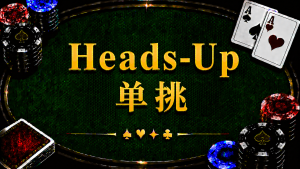
Heads-Up(單挑)是德州撲克最後兩位玩家對決的牌局形式。本篇完整解析 Heads-Up 的定義、位置優勢、Range、Blind、ICM、MTT 與 Cash Game 的策略差異
Heads-Up A form of Texas Hold'em in which only two players remain in competition, and the final stage in which most tournaments determine their champion.
With no other players involved, both players' starting-hand ranges expand dramatically, while the importance of positional advantage and sustained pressure becomes even more apparent than at a multiway table.
Truly understanding Heads-Up is not simply knowing that only two players remain, but understanding how position, range, aggression, ICM, and psychological dynamics collectively affect every decision.
Many beginners believe Heads-Up 就是比誰拿到大牌,actually,由於兩人的 Range 非常寬,真正決定勝負的通常是位置、持續施壓、讀牌能力與策略調整,而不是單純等待 AA 或 KK
Heads-Up is one of the forms of Texas Hold'em that most tests a player's fundamentals and ability to adjust.
What Is Heads-Up?
Heads-Up(簡稱 HU)是指牌桌上只剩兩位玩家進行對戰,Common situations include:
→ 錦標賽冠軍戰
→ Cash Game Heads-Up tables
→ Heads-Up challenge matches
All Heads-Up strategies are built on the premise that only two players are involved in the hand.
The Differences Between Heads-Up and Multiway Tables
Multiway tables:
→ 玩家較多
→ Tighter ranges
→ Bluff success rates are affected by multiple players
Heads-Up:
→ 只有一位對手
→ Ranges become significantly wider
→ Aggression is generally higher
Heads-Up is not a scaled-down version of a multiway table; it is an entirely different strategic environment.
Heads-Up Blind Rules
Heads-Up 時,Button 同時擔任 Small Blind,另一位玩家為 Big Blind
Preflop:Button(Small Blind)先行動
Flop、Turn、River:Big Blind 先行動,Button 最後行動
The Heads-Up Button has postflop positional advantage, making it a major strategic edge.
Why Do Ranges Become Wider?
This is because只有一位對手,therefore:
→ 許多 Full Ring 必須 Fold 的牌
→ Can be opened in Heads-Up
→ Can be raised
→ Can even be value bet
In Heads-Up, hand strength is a relative concept rather than an absolute one.
Why Is Position More Important in Heads-Up?
This is because:
→ 每一手牌幾乎都會進入翻牌後
→ Information advantage becomes more important
→ The player acting last can control the pot more easily
In Heads-Up, the value of position is more apparent than at a multiway table.
Aggression in Heads-Up
由於雙方 Range 很寬,因此,Open Raise 頻率增加、Continuation Bet 增加、Check-Raise 增加、Bluff 頻率通常提高,A passive approach usually struggles to maintain an edge in Heads-Up over the long term.
Heads-Up and ICM
如果是錦標賽最後兩人,ICM 仍然存在,但通常比三人桌或四人桌更弱,because已沒有第三名淘汰壓力
Heads-Up strategy is usually closer to pure Chip EV than the earlier stages of a Final Table.
Cash Game Heads-Up and Tournament Heads-Up
Cash Game:
→ 每個籌碼價值固定
→ No ICM
→ Players can reload at any time
Tournament:
→ 仍受獎金結構影響
→ Chips cannot be directly converted into cash
→ No rebuys allowed
Although Cash Game and Tournament Heads-Up have the same format, their strategic priorities differ
Can you Bluff in Heads-Up?
可以,而且通常比多人桌更常見,Reasons include:
→ 對手只有一位
→ Ranges are very wide
→ Many hands cannot continue calling
Successful Heads-Up Bluffing is built on continuously observing and adjusting to your opponent, rather than attacking blindly
The most common Heads-Up mistakes
Many players:
→ 等待 Premium Hand
→ Open with ranges that are too tight
→ Are afraid to Bluff
→ Ignore positional advantage
→ Fail to adjust their strategy based on their opponent
The biggest Heads-Up mistake is continuing to use a multiway-table strategy
Practical Example 1
Heads-Up,Button 持有 K♥5♠
At a multiway table, this would often be a Fold, but in standard Heads-Up situations, it can usually be Open Raised
In Heads-Up, many medium-strength hands are playable
Practical Example 2
Flop:A♣ 8♦ 3♠
Button 持有:Q♠J♠
Even without connecting, you can still continue betting by leveraging your Range Advantage
In Heads-Up, C-Bet frequency is generally higher than at multiway tables
Practical Example 3
Entering Tournament Heads-Up
champion:100,000
亞軍:70,000
You still need to consider the payout difference at this point, but high-EV confrontations are more acceptable than in three-handed play
Heads-Up generally encourages more aggressive chip accumulation than the early stages of a Final Table
The most common misconception among beginners
Many players believe Heads-Up 就是運氣,In fact,長期 Heads-Up 勝率高度取決於策略、調整能力與心理素質
Heads-Up has higher Variance, but a technical edge will still show in long-term results
Another common misconception
Many players believe只要打得夠 Aggressive 就能贏,In fact,真正重要的是根據對手不斷調整,而不是無限制提高 Bluff Frequency
Strong Heads-Up players know how to maintain a balance between Value and Bluff
Key conclusion
Heads-Up is a form of Texas Hold'em in which only two players remain, and it is also the final stage in which most tournaments determine the champion
Understanding Heads-Up, Position, Range, Aggression, Blind Pressure, ICM, and the ability to adjust to opponents will help players make higher-EV decisions in heads-up situations. A truly successful Heads-Up strategy is not about waiting for the best starting hands, but about using position, aggression, and continual adjustments to build an edge over the long term
Extended Reading for Teaching
Texas Hold'em Terminology Dictionary
Final Table
Texas Hold'em Terminology Dictionary
ITM: In the Money
Texas Hold'em Terminology Dictionary
Bubble Boy
Texas Hold'em Terminology Dictionary