




International news
PokerStars Team Pro Kenny Hallaert reviews his two appearances at the WSOP Main Event final table in 2016 and 2025, compares the differences between the three-month break in November Nine and the modern format, and analyzes the impact of the new three-week interval in 2026 on player preparation, exposure, and tournament pace.
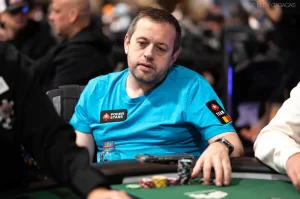
On July 23, 2026, Kenny Hallaert, who has twice reached the final table of the World Series of Poker (WSOP) Main Event, gave an exclusive interview to PokerNews, reflecting on his two deep runs in 2016 and 2025, and comparing the impact of three different rest arrangements—three months, one day, and three weeks—on players and events.
For most poker players, reaching the WSOP Main Event final table even once in their lifetime is enough to be considered a significant achievement in their career. However, Hallaert returned to the highest stage after a nine-year hiatus, becoming one of only ten players since 2000 to have reached the Main Event final table multiple times.

Making the cut twice in nine years sets a rare record for the Main Event.
Hallaert first reached the WSOP Main Event final table in 2016, finishing in sixth place; in 2025, he once again broke through the huge field, finishing in fourth place to complete his second final table journey.
His two final table appearances were separated by nine years, tying with 2009 champion Joe Cada for the second-longest gap in the modern WSOP Main Event. The record is held by Michael Mizrachi, who, after first reaching the final table in 2010, waited 15 years to return to the final stage and win the championship in 2025.
Player who has reached the WSOP Main Event final table multiple times since 2000
| player | First FT Results | FT results again |
|---|---|---|
| Jeff Shulman | 7th place in 2000 | 5th place in 2009 |
| Mike Matusow | 6th place in 2001 | 9th place in 2005 |
| Dan Harrington | 3rd place in 2003 | 4th place in 2004 |
| Joe Cada | 2009 champion | 5th place in 2018 |
| Antoine Saout | 3rd place in 2009 | 5th place in 2017 |
| Michael Mizrachi | 5th place in 2010 | 2025 champion |
| Ben Lamb | 3rd place in 2011 | 9th place in 2017 |
| Mark Newhouse | 9th place in 2013 | 9th place in 2014 |
| Kenny Hallaert | 6th place in 2016 | 4th place in 2025 |
| Damian Salas | 7th place in 2017 | 2020 Champion |
This list includes champions, Hall of Famers, and professional players who have been active in top-level tournaments for a long time, highlighting the difficulty of reaching the Main Event final table twice.

November 9, 2016: Three Months of Preparation and a Complete Reset
When Hallaert first qualified in 2016, the WSOP Main Event still used the "November Nine" format. After the final nine were determined in the summer, the tournament was suspended for about three months, and then regrouped in the fall to compete for the championship.
For Hallaert, the biggest advantage of the extended break is that athletes have ample time to arrange transportation, accommodation, and travel plans for family and friends. Athletes from Europe can also organize complete on-site support teams without having to deal with intercontinental travel in a very short period of time.
However, the three-month gap also brought obvious drawbacks. Players had time to undergo extensive training and targeted analysis, and the table dynamics, opponent impressions, and psychological rhythms established in the previous few days of competition almost completely disappeared. Hallaert described the restart as more like a single-table tournament with different starting chip stacks.
With only one day of rest in 2025, the competition rhythm can continue.
When Hallaert made it to the final table for the second time in 2025, the final nine players were given only one day of rest before the competition resumed.
The short break allowed all players to stay in the rhythm of the main event. The table history, opponent observations, and emotional tension accumulated over the previous days were still clear, and the final table felt like a direct continuation of the entire main event journey.
However, for overseas athletes, one day is almost insufficient to arrange for family and friends to travel to Las Vegas. Hallaert revealed that only his girlfriend was able to arrive in time, and it would be difficult for other family and friends to complete the international trip within such a limited time.

November Nine brings greater exposure to players
The three-month break not only gives athletes more time to prepare, but also creates a complete publicity cycle for the media.
Hallaert recalled that in 2016, ESPN broadcast the Main Event continuously before the final table, giving viewers ample time to get to know the nine players. During this period, the final table members became temporary representatives of the sport of poker, gaining far more public exposure than regular tournament players.
He was recognized by people on the streets of Bruges, Belgium, and later, when he traveled to Australia and attended music festivals, people also asked to take photos with him. For Hallaert, this sudden fame was a rather special part of his 2016 main event journey.
With the development of live streaming technology, the WSOP Main Event final table has been held almost continuously since 2017. Although the immediacy of the event has improved, Hallaert believes that viewers may not have enough time to get to know each final table player, and it is also more difficult to accumulate player stories and personal images.
To enhance the visibility of the final table players in 2026, the WSOP will air four montage episodes on ESPN before the final event, attempting to recreate the promotional effect of the November Nine era under the new format.
Behind the glory lies a long period of physical and mental exhaustion.
The two main races made Hallaert realize that advancing to the final stage is not only a test of technique, but also puts a huge burden on the body and mind.
He described the experience as exhausting, stressful, and pressure-filled, but also a dream come true and unforgettable one for poker players.
As the main event progresses into Days 5, 6, and 7, players not only need to maintain intense focus for extended periods but also struggle to get a full night's sleep. The tournament results can potentially alter a player's career, and the closer they get to the final table, the harder it becomes to detach themselves from the pressure outside of the competition.
Hallaert said that after talking with other runners who had participated in the main race, he found that insomnia, fatigue and mental tension were not isolated cases, but common challenges that most participants faced when entering the final stage.
Is a three-week truce the ideal scenario?
For the first time, the 2026 WSOP Main Event will have a three-week break after the nine-player final table is set, in an effort to strike a balance between the traditional November Nine format and the continuous format of recent years.
Hallaert believes that three weeks is enough for players to manage their schedules, make arrangements with family and friends, get rest, and receive adequate training, without completely fading the main event storyline and table memories.
However, the off-season usually benefits less experienced players. Recreational players or those making their first appearance in a major final table can make significant progress within three weeks through coaching and targeted learning; experienced professional players, whose foundation is already relatively solid, usually have less room for improvement in the short term.
Hallaert believes that a week might be the theoretically optimal interval, but three weeks is still a reasonable compromise: it allows final table players to regroup both mentally and logistically, while also maintaining the excitement of the final stages of the main event.
Two experiences with the Final Four provide a reference for the new format.
Kenny Hallaert's three-month hiatus and one-day break make him one of the few players who can directly compare the two main event formats.
November Nine offers a full promotional period, support from family and friends, and ample time for preparation; the continuous format preserves the rhythm of the competition and table history. The three-week interval in 2026 is an attempt to combine the advantages of both while minimizing the need for a complete reset due to a long hiatus.
For the nine players who are about to return to the Main Event final table, this break is not just a time to rest, but also a crucial period for dealing with pressure, studying their opponents, and preparing for the biggest stage of their careers.
Want to change Texas Holdem from "can understand" to "can win"?
If you want to learn more about Texas Hold'em, you can continue reading:
The Origins of Texas Hold'em: Why is it the World's Most Popular Poker Variant?
Texas Hold'em Hand Rankings and Showdown Rules (Beginner’s Essentials)
Texas Hold'em Betting teaching: Check / Bet / Call /Raise and Betting Strategy Analysis
The importance of Texas Hold'em position? Why is the back position more advantageous?
How to play Texas Hold'em? Novices learn Texas Hold'em rules, processes and betting teaching in 10 minutes
Texas Hold’em starting hands guide: Which hands should you play? A complete guide to Starting Hands strategy
Texas Holdem Starting Hands Chart guide: Complete starting-hand charts and positional strategy
How to play Texas Hold’em: Complete rules and the flow of a hand (Preflop / Flop / Turn / River)
Hunter Poker offers comprehensive tutorials, hand analysis, and strategy sharing to help players upgrade from simply "reading the cards" to understanding the range . This allows you to make better decisions in every hand.
▶️ In Facebook .
📘 In YouTube .
Want to learn more about Texas Hold'em strategy and gameplay?
Free online Texas Hold'em tournaments usually require no entry fee, making them suitable for beginners to become familiar with the rules while also allowing advanced players to test strategies and gain tournament experience. View the full brand introduction to learn about each platform's freeroll schedule, tournament features, and suitable player groups.
Further News Reading
International news
Brutal Full House Cooler Decides $10K Poker Masters Champion
International news
Poker player Lynne Ji denies allegations in alleged domestic dispute stabbing case
International news
Adrian Mateos completes an “unwanted hat trick” at the Poker Masters: three consecutive bubble exits
International news