


International news
Malaysian professional poker player Kiat Lee has amassed four Triton Poker titles. Starting with a roughly £50,000 win in a £300 buy-in event in the UK in 2015, he gradually developed into a leading name in international high-stakes tournaments. In a recent GipsyTeam interview, he shared the keys to his victory in the Mystery Bounty event at the 2026 Jeju stop, the painful experience of having AA cracked, his use of GTO Wizard for training, and his stance on cheating in online poker. He also explained why he would rather sell part of his action to enter a $100,000 high-stakes event than fully bankroll himself in a $10,000 tournament.
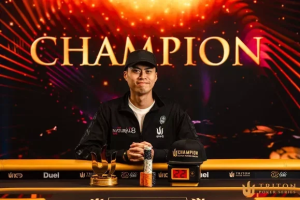
On November 10, 2026, the career story of Malaysian professional poker player Kiat Lee (Wai Kiat Lee) once again drew attention. The high-stakes tournament star, who has already amassed four Triton Poker championship trophies, recently sat down with GipsyTeam reporter Alexander Badzhik to discuss how he began in a local UK event with a £300 buy-in and gradually made his way to poker’s elite high-stakes stage.
The interview covered Kiat Lee’s career, his Triton Jeju title runs, his training methods using tools such as GTO Wizard, and his views on online poker cheating, bankroll management for professional players, and staking deals in high-stakes events.
The aspect that drew the most attention was his approach to high-stakes events:Rather than fully funding his own entry into a $10,000 event, he would prefer to sell part of his action and take on a $100,000 buy-in tournament.
For Kiat Lee, who has already stood atop the Triton winners’ podium four times, high buy-ins are more than a financial threshold—they represent an opportunity to compete alongside the world’s best players.
Starting in £300 UK Local Events, a £50,000 Prize Changed His Career Path
Kiat Lee’s poker story was not initially connected to Triton high-stakes events.
He first encountered live poker tournaments while studying in the UK.
At the time, the UK had many local daily tournaments (Daily MTTs), as well as live poker series of varying scales, which gradually introduced him to competitive poker.
Kiat Lee recalled that he was initially excited simply by poker’s competitive nature, and only began studying the game more seriously as he gained more tournament experience.
What truly changed his career path was an event held in the UK in 2015.
He entered a live tournament with a buy-in of just £300, eventually winning the title and approximately £50,000 in prize money.
Although that prize was far smaller than his later results on the Triton stage, the victory was pivotal early in his career.
On one hand, the prize money gave him a more substantial poker bankroll; on the other, it gave him confidence in his tournament ability.
From a £300 buy-in and a £50,000 first-place prize to later playing high-stakes events with buy-ins of as much as $100,000 or even $200,000, Kiat Lee’s career steadily entered another tier.

Four Triton Titles Make Kiat Lee a Key Figure in International High-Stakes Events
After starting out in local live events, Kiat Lee gradually shifted his tournament focus to international competition.
Among them, the Triton Poker Super High Roller Series became one of the most important series of his career.
He first played a Triton event in 2022 and finished runner-up at the Northern Cyprus stop.
However, his true championship breakthrough came at Triton Jeju in March 2025.
Kiat Lee won his first Triton trophy there, ending a run of several near-misses where he had come close to a title without reaching the top.
In May that year, he won his second Triton title in Montenegro.
When he returned to Jeju in March 2026, he again claimed victory in a $50,000 Short Deck event, defeating Triton co-founder Paul Phua to win the $840,000 top prize.
Then, in September 2026, he defeated Canadian player Jamil Wakil in the $40,000 Mystery Bounty event to capture his fourth Triton title.
Key Milestones in Kiat Lee’s Triton Career
| Date | Key Result | Main Highlight |
|---|---|---|
| 2015 | Won a £300 buy-in event in the UK | Won approximately £50,000 |
| 2022 | First appearance in the Triton series | Runner-up finish in Northern Cyprus |
| March 2025 | First Triton title | Short Deck event in Jeju |
| May 2025 | Second Triton title | Won in Montenegro |
| March 2026 | Third Triton title | $50,000 Short Deck, won $840,000 |
| September 2026 | Fourth Triton title | $40,000 Mystery Bounty, won $619,000 in prize money plus additional bounties |
In just around a year and a half, Kiat Lee went from his first title to accumulating four Triton championship trophies.
This has made him one of the most outstanding Malaysian players in the Triton series in recent years.
Most Memorable at Jeju 2026: Short Deck Victory and a Three-Way Deal in a $125,000 Event
In the interview, when asked which Triton stop had been the most memorable, Kiat Lee chose Jeju in March 2026.
At that stop, he not only won a Short Deck event, but also reached a Three-Way Chop with two other players in a $125,000 buy-in high-stakes event.
These two results also reflected his ability to compete across different tournament formats.
Kiat Lee noted that he particularly enjoys Mystery Bounty, Short Deck, and Turbo events.
These formats are not only the ones that interest him most, but also the types of events in which he has achieved major results in the past.
His first two Triton titles both came in Turbo events.
By comparison, Pot-Limit Omaha (PLO) is not a game in which he excels, so it is generally not part of his main tournament schedule.
However, aside from Omaha, as long as time and circumstances permit, he is generally willing to play most events across the different buy-in levels of the Triton series, including Triton ONE and the highest-tier Super High Roller events.
A Pocket Aces Hand Eliminating Three Players Became a Key Turning Point in His Fourth Title
When discussing his most memorable hand, Kiat Lee first mentioned the $40,000 Mystery Bounty event at Jeju in September 2026.
The event drew 133 entries and generated a total prize pool of $5,320,000.
Kiat Lee experienced several swings in his chip stack during the tournament and at one point even faced elimination near the money bubble.
However, he ultimately doubled up to stay alive and later secured a crucial victory.
With around a dozen players remaining, Kiat Lee was dealt pocket aces while three opponents had already gone all-in ahead of him.
As his stack covered all of his opponents, he decided to call, creating a four-way all-in pot.
Key Hand: AA Against Three Opponents
| player | Hand |
|---|---|
| Kiat Lee | A♣ A♠ |
| Seth Davies | K♣ 9♠ |
| Samuel Mullur | K♥ 9♥ |
| Phil Ivey | A♦ 9♦ |
The board ran out:
7♣ 8♠ 7♥ Q♠ 2♠
Kiat Lee’s pocket aces held up, eliminating all three opponents in one hand.
The hand not only gave him a massive chip boost, but also earned him three Mystery Bounty envelopes.
After that, Kiat Lee gradually built up a chip advantage and eventually made the final table.
Although he was still significantly behind Jamil Wakil when Heads-Up play for the title began, he mounted another comeback, claiming $619,000 in prize money and eight mystery bounty envelopes to win his fourth Triton title.
This journey from the brink of the bubble to ultimately winning the title became one of the most defining tournaments of his career.
The same AA, but the $200,000 Triton Invitational in 2023 became a painful memory
Interestingly, Kiat Lee's two most unforgettable hands both involved pocket AA.
If the AA in the 2026 Mystery Bounty brought him a title, then the AA in the $200,000 Triton Invitational at the 2023 North Cyprus stop produced a completely different outcome.
At the time, six players remained, and Kiat Lee was approximately third in chips.
There were also several short stacks at the table, including Patrik Antonius, who had only around five big blinds remaining.
Given the payout structures common in high-stakes tournaments, this type of situation usually requires players to be more mindful of elimination risk.
However, Kiat Lee was dealt pocket AA in one hand and got all-in preflop against then-chip leader Ramin Hajiyev.
Hajiyev held suited K2.
Although Kiat Lee was a huge favorite preflop, the eventual board gave Hajiyev a flush, completing the comeback.
Kiat Lee was eliminated as a result.
He admitted in the interview that this Bad Beat hit him hard, because the payout difference resulting from an early exit in a $200,000 buy-in high-stakes invitational can be very substantial.
The same pocket AA helped him win a Triton title once, yet suffered a reversal at the most critical moment on another occasion.
These two experiences also show that in high-stakes tournaments, even when a hand is heavily favored, the final result can still be affected by how the board runs out.
How do high-stakes players stay sharp? Sleep, diet, and mental recovery are equally important
In addition to looking back on his tournament results, Kiat Lee also shared how he organizes his daily life during major series.
For professional players who regularly compete in high-stakes tournaments such as Triton, maintaining their mental state is an important challenge.
His routine on tournament days is relatively consistent.
First, he makes sure to get enough sleep.
After waking up, he eats a regular meal, does some light exercise or stretching, and only then begins playing.
When the tournament ends, he tries to avoid continuing to think about hands, allowing himself time to mentally recover.
When he is not competing, he enjoys spending time with family and friends, going out to restaurants, exercising, or simply resting.
Kiat Lee believes that the higher the buy-in level, the more important it is to maintain clear and focused thinking.
Therefore, rather than constantly replaying every hand during breaks, he places greater importance on restoring his mental state.
Kiat Lee trains with GTO Wizard and HRC, emphasizing that learning must never stop
In terms of technical training, Kiat Lee is not opposed to using modern poker analysis tools.
He said that he mainly uses the following two software programs for study.
| Tool | Primary use |
|---|---|
| GTO Wizard | Studying GTO strategies, hand ranges, and decisions in different situations |
| HRC (Holdem Resources Calculator) | Analyzing tournament all-in strategies, payout structures, and ICM-related decisions |
These tools can help players review hands, analyze strategies at different stack depths, and understand how final-table payout pressure affects decision-making.
However, Kiat Lee also clearly distinguishes between post-game study and the use of unauthorized assistance during play.
To him, training with software is a way to improve his skills, but if players use Solvers or real-time assistance tools during competition in violation of platform rules, it becomes an issue of fair play.
How does he view poker cheating? He supports penalties but does not advocate permanently banning every offender
In the interview, GipsyTeam also asked Kiat Lee about online poker security and cheating.
When asked whether players who use unauthorized Solvers during play should be permanently banned, he expressed a relatively clear position.
Kiat Lee believes that if someone knowingly uses cheating or prohibited tools to gain an advantage, they should bear the corresponding consequences.
At the same time, he believes that penalties must take the specific circumstances into account, including the severity of the violation, whether it was intentional, and how the person responds afterward.
If an offender is willing to admit their mistake, accept punishment, and genuinely change their behavior, he believes the poker community can consider giving them a second chance.
Online poker security: Platforms must strengthen RTA detection
Regarding the controversies involving Mesh Agent and WPN Network, Kiat Lee also discussed the security challenges that online poker platforms need to confront.
He believes that as technology continues to advance, methods of cheating and assistance tools may also continue to evolve.
Therefore, online poker platforms must invest more technical and human resources in identifying suspicious behavior, real-time assistance (RTA), and other software that may undermine fair competition.
In addition, platforms and players need to establish more effective information-sharing mechanisms.
For Kiat Lee, maintaining players' trust in the fairness of the game is an important condition for the continued healthy development of online poker.
Why choose to sell action for a $100,000 event rather than self-fund a $10,000 event?
At the end of the interview, Kiat Lee answered a question related to bankroll management in professional poker.
Suppose there are two options:
Use entirely personal funds to enter a tournament with a $10,000 buy-in.
Sell part of the action and enter a high-stakes tournament with a $100,000 buy-in while taking on a lower proportion of the buy-in personally.
Kiat Lee chose the second option without hesitation.
His reason was not simply to pursue a bigger prize pool, but to compete against the strongest players and challenge himself at a higher level.
However, he also specifically emphasized that the percentage of action he actually retains must be reasonable.
What is selling action?
In professional poker tournaments, players can sell part of their action to investors.
For example, in a tournament with a $100,000 buy-in, if a player sells 80% of their action at face value and retains 20%, they only need to cover $20,000 of the buy-in cost.
If that tournament pays $500,000 in prize money, then under this simplified assumption:
| Category | Player retains 20% | Investors collectively hold 80% |
|---|---|---|
| Buy-in cost | $20,000 | $80,000 |
| Prize distribution | $100,000 | $400,000 |
| Return after deducting buy-in | $80,000 | $320,000 |
This table is for illustrating the action-selling system only and does not represent Kiat Lee's actual tournament entries or financial information. In practice, Markup, swaps, taxes, and other agreements may also be involved.
This model allows players to participate in higher-stakes tournaments without taking on the entire buy-in cost.
However, part of any prize money must also be distributed to investors, so it does not mean the risks of high-stakes events disappear entirely.
For Kiat Lee, selling action is not a lack of confidence, but a bankroll allocation choice when entering high-stakes tournaments.
Million-dollar prize money does not mean everyday life must be extravagant
When asked how high-stakes players view everyday spending, Kiat Lee pointed out that he manages poker funds separately from living expenses.
Even though he regularly enters tournaments with buy-ins of tens of thousands of dollars or more, it does not mean he adopts the same spending habits in daily life.
He believes that tournament buy-ins are part of the job and bankroll management, while everyday spending should be judged according to actual needs and value.
This philosophy also aligns with his willingness to sell action in order to play high-stakes events.
A high buy-in does not necessarily mean blindly taking on risk; what matters is understanding how much capital you are actually committing and whether you are sufficiently able to absorb the losses.

Kiat Lee's top three MTT players in the world: Jason Koon, Stephen Chidwick, Adrian Mateos
During the rapid-fire Q&A portion of the interview, Kiat Lee also discussed the professional players he admires most.
When asked to name the three best tournament players in his view, he gave the following list:
| player | Country/Region |
|---|---|
| Jason Koon | United States |
| Stephen Chidwick | United Kingdom |
| Adrian Mateos | Spain |
All three have been active in the world's elite high-stakes tournament scene for many years, accumulating numerous major results in Triton, WSOP, and other international events.
Additionally, when asked which Russian player he admires most, Kiat Lee chose Artur Martirosian.
If he were to play the Triton Invitational as a businessperson and needed to invite a professional player as his partner, he said he would choose Brazilian player João Simão.
The reason is that he admires Simão's personality and playing style at the table.
Jeju, South Korea is his favorite tournament destination, while he plans to continue playing at Triton North Cyprus
Although Kiat Lee has traveled around the world to compete in major tournaments, he still chose South Korea when asked which country he most enjoys playing in.
Jeju, in particular, holds special significance for him.
It is not only where he has made several important final tables, but also where he won his first Triton trophy.
In March 2026, he won his third Triton title in Jeju; in September of the same year, he captured his fourth title at the same location.
For Kiat Lee, Jeju has become one of the most important tournament stops of his career.
As for the Triton North Cyprus stop in November 2026, he also expressed his desire in the interview to continue competing.
As long as circumstances permit, he hopes to continue playing different events in Triton ONE and the Triton Super High Roller Series, while challenging himself at even higher levels of competition.
Behind four Triton titles: continuous learning, risk control, and challenging stronger opponents
From a £300 local tournament in the UK in 2015 to four Triton trophies by 2026, Kiat Lee has spent more than a decade competing in live poker.
In this interview, he did not attribute his success to a single strategy or good fortune in any particular event.
Instead, the interview highlights several key principles he holds about professional poker: maintaining a consistent lifestyle, continually learning with strategy tools, adhering to fair-play rules, and managing the financial risk of high-stakes tournaments separately from everyday living expenses.
At the same time, winning four Triton titles has not diminished his interest in playing at higher levels.
For Kiat Lee, his career remains centered on the same core goal: continually improving his skills and testing himself in the world's highest-level tournaments.
As the 2026 Triton North Cyprus stop enters its key stages, attention will turn to whether this four-time Malaysian champion can carry on his Jeju form and further increase his total number of Triton titles.
Want to change Texas Holdem from "can understand" to "can win"?
If you want to learn more about Texas Hold'em, you can continue reading:
The Origins of Texas Hold'em: Why is it the World's Most Popular Poker Variant?
Texas Hold'em Hand Rankings and Showdown Rules (Beginner’s Essentials)
Texas Hold'em Betting teaching: Check / Bet / Call /Raise and Betting Strategy Analysis
The importance of Texas Hold'em position? Why is the back position more advantageous?
How to play Texas Hold'em? Novices learn Texas Hold'em rules, processes and betting teaching in 10 minutes
Texas Hold’em Starting Hands Guide: Which Hands Should You Play? A Complete Starting Hands Strategy Guide
Texas Holdem Starting Hands Chart Guide: Complete Starting Hand Charts and Positional Strategy
How to Play Texas Hold’em: Complete Rules and the Flow of a Hand (Preflop / Flop / Turn / River)
Hunter Poker provides complete teaching, hand analysis and strategy sharing to help players upgrade from "watching cards" toLook at the range (range). Let you make better decisions in every hand.
▶️ In Facebook .
📘 In YouTube .
Want to learn more about Texas Hold'em strategy and gameplay?
Online Texas Hold'em freerolls usually do not require an entry fee, making them suitable for beginners to learn the rules and allowing more advanced players to test strategies and build tournament experience. View the full brand introduction to learn about each platform's freeroll schedule, tournament features, and suitable player groups.
Further News Reading
International news
Interview with Four-Time Triton Champion Kiat Lee | From £300 Events to the World’s High-Stakes Tables: His Championship Story, Cheating Controversies, and Bankroll Management Philosophy
International news
Triton North Cyprus | Yan Jingyao Wins Big Bounty Title, Defeats TJ Reid for $51,000
International news
Triton North Cyprus | Alin Ivan makes a heroic call to come from behind for the title; Zhang Yang finishes fifth, Chen Peng sixth
International news