

International news
On October 30, 2026, China Poker Network revisited a high-stakes poker interview with Mikita Badziakouski, revealing how elite players cover tournament buy-ins that can exceed $8 million per year. Badziakouski won the 2023 WPT Big One for One Drop, earning $7.1145 million, though his actual proceeds had to be distributed according to the shares he held. He discussed Backing support, Markup premiums on pieces, Swap arrangements, and the risk of conflicts of interest at final tables, lifting the curtain on the financial mechanics behind million-dollar high-roller events.
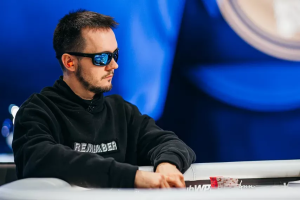
On October 30, 2026, China Poker Network revisited Belarusian high-stakes poker starMikita Badziakouskiin an in-depth GipsyTeam interview, revealing the financial mechanics behind elite professionals entering US$1 million buy-in tournaments.
In December 2023, Badziakouski won the WPT Big One for One Drop in Las Vegas, emerging from a 17-player field to claimUS$7,114,500 first prize.
The tournament carried a US$1 million buy-in, with a first prize of more than US$7.11 million. However, Badziakouski did not display the overwhelming joy outsiders might have expected after the event.
The reason is that for professionals who regularly play high-stakes tournaments, US$7.11 million does not fully equal personal income. What truly affects returns also includes sold action, investor distributions, tournament costs, and long-term bankroll management.
Badziakouski further revealed that, based on the scale of high-roller events worldwide at the time, a top professional's total annual buy-ins could exceedUS$8 million.
US$1 million buy-in, 17 players: Mikita wins US$7.11 million
The 2023 WPT Big One for One Drop was held at Wynn Las Vegas from December 18 to 20 and attracted 17 entrants.
The total prize pool was US$15,810,000, with only the top four players receiving payout positions.
Badziakouski defeated Austrian player Mario Mosboeck in the final Heads-Up battle, securing one of the most important titles of his career.
Key data for the 2023 WPT Big One for One Drop
| Category | Statistics |
|---|---|
| Tournament | WPT Big One for One Drop |
| Date | December 18 to 20, 2023 |
| Location | Wynn Las Vegas |
| Buy-in | US$1,000,000 |
| Entries | 17 |
| Total prize pool | US$15,810,000 |
| In the money | Top 4 |
| Champion | Mikita Badziakouski |
| First-place prize | US$7,114,500 |
Final top-four payouts
| Rank | player | bonus |
|---|---|---|
| 1 | Mikita Badziakouski | US$7,114,500 |
| 2 | Mario Mosboeck | US$4,663,950 |
| 3 | Dan Smith | US$2,806,750 |
| 4 | Isaac Haxton | US$1,224,800 |
With only four paid places, fifth-place finisher Nick Petrangelo and sixth-place finisher Santhosh Suvarna both received no payout.
This meant that even reaching the final six could still result in losing the entire US$1 million buy-in.
Why do elite players need US$8 million in annual buy-ins?
In the GipsyTeam interview, Badziakouski discussed the most important reality of high-stakes poker:
Even world-class professionals do not necessarily use all of their own money to pay every tournament buy-in.
He noted that as high-stakes tournaments worldwide continue to multiply, professionals who regularly play US$25,000, US$50,000, US$100,000, and even US$1 million buy-in events could face total annual buy-ins exceeding US$8 million.
This figure does not include travel, accommodation, and other related expenses.
Annual bankroll pressure for high-stakes players
| Category | Description |
|---|---|
| Potential annual buy-ins | More than US$8,000,000 |
| Main events | International high-roller and super high-roller events |
| Highest single-event buy-in example | US$1,000,000 |
| Main financial challenges | Large funding requirements and prize-money variance |
| Common solutions | Backing, selling action, Swap |
It should be emphasized that US$8 million is Badziakouski's estimate of the annual tournament volume for high-stakes players; it does not mean every professional must put up US$8 million in personal cash each year.
This is precisely why high-stakes poker funding arrangements exist.
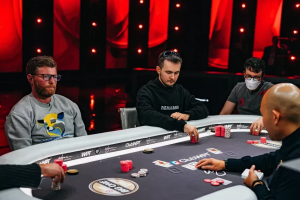
For the US$1 million buy-in, Mikita held only part of the action
When asked how much of the US$1 million buy-in for the 2023 Big One for One Drop came from his own funds, Badziakouski did not disclose the exact percentage.
But he confirmed that, including himself, most professionals in the event held only a relatively small personal share of their own action.
In other words, although a player enters a US$1 million buy-in event under their own name, the actual funding may come from multiple investors.
The player is responsible for competing, while different investors share the risk and receive corresponding returns according to the percentage of action each holds.
Therefore, even though Badziakouski won the US$7.11 million first prize, it does not mean all of that money belonged to him personally.
The actual amount he received depended on the pre-arranged action agreement and settlement terms.
What is Backing? How high-stakes players obtain investment support
In the interview, Badziakouski discussed a highly common funding model in the high-stakes poker world:
Backing (financial support)
Under this model, investors provide a professional player with part or all of the funds needed to enter events, then divide the proceeds generated by tournament results according to their agreement.
Some wealthy players who themselves play US$25,000 to US$200,000 high-stakes events also invest in several professionals at the same time.
Badziakouski mentioned that some investors back around five players.
For professionals, the biggest advantage of Backing is reducing the personal financial risk they bear.
Even when tournament results fluctuate significantly, they do not have to absorb all buy-in losses alone.
How is Backing different from paying your own buy-ins?
| Comparison item | Self-funded | Backing financial support |
|---|---|---|
| Source of buy-ins | Player's personal funds | Investors provide part or all of the funds |
| Financial risk | Primarily borne by the player | Shared according to the agreement |
| Prize-money entitlement | In principle, received by the player | Distributed according to the agreement |
| Long-term obligations | No obligations under an investment contract | May involve ongoing cooperation and Makeup |
| Applicable situation | Players with more ample personal funds | Those seeking to control high-stakes variance |
However, Backing does not mean players can completely disregard losses.
Some long-term cooperation contracts use a Makeup system, under which players must first make up agreed accumulated prior losses before profits can again be divided according to the contract.
For some professionals, this can create long-term financial and career pressure.
Mikita prefers selling action for individual events to avoid Makeup pressure
Compared with long-term Backing, Badziakouski said he prefers selling action on an event-by-event basis.
This approach is usually called Staking or Selling Action.
A player sells part of their interest in a tournament to investors, with both sides sharing costs and results according to percentages agreed in advance.
Once the tournament ends, settlement is completed for that event.
This allows Badziakouski to control his personal financial risk while avoiding the Makeup obligations that long-term Backing may create.
For players who need to enter numerous high-stakes events throughout the year, individual-event action sales also make funding arrangements for each tournament more flexible.
Markup: How do elite players price their skill edge?
Another important concept in the high-stakes poker investment market is:
Markup (action premium)
Markup is the price multiplier a player charges investors when selling tournament action.
If a player is considered to have strong long-term profitability, investors may be willing to pay more than the face value of the action.
For example, in a US$1 million buy-in event, if a player sells 10% of their action at 1.10 Markup:
| Category | Assumed amount |
|---|---|
| Tournament buy-in | US$1,000,000 |
| Action sold | 10% |
| Face value of action | US$100,000 |
| Markup | 1.10 |
| Amount paid by investor | US$110,000 |
| Prize-money interest received by investor | 10% |
The above is purely a calculation example and does not represent the actual price or percentage of action sold by Badziakouski.
This model enables strong players to sell action at a premium based on the market's assessment of their playing ability.
However, higher Markup is not always better.
For investors, the higher the purchase price, the higher the expected return on investment required; if the price exceeds a reasonable range, investing in the action may still be unattractive even if the player has a skill edge.
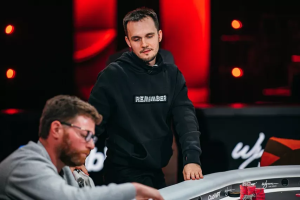
The mysterious “X”: Who determines Markup for the world's elite players?
Badziakouski revealed that many high-stakes professionals' investor lists overlapped substantially at the time.
Within this circle, one widely trusted professional player was regarded by many investors as an important reference for evaluating Markup.
Badziakouski did not disclose the player's identity, referring to them only as “X.”
When selling action, some players would transact directly at the Markup assessed by X.
For investors, this method can reduce the burden of independently assessing every player's ability and a fair price.
However, it remains a market-based trust mechanism rather than an officially standardized action price.
Investors hold action in eight players at once to spread single-event risk
The US$1 million buy-in Big One for One Drop had only 17 entrants, with prize money heavily concentrated among very few finishing positions.
Therefore, if an investor buys action in only one player, they may lose their entire investment if that player is eliminated early.
Badziakouski noted that some investors choose to buy action in multiple professionals simultaneously.
Some of these investors even hold interests in eight players at the same time.
As a result, investors no longer rely entirely on a single player's performance, instead spreading result variance through the performance of different players.
Badziakouski believes this approach has particular value in super high-roller events with smaller fields.
But he also stressed that the premise is that every individual action investment must itself have positive expected value (+EV).
Diversification can alter the distribution of risk, but it cannot turn an inherently unreasonable action price into a favorable investment.
Elite players Swap action with one another to reduce variance
Besides selling action to outside investors, professionals also use another common arrangement among themselves:
Swap (action swap)
Two players can agree in advance to each hold a certain percentage of the other's tournament action.
For example, if two players Swap 5% of their action, both can share part of the return when either one posts a strong result.
Badziakouski said he has maintained action-swapping arrangements with some high-stakes regulars for years.
He even revealed that when his own results in the Triton series were disappointing, he relied on the action he held in other players to offset some of his tournament losses.
However, this model also raises a highly sensitive issue.
Can cross-holding action affect Final Table fairness?
If two players who hold action in each other both reach the Final Table, could it affect normal competition?
Badziakouski acknowledged that this does create a risk of conflict of interest.
For example, if one player holds action in another opponent, eliminating that opponent may simultaneously reduce the potential return they could receive through that action.
Even if players subjectively want to compete fairly, economic interests may influence them in certain extreme decisions.
This situation involves so-called Soft Play, where a player does not compete against an opponent with full normal intensity because of a particular relationship or interest.
To reduce this risk, Badziakouski said he set one rule for himself:
The personal action he retains must be at least four times as large as the action he holds in any other player.
He believes this helps ensure that his primary financial interest still comes from his own tournament results.
In addition, many major event Final Tables are broadcast with hole cards shown, which can improve tournament transparency to a certain extent.
But public broadcasts cannot completely eliminate potential conflicts of interest, and action arrangements remain a competitive-integrity issue the high-stakes poker world needs to confront.
In a US$1 million event, major losses can be at stake from the very first level
Discussing the actual competition at the 2023 Big One for One Drop, Badziakouski also shared the psychological pressure created by the event.
The tournament used a deep-stack structure, with effective stack depths in some hands reaching as high as 330 BB.
In addition, the event imposed strict action time limits:
Preflop decisions: 15 seconds
Postflop decisions: 30 seconds
With such deep stacks, even a single hand could involve enormous financial risk.
Badziakouski recalled that about 10 minutes after play began, he played a hand against Nick Petrangelo that was worth examining in depth.
Petrangelo raised to 3 BB from the BTN, Badziakouski 3-Bet to 15 BB from the SB with offsuit AQ, and his opponent called.
Reviewing the hand with a Solver afterward, he found that the spot offered strategic options more aggressive than the line actually taken at the time.
At some theoretical frequencies, the flop could even use an Overbet of around 150% of the pot, followed by continued large bets on later streets.
For Badziakouski, this meant that even in the opening stages of a US$1 million buy-in tournament, one could not completely abandon theoretically sound aggression simply because of the enormous sums involved.
One month of preparation: the US$1 million buy-in became motivation to study
Badziakouski said the foremost condition for deciding to enter the One Drop was confirming that the event had positive expected value.
If he did not believe he had a profitable edge, he would not ask investors to share the risk of the tournament with him.
However, beyond expected value, he also considered two other factors.
First, part of the One Drop buy-in would go to charity.
He noted that if his entry could still maintain a slight positive expected value, while roughly US$50,000 from every buy-in could support charitable programs, that carried a different meaning from rake in a standard commercial tournament.
The second factor was rebuilding his motivation to study.
At the time, Badziakouski already had around 15 years of poker experience and had long been in a relatively stable professional position.
He admitted that, unlike some younger players, he was no longer willing to devote large amounts of time every day to studying strategy.
Therefore, he viewed this US$1 million buy-in event as an opportunity to recommit to theoretical study.
To prepare, he conducted about one month of targeted study in advance.
Final Table mindset: You must accept that you may not win a single dollar
The 2023 One Drop had only four paid places.
This meant that even reaching the six-handed final stage did not guarantee any payout.
Badziakouski said that before the Final Table began, he deliberately prepared himself mentally for the possibility of busting before the money.
The reason is that when the gap between buy-ins and payouts reaches the million-dollar level, players can easily be affected by financial pressure and fold hands they should have called with.
He believes the greatest danger is not clearly knowing that you are afraid, but unconsciously finding reasons to justify the more conservative option when analyzing close decisions.
Therefore, he reminded himself:
If the correct strategy means you could be eliminated on the very first hand of the Final Table, you must still be willing to accept it.
This psychological preparation allowed him to maintain rational decision-making quality as much as possible under the pressure of massive prize money.
Only upon reaching Heads-Up did he realize he had not reviewed heads-up ranges for half a year.
Badziakouski also shared an interesting detail in the interview.
Only after he actually reached the Heads-Up battle for the title did he realize that he had not seriously reviewed heads-up ranges for about half a year.
In one hand, he held Q2 offsuit against his opponent's Limp and chose to shove directly.
According to his post-tournament analysis, with effective stacks of around 15 big blinds and a 1-big-blind Ante structure, this type of shove has a certain theoretical frequency.
But he also acknowledged that when preparing for a major tournament, study time must be allocated selectively.
Compared with Heads-Up situations, which only arise when two players remain, other more common stages of a tournament generally require priority preparation.
In the end, despite not fully reviewing heads-up ranges, he still successfully won the title.
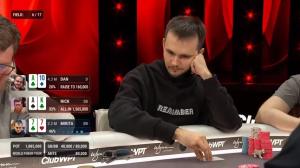
A9 defeats KJ on the final hand as Badziakouski wins $7.11 million.
On December 20, 2023, Badziakouski and Mario Mosboeck reached the final heads-up showdown for the title.
In the hand that decided the championship, Badziakouski held A♦9♠ against Mosboeck's K♣J♦.
The two got All-in preflop.
Final hand of the WPT Big One for One Drop championship
| Street | Board |
|---|---|
| Mikita Badziakouski | A♦ 9♠ |
| Mario Mosboeck | K♣ J♦ |
| Flop | T♦ T♣ 8♣ |
| Turn | 8♥ |
| River | 4♥ |
The final board produced two pair, tens and eights.
Badziakouski's ace kicker beat Mosboeck's king kicker, officially securing the title.
He received $7,114,500 in prize money for first place, while Mosboeck earned $4,663,950 as runner-up.
However, once the champion had been decided, Badziakouski's first thought was not how much he had won, but how to settle the finances with his investors.
No wild celebration after the win; Mikita first thought of more than a dozen investors.
Badziakouski revealed in the interview that more than 10 investors were involved behind his entry in this $1 million buy-in event.
After the tournament, everyone might soon have to leave Las Vegas.
Therefore, he had to calculate the percentage of action held by each party, confirm the amounts to be distributed, and complete the subsequent payments within a short period of time.
This was also one of the main reasons he could not immediately immerse himself fully in the joy of winning.
Another reason was that he viewed $7.11 million differently from the average player.
For professionals who regularly play high-stakes tournaments, while this prize is enormous, in terms of buy-in size it is only roughly the total of seven $1 million buy-in events.
If he were to suffer major tournament losses in succession in the future, the large prize could still be depleted quickly.
Therefore, he believes professional earnings should not be measured solely by a single tournament's first-place prize.
What truly matters is long-term return on investment, one's personal percentage of action, and the Markup the market is willing to pay for a player's technical edge.
Winning $7.11 million: what truly matters is increasing one's professional safety cushion.
Badziakouski said that the real sense of satisfaction usually comes some time after winning.
Only once the investors have been settled and all related payments have been handled can he more clearly determine how much his financial reserves have actually increased.
For him, the greatest value of these funds is that even if he loses several tournaments in a row in the future, he will not have to endure excessive financial and psychological pressure.
This mindset also reflects the importance he places on bankroll management.
He admitted that when he played million-dollar-level events in 2018 and 2019, he was actually willing to use a higher percentage of his own money than he was later on.
As he has grown older and gained greater financial security, he has gradually placed more emphasis on risk control.
When he was younger, he might have been more willing to take risks just after winning a large sum; but once financial stability becomes part of long-term life, the cost of losing that sense of security becomes harder to accept.
A new generation of Solver players is rising as high-stakes competition continues to evolve.
In addition to bankroll matters, Badziakouski also discussed generational changes among top professionals.
He noted that many of the top professional entrants in the 2023 Big One for One Drop had already played a similar event in 2018.
Most of these players had established their careers before Solver tools became widely available.
However, he does not believe these veteran players have neglected modern poker theory.
On the contrary, they continue to study and strive to keep up with developments in Solver strategy.
When discussing the younger new generation of high-stakes regulars, Badziakouski specifically mentioned:
Aleksejs Ponakovs
Artur Martirosian
Alex Kulev
He believes these players already possess the technical ability to compete with the previous generation of top professionals, and have received sufficient market recognition to sell action in high-stakes events.
This also reflects another feature of the high-stakes poker investment market: a player's technical performance and reputation affect not only competition at the tables, but also investors' valuation of the price of their action.
Behind the $7.11 million prize, what truly matters is bankroll management and risk control.
Mikita Badziakouski's story reveals an important difference between high-stakes poker and ordinary tournaments.
The $1 million buy-in, 17-player field, and $7,114,500 first-place prize at the 2023 WPT Big One for One Drop are all highly eye-catching figures.
But behind these figures lies a financial framework involving investors, action sales, Markup premiums, Backing support, and Swap agreements.
Badziakouski estimates that top high-roller players may pay more than $8 million in buy-ins over the course of a year, so even with a clear technical edge, they need sensible bankroll arrangements to spread risk.
He also cautioned that Swap agreements can create conflicts of interest, while excessively large buy-ins can affect normal strategic decision-making at the final table.
For ordinary poker players, the most important lesson from this interview is not how to enter a $1 million buy-in tournament, but how to distinguish between tournament prize money, actual personal earnings, and long-term risk.
The $7.11 million first-place prize is certainly eye-catching, but for Badziakouski, true professional success means maintaining both competitive ability and financial security while continually facing high-stakes variance.
Want to change Texas Holdem from "can understand" to "can win"?
If you want to learn more about Texas Hold'em, you can continue reading:
The Origins of Texas Hold'em: Why is it the World's Most Popular Poker Variant?
Texas Hold'em Hand Rankings and Showdown Rules (Beginner’s Essentials)
Texas Hold'em Betting teaching: Check / Bet / Call /Raise and Betting Strategy Analysis
The importance of Texas Hold'em position? Why is the back position more advantageous?
How to play Texas Hold'em? Novices learn Texas Hold'em rules, processes and betting teaching in 10 minutes
Texas Hold’em Starting Hands Guide: Which Hands Should You Play? A Complete Starting Hands Strategy Guide
Texas Holdem Starting Hands Chart Guide: Complete Starting Hand Charts and Positional Strategy
How to Play Texas Hold’em: Complete Rules and the Flow of a Hand (Preflop / Flop / Turn / River)
Hunter Poker offers comprehensive tutorials, hand analysis, and strategy sharing to help players upgrade from simply "reading the cards" to understanding the range . This allows you to make better decisions in every hand.
▶️ In Facebook .
📘 In YouTube .
Want to learn more about Texas Hold'em strategy and gameplay?
Online Texas Hold'em freerolls typically require no buy-in, making them ideal for beginners to learn the rules and allowing more advanced players to test strategies and build tournament experience. View the full brand introductions to learn about each platform's freeroll schedule, tournament features, and target players.
Further News Reading
International news
Triton North Cyprus|Malaysia’s Ang Yang Yi wins the QQPK Challenge, turning a $140 buy-in into $11,000 worth of tournament entries
International news
Triton North Cyprus | QQPK Genesis draws 387 entries across its first two starting flights, 62 advance, 12 Chinese players qualify, and Erik Eisen is the current chip leader
International news
Triton Cyprus Opens | 32 Events Set for the 10th-Anniversary Season Finale, with QQPK Genesis Kicking Off and Phil Ivey Playing the $200,000 Invitational
International news