




Texas Hold'em Poker Tutorial Articles
A complete analysis of Poker Bluff EV: Texas Hold'em bluff success rate, Fold Equity, and long-term EV logic.
Poker Bluff EV This is a crucial core element that truly elevates Texas Hold'em to a higher level of offensive mathematics.
Many beginners think that bluffing is just "acting".
But true experts know that Bluff is essentially an EV and Fold Equity game.
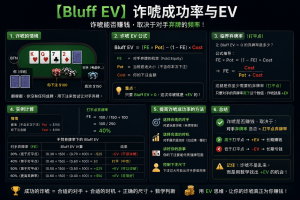
1. How exactly does bluffing generate profit?
2. How high does the success rate of Bluff need to be?
3. Why do expert players dare to use empty cards to attack?
The answer lies in Bluff EV and Fold Equity.
The core conclusion of Poker Bluff EV: Bluff is essentially a mathematical game.
Many beginners think:
→ Bluff is just a lie
But true experts know:
→ Bluff is used in EV calculations
Truly sophisticated bluffing is essentially about Fold Equity pressure.
What is Bluff EV?
Bluff EV Representative:
→ How much can you win on average from a single bluff in the long run?
It mainly comes from:
→ Opponent fold rate
If the opponent has enough Folds, Bluff could potentially be a positive EV.
What is Fold Equity?
Fold Equity represents:
→ The probability that the opponent will fold under pressure
This means:
→ You can profit without having to reveal your true colors
Fold Equity is the core of all Bluff.
How is the success rate of Bluff calculated?
Assumption:
Bottom of the pot: 100
You bet: 50
at this time:
→ Your risk is 50
→ Want to win 100
Minimum success rate: 33%
Bluff typically starts to profit as long as the opponent's Fold exceeds 33%.
Bluff EV Core Logic
if:
→ High opponent's Fold rate
Even if you have absolutely no cards:
→ Bluff may still be +EV
True professional gamers use mathematics to exert pressure.
Why is betting size important?
The larger the bet:
→ The higher the pressure on the opponent
But at the same time:
→ The higher your risk.
True masters know how to balance risk and fold rate.
Classic Semi-Bluff Scenario
You hold: A♠ J♠
Cards: 7♠ 2♠ K♦
You have Flush Draw.
If Raise:
→ The opponent may Fold
Even if called:
→ You still have a high Equity.
This is the high EV Semi-Bluff.
Why do expert players often dare to use Bluff?
Because experts know:
→ Many people fold too much
therefore:
→ Bluff will make money in the long run
A truly high-level Bluff isn't about randomly attacking, but about applying precise pressure.
In what situations is Bluff EV very bad?
if:
→ The opponent loves to call
→ Board is unreasonable
→ I don't have an advantage in my own range
Many Bluffs may become:
→ Pure money giveaway
Random bluffing is essentially a negative EV behavior.
The most common mistakes of novices
→ Bluff based entirely on intuition
→ I don't understand Fold Equity
→ Bluff has no story
→ Stealing from Calling Station
Many players lose not because of luck, but because of Bluff math.
Advanced understanding: Bluff EV × Fold Equity × Range
True professional gamers will analyze:
→ Fold Frequency
→ Pot Odds
→ Range Advantage
→ Board Texture
→ Bet Size
→ Long-term EV
A truly high-level Bluff is essentially a complete EV stress system.
Key conclusions
Truly high-level Bluffing isn't about luck, but about leveraging Fold Equity to create long-term EV.
You only truly begin to understand Bluff EV when you start to grasp professional-level offensive thinking.
Further Learning: Card Strength, Win Rate, and Range Thinking
[Complete Table of Contents] Texas Hold'em Win Rate and EV Calculation Tutorial
▶️ In Facebook Follow Hunter Poker.
📘 In Youtube Follow Hunter Poker.
Extended Reading for Teaching
Equity & Logic Analysis
[EV Conversion] EV Changes under ICM
Equity & Logic Analysis
[ICM Retrospective] How to Examine Decisions
Equity & Logic Analysis
[Middle Code Strategy] The Most Difficult Position
Equity & Logic Analysis