




Texas Hold'em Poker Tutorial Articles
A complete analysis of Poker EV vs Equity and the differences in long-term profitability in Texas Hold'em.
Poker EV vs Equity It is one of the most easily misunderstood core concepts in Texas Hold'em.
Many beginners think: "A high win rate means you're guaranteed to make money."
But true experts know that a high win rate does not necessarily mean a high EV.
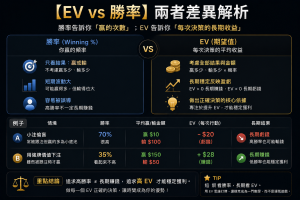
1. Why do I still lose even with a high win rate?
2. What are the differences between EV and Equity?
3. Why do expert drivers place more emphasis on EV?
The answer lies in the fundamental difference between EV and win rate.
The core conclusion of Poker EV vs Equity: Win rate does not equal EV.
Many beginners might think:
→ High win rate = guaranteed profit
But true experts know:
→ EVs also include risks and benefits
What truly matters is not just the odds of winning, but the long-term average profitability.
What is win rate (Equity)?
Equity represents:
→ Your chances of winning
For example:
→ AK vs QQ
→ AK has a win rate of approximately 43%.
Win rate is essentially just the "probability of winning".
What is EV?
EV (Expected Value) represents:
→ Long-term average win or loss amount
It doesn't just look:
→ Win rate
Also watch:
→ How much can I win?
→ How much will I lose?
EV is essentially a calculation of long-term returns.
Why does a high win rate not necessarily mean a high EV?
Because EVs will also be affected by:
→ Pot Odds
→ Bet Size
→ Risk/Reward
Influence
Truly advanced poker is a complete mathematical system.
Classic Case: High Win Rate but Low EV
Assumption:You have a 60% win rate
But an investment of 500 is required.
Only one can win: 100
Even with a high win rate:
→ EV may still be negative
A high win rate does not necessarily mean a good trade.
Classic Case: Low Win Rate but Positive EV
Some Bluffs:
→ Success rate less than 50% TP3T
But because:
→ The pot is very large
→ High Fold Equity
It could still be:
→ Positive EV
What truly matters in EV analysis is the long-term mathematical results.
Pot Odds is actually connecting EV (Effective Value) and Win Rate.
Pot Odds will tell you:
→ Minimum Equity Required
if:
→ The actual win rate is higher than the demand
generally:
→ EV begins to turn positive
Pot Odds is a bridge between EV and Equity.
Why do expert drivers place more emphasis on EV (Electronic Vehicle Emission)?
Because experts know:
→ Win rate alone is meaningless
What really matters is:
→ Long-term profitability
True professional gamers play for long-term EV (Effective Value).
Classic All-in Scenario
AK vs QQ:
→ AK approximately 43% win rate
If you have a lot of dead money:
→ Shove may still be a positive EV
True experts will look at both Equity and EV simultaneously.
The most common mistakes of novices
→ Only look at win rate
→ Completely ignore Pot Odds
→ Not understanding risk and return
→ Judging decisions based on short-term results
Many players don't lose because of their hand strength, but because of their lack of understanding of EV (Effective Value).
Advanced understanding: EV × Equity × Pot Odds
True professional gamers will analyze:
→ Real Equity
→ Pot Odds
→ Bet Size
→ Fold Equity
→ Risk/Reward
→ Long-term EV
True high-level poker is essentially a complete EV system.
Key conclusions
Win rate is just your probability of winning, while EV (Earnings Per Second) is what truly determines whether you will be profitable in the long run.
You only truly begin to think like a pro when you start to understand EV vs. Equity.
Extended Reading for Teaching
Equity & Logic Analysis
[EV Conversion] EV Changes under ICM
Equity & Logic Analysis
[ICM Retrospective] How to Examine Decisions
Equity & Logic Analysis
[Middle Code Strategy] The Most Difficult Position
Equity & Logic Analysis