




Texas Hold'em Poker Tutorial Articles
Poker OESD Odds provides a complete analysis of the win rate, outs calculation, and EV application of two-headed straight draws (OESD) in Texas Hold'em, helping you understand the mathematics of straight draws.
Poker OESD Odds It is one of the most important mathematical methods for drawing straights in Texas Hold'em.
Many players know that a double-headed straight is very strong, but they don't know its actual win rate.
True experts will directly use Outs and EV to determine whether it's worth continuing.
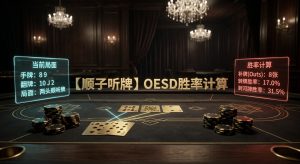
1. What is OESD's actual win rate?
2. Is a double-headed straight worth calling?
3. Why do expert players like to use OESD?
The answer lies in OESD's Outs and EV.
The core conclusion of Poker OESD Odds: OESD typically has 8 Outs.
OESD (Two-Headed Straight Hand) represents:
→ Both ends of a straight can complete a straight.
For example:
You hold: 8♠ 9♦
Cards: 6♣ 7♥ K♠
If it occurs:
→ 5
→ T
You've completed the straight.
Therefore, OESD typically has 8 Outs.
What is the win rate of OESD?
Flop to River:
→ Win rate approximately 31%~32%
Turn to River:
→ Approximately 17% win rate
This means OESD is a very strong draw.
How to quickly calculate OESD win rate mentally?
Use the 2x and 4x rule:
Flop to River:
→ 8 Outs × 4 ≈ 32%
Turn to River:
→ 8 Outs × 2 ≈ 16%
This is one of the most common fast algorithms in Texas Hold'em.
Why is OESD so strong?
because:
→ Outs are plentiful
→ Straights are usually strong hands.
→ It is easy to create Semi-Bluff stress
OESD is not just for chasing cards, but also for attacking.
Classic practical scenarios
You hold: J♠ T♠
Cards: 8♦ 9♣ 2♥
As long as Turn or River occurs:
→ 7
→ Q
You've completed the straight.
This is a typical OESD.
Do we really need to pursue OESD?
uncertain.
What really matters is:
→ Pot Odds
→ Opponent's betting size
→ Implied Odds
→ Do Reverse Implied Odds exist?
Experts don't just call when they see a winning hand; they calculate the EV (Effective Value).
OESD vs Flush Draw
Flush Draw:
→ Usually 9 Outs
OESD:
→ Usually 8 Outs
therefore:
→ Flush Draw usually has a slightly higher win rate
However, OESD is still considered a high-win-rate draw.
The most common mistakes of novices
→ Treat Gutshot as OESD
→ Overestimating straight draw
→ Don't look at Pot Odds
→ Ignore the opponent's higher chance of winning
The real danger is the "second straight".
How do experts use OESD?
Experts will combine their skills:
→ Fold Equity
→ Real Outs
→ Opponent Range
→ EV
What makes OESD truly strong is that it combines win rate and pressure.
Advanced understanding: OESD × Semi-Bluff × EV
Many professional gamers use OESD:
→ Active Raise
→ Continue to apply pressure
Because even if you are called:
→ Still retains a large amount of Equity
This is the core logic of high-level Semi-Bluff.
Key conclusions
OESD is not simply about chasing cards; it's a high-EV offensive tool.
When you truly understand OESD, you begin to delve into real mathematical poker.
Extended Reading for Teaching
Equity & Logic Analysis
[EV Conversion] EV Changes under ICM
Equity & Logic Analysis
[ICM Retrospective] How to Examine Decisions
Equity & Logic Analysis
[Middle Code Strategy] The Most Difficult Position
Equity & Logic Analysis