




Texas Hold'em Poker Tutorial Articles
Poker Pot Odds provides a complete analysis of Texas Hold'em pot odds, EV, Outs, and Call decisions, allowing you to learn the mathematical thinking of professional players.
Poker Pot Odds It is one of the most important mathematical concepts in Texas Hold'em.
Many players ask, "I have Flush Draw, should I call it?"
The real answer isn't in your feelings, but in Pot Odds.
1. Can I call if I have a winning hand?
2. Why do experts always know whether something is worth pursuing?
3. How exactly are Pot Odds calculated?
The answer lies in Pot Odds and EV.
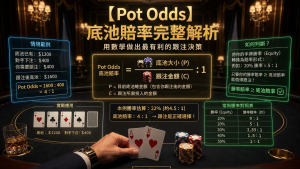
The core conclusion of Poker Pot Odds: Pot Odds = the ratio of investment to reward.
Pot Odds represents:
→ How many chips do you need to invest?
→ Only then can we win the current pot
This determines whether your calls will be profitable in the long run.
Poker Pot Odds Basic Formula
formula:
Pot Odds=Call / (Pot+Opponent Bet+Call)
You need to compare:
→ Your own win rate
→ Is it higher than Pot Odds demand?
This is the core of EV decision-making.
Classic Pot Odds Example
Current pot size: 100
Opponent's bet: 50
You need to call 50.
Total pot after call:
→ 200
Therefore, your Pot Odds requirement is approximately:
→ 25%
If your win rate exceeds 25%, the call will usually be a positive EV.
How to apply Pot Odds in Flush Draw?
Flush Draw typically includes:
→ Approximately 35% win rate (Flop to River)
If Pot Odds only requires 25%:
→ Call is usually positive EV
This is why professional gamers pursue Flush Draw.
Why is Gutshot often unrecoverable?
Gutshot typically only has:
→ Approximately 16% win rate
If Pot Odds demand exceeds 20%:
→ Call is usually a negative EV
Many beginners seriously overestimate Gutshot.
Pot Odds isn't just about the present.
True masters will also consider:
→ Implied Odds
→ Reverse Implied Odds
→ Future betting potential
The true EV is overall profitability.
Classic practical scenarios
You hold: A♠ J♠
Cards: 7♠ 2♠ K♦
You have:
→ Flush Draw (approximately 35%)
If the opponent bets too small:
→ Pot Odds are good
If the opponent overbets:
→ Pot Odds may not be enough
What really matters is the mathematical proportions.
Why do expert players sometimes raise draws?
Because experts don't just utilize:
→ Real Equity
Also utilize:
→ Fold Equity
Even if called:
→ Still retains a large number of Outs
This is the core of Semi-Bluff.
The most common mistakes of novices
→ Not including Pot Odds
→ If there's a Draw option, just keep trying.
→ Overestimate Outs
→ Ignore Dirty Outs
→ Use results to judge decisions
Many players don't lose because of luck, but because of math.
Advanced understanding: Pot Odds × EV × Range
True professional gamers will analyze simultaneously:
→ Pot Odds
→ Real Equity
→ Range Combat
→ Implied Odds
→ Long-term EV
What's truly important about Pot Odds is turning probability into profit.
Key conclusions
A real call isn't because you "want to win," but because the EV (Employment, Performance, and Qualification) is correct.
You've truly entered the world of professional-level mathematical poker when you start to understand Pot Odds.
Extended Reading for Teaching
Equity & Logic Analysis
[EV Conversion] EV Changes under ICM
Equity & Logic Analysis
[ICM Retrospective] How to Examine Decisions
Equity & Logic Analysis
[Middle Code Strategy] The Most Difficult Position
Equity & Logic Analysis