




Texas Hold'em Poker Tutorial Articles
A complete analysis of Poker Raise EV, Fold Equity, and professional offensive decision-making in Texas Hold'em.
Poker Raise EV This is the core of Texas Hold'em's true offensive mathematics.
Many beginners only know how to call.
But true masters will use the Raise to create additional EV.
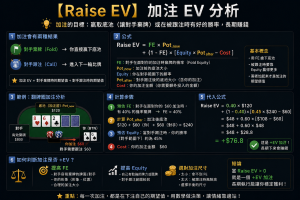
1. Why do expert players like to raise the stakes?
2. What exactly is Raise EV?
3. How can Bluff Raise achieve long-term profitability?
The answer lies in Raise EV and Fold Equity.
The core conclusion of Poker Raise EV: Raises are not just about making the pot bigger.
Many beginners think:
→ Raise just wants to win more
But true experts know:
→ Raise is creating additional EV
A truly advanced Raise is essentially a pressure tool.
What is Raise EV?
Raise EV Representative:
→ How much can you earn on average in the long run after adding to your bet?
It comes from:
→ Opponent Fold
→ Opponent's wrong call
→ Build a higher EV pool
True raising is a mathematical act.
Fold Equity is the core of Raise.
When you raise:
→ The opponent may directly Fold
This means:
→ You can profit without having to reveal your true colors
Fold Equity is an important source of offensive EV.
Why is a Raise stronger than a Call?
Call can only rely on:
→ Your own hand strength
But Raise can still rely on:
→ Opponent Fold Rate
True masters profit by leveraging both card strength and pressure.
Classic Semi-Bluff Raise
You hold: A♠ J♠
Cards: 7♠ 2♠ K♦
You have Nut Flush Draw.
If Raise:
→ The opponent may directly Fold
Even if called:
→ You still have a high Equity.
This is the high EV Semi-Bluff.
Where does the Raise EV come from?
Raise EV typically includes:
→ Fold Equity
→ Pot Equity
→ Future Pressure
→ Range Advantage
A truly high-level Raise is not just about having "good cards".
Why does betting size affect Raise EV?
The higher the Raise:
→ Fold pressure is usually higher
But at the same time:
→ Risks will also increase
True masters can balance risk and Fold Equity.
Under what circumstances is the Raise EV very high?
Typically includes:
→ Opponents are easy to Fold
→ I have a range advantage
→ Board is suitable for applying pressure
→ Possesses strong drawing capabilities
True high EV Raise comes from complete control of the game.
In what situations is the Raise EV performing poorly?
if:
→ The opponent loves to call
→ I don't have Equity
→ Board is not suitable for applying pressure
Many raises may become:
→ Pure money burning
A chaotic Raise is essentially a negative EV attack.
Why are skilled players more aggressive in their attacks?
Because experts know:
→ Active power can create EV
Often:
→ The most profitable thing is not calling
→ Instead, it's Raise
True professional gamers use pressure to make their opponents make mistakes.
The most common mistakes of novices
→ Only call
→ I don't understand Fold Equity at all
→ Bluff Raise has no Equity
→ Attacking recklessly without considering the range
Many players lose not because of their hand strength, but because of their lack of understanding of offensive tactics.
Advanced understanding: Raise EV × Fold Equity × Range
True professional gamers will analyze:
→ Fold Frequency
→ Pot Equity
→ Range Advantage
→ Board Texture
→ Stack Depth
→ Long-term EV
A truly advanced Raise is essentially a complete EV stress system.
Key conclusions
Truly advanced raising isn't just about increasing the pot size, but about creating additional EV (Effective Value).
You only truly begin to understand Raise EV when you start to grasp professional-level offensive thinking.
Extended Reading for Teaching
Equity & Logic Analysis
[EV Conversion] EV Changes under ICM
Equity & Logic Analysis
[ICM Retrospective] How to Examine Decisions
Equity & Logic Analysis
[Middle Code Strategy] The Most Difficult Position
Equity & Logic Analysis