




Texas Hold'em Poker Tutorial Articles
Poker Reverse Implied Odds: A Complete Analysis of Texas Hold'em Reverse Implied Odds, Dangerous Draws, and Deep-Card EV Traps.
Poker Reverse Implied Odds It is one of the most dangerous EV traps in Texas Hold'em.
For many players, the most painful way to lose is not by not getting a winning hand, but by "losing even more after getting a winning hand".
A true master is not afraid of not having a hit, but of hitting a minor hand.
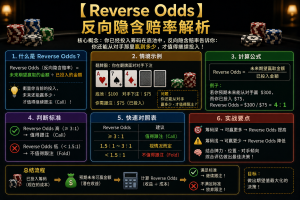
1. Why do I lose even more after winning a hand?
2. Why are expert players so afraid of secondary flushes?
3. What exactly are Reverse Implied Odds?
The answer lies in "a winning hand may be covered by a higher hand".
The core conclusion of Poker Reverse Implied Odds: Not all hits are truly a good thing.
Many beginners might think:
→ As long as I get a license plate, that's fine.
But true experts know:
→ Some cards become more dangerous after being dealt a winning hand.
These are Reverse Implied Odds.
What are Reverse Implied Odds?
Reverse Implied Odds represent:
→ After you hit the card
→ Could lose an even bigger pot
It is essentially about "how much more we might lose in the future".
Why are deep-code games particularly dangerous?
Because of deep codes:
→ The pot can become very large
If you have completed:
→ Secondary Flush
→ Secondary Straight
→ Weak Top Pair
It's easy for them to be drained dry by stronger players.
Deep code will amplify Reverse Implied Odds.
Classic secondary flush trap
You hold: 7♠ 6♠
Cards: A♠ T♠ 2♦ K♠
You have finished flushing.
Many beginners will be very excited.
But if the opponent holds:
→ A♠ Q♠
You are actually losing a huge pot.
These are classic Reverse Implied Odds.
Top pairs can also be dangerous.
For example:
You hold: KJ
Face Card: K72
It looks very strong.
But if the opponent's Range includes:
→ AK
→ KQ
→ AA
You may be dominate for a long time.
Many top pairs are actually hidden traps.
Why are multi-player pools more dangerous?
Because in a multiway:
→ More strong hand combinations
→ Higher Nut coverage
→ The value of secondary hand types decreases
The more people there are, the higher the Reverse Implied Odds usually are.
Why do expert players place more emphasis on Nut cards?
Because of the deep code:
→ EVs mainly come from Oike
If your card is not Nut:
→ It's easy to lose a huge pot.
True masters pursue Nut Advantage.
Classic practical scenarios
You hold: 9♠ 8♠
Cards: Q♠ T♠ 2♦
You have Flush Draw.
Many players will find it very comfortable.
But what if the opponent might hold:
→ A♠
→ K♠
Some Outs can actually make you lose more.
This is the risk of high-end EVs.
The most common mistakes of novices
→ Excessive obsession with Chinese cards
→ Overestimating the secondary flush
→ Deep code random typing Top Pair
→ Ignore opponent's range
Many players don't lose because they didn't get the right cards, but because they got the wrong cards.
Advanced understanding: Reverse Implied Odds × Range × EV
True professional gamers will analyze:
→ Nut Coverage
→ Range suppression
→ Deep Stack Pressure
→ Dirty Outs
→ Long-term EV
True high-level poker isn't just about how much you can win, but about avoiding losing too much.
Key conclusions
Sometimes the most dangerous thing isn't not getting a hit, but getting a hit on a lower-ranking hand.
You only truly begin to enter the realm of professional-level risk control when you start to understand Reverse Implied Odds.
Extended Reading for Teaching
Equity & Logic Analysis
[EV Conversion] EV Changes under ICM
Equity & Logic Analysis
[ICM Retrospective] How to Examine Decisions
Equity & Logic Analysis
[Middle Code Strategy] The Most Difficult Position
Equity & Logic Analysis