




Texas Hold'em Poker Tutorial Articles
Poker Tournament Turning Point Hand Review: In-depth analysis of turning points in Texas Hold'em tournaments. This article breaks down key hands into how they can alter the course of the entire game, analyzing ICM pressure, chip flow, and decision EV.
Poker Tournament Turning Point Hand Review It is one of the most influential types of replays in Texas Hold'em tournaments.
Many players, after finishing a match, will say, "Actually, I lost because of that one move," but the real point of that statement is not luck, but decision-making.
A true game-changer can directly alter the distribution of chips, the pressure structure, and the overall rhythm, thereby influencing the strategies of everyone who follows.
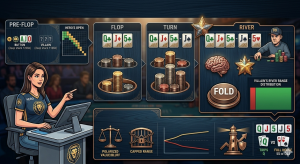
1. Why do some seemingly ordinary hands become crucial to the entire game?
2. Can a single hand really determine the entire game?
Key takeaway: Poker Tournament Turning Point = A single hand changes the overall situation, not just a single win or loss.
The essence of turning point:
1. Change the distribution of chips
2. Change ICM pressure
3. Change the pace of attack and defense on the table.
4. Change the player's psychological state
The real key is not just winning or losing, but changing the entire game situation afterward.
What is a game turnaround player?
Turning Point Hand
1. Refers to a hand that, at a certain point in time, significantly influences the overall course of the game.
2. Typically involves large pots, all-in matches, or crucial eliminations.
3. It affects not only the chips, but also the strategic choices of all players at the table.
The value of a turning point lies not in its magnitude, but in what it changes.
How does a turnaround hand affect the game?
1. Redistribution of chips
→ What was originally a balanced situation may turn into a one-sided one.
2. Pressure transfer
→ Short-term pressure increases, large-scale trading begins to dominate the pace.
3. Strategy Change
→ Players will change their playing style due to chip stack and ICM pressure.
4. Psychological impact
→ A single hand can make a player either conservative or out of control.
All these influences combined constitute the real "turning point of the game".
Classic practical scenarios
1. There are 12 players remaining in the match.
2. You have a medium to high stake.
3. The opponent is another medium-to-large chip.
4. Flop forming a strong draw + middle pair
5. Under intense pressure from your opponent, you face an all-in decision.
Question: This hand isn't just about winning or losing; it's about whether you're willing to take high risks at this stage.
Misconception: Focusing solely on the outcome of this hand.
Many players will:
→ I felt this hand was crucial; losing it would be bad luck.
→ Define the entire game by the result.
→ Ignore whether this hand itself is worth entering a high-risk confrontation
Result: You won't learn from the turning point; you'll just keep making the same mistakes.
Correct thinking: The key lies in whether the decision-making in this hand is reasonable.
In this context:
→ Do you have the resources to take this risk?
→ Does the opponent's range contain enough Bluff?
→ After losing this hand, will you be at a disadvantage?
→ If we win this hand, can we establish dominance?
Conclusion: The value of a turning point is not the outcome, but whether you make a decision under the right conditions.
Three core principles of turning point
1. Assess the risks and rewards.
→ Not every big pot is worth betting on.
2. Understand the current stage of the game
→ Risk tolerance varies at different stages
3. Look at the whole picture, not just one hand.
→ How does this hand affect the next 10 or 20 hands?
Most common mistakes
→ Overly radical, leading to unnecessary confrontation
→ Overly conservative approach leads to missed opportunities for suppression
→ Explaining decisions with results
→ Ignore the influence of ICM and chip distribution
The game wasn't lost because of that one move, but because of the wrong decisions made behind that move.
Advanced strategies: Momentum × ICM × Stack Flow × Decision Quality
Experts' Gathering:
→ Control risks and avoid engaging in confrontation unnecessarily.
→ Amplify pressure at the right time
→ Use your chip advantage to change the pace of the game
→ Put each hand into the overall strategy framework
The real turning point wasn't luck, but rather the amplified impact of decisions made at crucial moments.
Core Decision Conclusions
The turning point in a Texas Hold'em game is not accidental, but rather the result of risk, ICM, and decision-making converging at a certain moment.
When you start looking at the game from this perspective, you will no longer just remember "that move we lost", but will start to analyze: whether this move should really have been made.
Classic Case Study: Learning Decision-Making Essence from a Key Hand
Some hands are considered classic not because of the outcome, but because of the decision-making logic and way of thinking they embody.
These examples will give you a more intuitive understanding of the key choices made in high-level games:
[Classic Reversal] All-in Reversal Hand Analysis
How does one successfully achieve a high-risk bluff in the "Epic Bluff"?
【Hero Call】The most classic card reading and calling decision
[Final Table Key] Final Table: A First-Hand Review
[Turning Point of the Game] A single hand that changed the outcome of the match.
[The Key to Collapse] Why does a single hand turn you from a leader into an out?
[Key to the Championship] How does the final move determine the outcome?
[Long-Term EV] Why do expert players not care about winning or losing?
The value of classic hands lies not in the outcome, but in the decision-making process. By reviewing these key cases, you can quickly absorb the thinking methods of high-level players and apply them to your own gameplay.
Extended Reading for Teaching
Hand resumption
[Review Methods] How do professional players review their hands?
Hand resumption
[Long-term planning] How to build a long-term profit strategy?
Hand resumption
[Strategy Selection] GTO vs Exploit: Which to choose in actual gameplay?
Hand resumption