




Texas Hold'em Poker Tutorial Articles
Texas Hold'em Rules are essential foundational knowledge for every beginner. This article provides a complete analysis of Texas Hold'em rules, a game's flow, betting methods, win/loss determination, and common beginner questions, helping you quickly understand the game and build a solid foundation.
Texas Holdem Rules This is the first basic skill that every Texas Hold'em beginner must understand.
Many people think Texas Hold'em is complicated, but the real rules are not difficult. The difficulty lies in whether you understand every process, betting method, and how to determine the winner.
The essence of Texas Hold'em rules is not just about knowing who has the stronger hand, but about understanding the complete workings of a hand from the dealing of cards, betting, to the showdown.
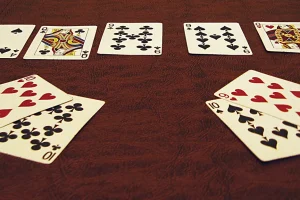
1. How exactly do you play Texas Hold'em?
2. Why do we compare five-card hands when each person only receives two cards?
Key conclusion: Texas Holdem Rules = Two cards in hand + Five community cards + Four rounds of betting
The basic structure of Texas Hold'em:
1. Each player receives 2 cards.
2. A maximum of 5 community cards can be dealt on the table.
3. There are a total of 4 main betting decisions.
Ultimately, you don't compare all 7 cards together; instead, you compare the best 5-card hand you have, which consists of your 2 cards and the 5 community cards on the table.
What is the basic goal of Texas Hold'em?
In Texas Hold'em, you have two ways to win the pot:
1. Make all opponents fold.
2. During the showdown, build a stronger 5-card hand.
Texas Hold'em is not just about having the best hand; it also includes betting, applying pressure, and getting your opponent to fold the pot early.
What is the process of a game of Texas Hold'em?
1. Dealing Hole Cards
→ Each player first receives two cards that only they can see.
2. Preflop
→ Players decide whether to fold, call, raise, or re-raise based on their two hands.
3. Flop (the turn of the cards)
→ Three community cards are flipped over at once on the table, and everyone can share them.
4. Turn
→ Turn over the 4th community card
5. River
→ Finally, reveal the 5th community card.
6. Showdown
→ If two or more players have not folded, the best 5-card hands are compared to determine who wins the pot.
In Texas Hold'em, a hand is not dealt all at once, but rather through multiple rounds of dealing and betting, gradually narrowing down the possibilities and determining the winner.
What are the basic moves in Texas Hold'em?
Check (pass the card)
→ If no one is betting at the moment, you can choose not to bet and pass the turn to the next player.
Bet (bet)
→ Actively invest chips to exert decision-making pressure on other players.
Call (call)
→ Match the previous player's bet amount
Raise (raise)
→ Increase the amount based on the previous player's bet.
Fold (fold)
→ Fold this hand and stop fighting for the pot.
For beginners, the most important thing is not just to memorize these terms, but to understand whether they represent "continue," "apply pressure," or "exit."
Why are there minor and major blind people?
Small Blind and Big Blind
1. These are the mandatory chips that must be invested before the start of each hand.
2. The goal is to ensure the pot has contestable value from the outset.
3. This also ensures that someone has to invest money in each hand, instead of everyone waiting for good hands for free.
The blind system makes Texas Hold'em more than just waiting for cards; it requires players to face cost and decision-making pressures every round.
How do you compare cards in Texas Hold'em?
Core principles:
→ Each player must ultimately choose their best 5-card hand from their 2 cards in hand plus 5 community cards.
→ It's not necessary to use 2 cards from your hand, nor is it necessary to use all the community cards.
→ Use the strongest 5-card combination for comparison.
One of the most common misconceptions among beginners is that all 7 cards count, or that they must use two cards from their hand.
Classic practical scenarios
1. You have A♠ K♠
2. The community cards on the table are A♦ 10♣ 7♠ 3♥ 2♣
Question: What is your final hand? Which 5 cards will you use to compare?
Misconception: I have 7 cards, so should all 7 be counted together?
Many beginners will:
→ It is believed that the two cards in hand plus the five community cards should all be counted together.
→ Or perhaps you think you absolutely have to use both cards in your hand in the final combination.
→ This often leads to misjudging one's actual hand when comparing cards.
Result: You may misjudge the strength of your hand, and you may not be able to tell who is the real winner when the cards are revealed.
Correct thinking: Always only look at the top 5 cards.
In this context:
→ The A♠ in your hand, paired with the A♦ on the table, forms a pair of A's.
→ Add K♠, 10♣, and 7♠ as the other three high cards in the best five-card combination.
→ So your best 5 cards are: A♠ A♦ K♠ 10♣ 7♠
Conclusion: Texas Hold'em always compares only the best 5 cards, not all 7 cards.
Three Core Principles for Beginners to Learn the Rules
1. Look at the process first, then the strategy.
→ If you don't first understand the rhythm of Preflop, Flop, Turn, and River, it's easy to learn the wrong strategies later.
2. Look at the best 5 cards first; don't count all 7 cards together.
→ When comparing cards, always only look at the strongest 5-card combination.
3. Learn the basic movements first, then learn the advanced concepts.
→ The logic behind Check, Bet, Call, Raise, and Fold must be clear before discussing their position, range, and EV.
Most common mistakes in Texas Hold'em rules
→ I thought all 7 cards had to be compared together.
→ I thought I had to use two cards.
→ Confused about the difference between Check and Call
→ I don't understand the role of blind betting and the sequence of events in a game.
→ Before even understanding the rules, they're rushing to learn advanced Bluff and advanced strategies.
If you don't master the rules, all subsequent strategies are likely to be built on a flawed foundation.
Advanced understanding: Once you understand the rules, what truly drives your progress?
Experts' Gathering:
→ First, practice the rules and the flow of a game until you don't even need to think about it.
→ Then add position, starting hand, card structure, and range thinking.
→ Evolve "understanding the rules" into "understanding decision-making"
The basics of Texas Hold'em begin with the rules; true progress begins with making better choices beyond the rules.
Core Decision Conclusions
The rules of Texas Hold'em are not complicated; what really matters is whether you truly understand every step of the process, the betting action, and the logic of comparing hands.
Once you truly understand the Texas Hold'em Rules, you'll no longer see Texas Hold'em as just a game of luck, but will begin to realize that it's a complex competitive system with interconnected rules, procedures, and decision-making. And the starting point for all of this is to fully understand the most basic gameplay.
Specific Scenario Retrospective: Key Decisions in Different Situations
Certain scenarios can drastically alter decision-making logic, such as tournament pressure, chip depth, positional structure, range matchups, and betting patterns.
When you enter different situations, the correct approach isn't just about looking at your hand, but about understanding the overall context. The following specific scenarios and core themes are key to influencing wins and losses and long-term profitability:
I. Special Scenarios in the Championship
[ICM Pressure] How to make decisions in the ICM tournament scenario?
[Bubble Phase] Should we be aggressive or conservative during the Bubble phase?
[Final Table] How should key moves be handled?
[Short Code Strategy] How should Short Stack be typed?
[Deep Stack Strategy] What are the differences in how Deep Stack is played?
[Blind Stealing Strategy] How to consistently steal blinds in tournaments?
【Stealing Blinds vs. Counter-Stealing Blinds】Strategies for Countering Blinds in the Bubble Phase
[Middle Chip Dilemma] Why is the middle chip the hardest to beat?
[Pressure Transfer] How to transfer ICM pressure to the opponent?
[Final Table Mindset] How to go from the final table to the championship?
[Chip Management] How to control risk and avoid collapse?
[Complete Tournament Strategy] The entire process from entry to victory
II. Core of the Underlying Strategy
[Position Advantage] How to play in different positions? A complete analysis of BTN / CO / SB / BB
[Range Thinking] Why do expert players look at the range instead of their hand?
[3-bet strategy] When should you raise your bet? How to counter your opponent's opening?
How does bet sizing affect your EV?
[Betting Line] How to design a complete Flop / Turn / River Line?
Fold Equity: How can you win without showing your cards?
III. Practical Decision-Making After the Cards Are Flipped
[C-bet Strategy] When should you continue betting?
[Turn Strategy] Should we fire the second shot?
[River Decision] Should the last street be Value or Bluff?
When should you retaliate?
[Blocker Application] What is a blocking sign? How does it influence decision-making?
[Range Shrinking] How to understand your opponent's range step by step?
IV. Advanced Competition and Professional Mindset
[Exploit Strategy] How to achieve stable profits for different player types?
[GTO vs Exploit] How to choose in actual combat?
[Result Bias] Why do I still lose even when I guess correctly?
[Decision-making process] How do experts make the right decisions quickly?
Why does overconfidence actually lead to more losses?
[Emotional Management] How to avoid Tilt?
How to establish a stable profit-making mindset for long-term EV (Electronic Vehicle) businesses?
V. Common Hand Issues and Practical Problems
[All-in Decision] When should you go all in?
[Missed Card] What should I do if I missed?
[Slow Play Judgment] When should you slow play?
Why do expert players rarely play marginal hands?
[Key Fold] When should you fold?
VI. Basics for Beginners and Traffic Sources
[Starting Hand Strategy] A Complete Guide for Beginners
Texas Hold'em Rules: Complete Gameplay Tutorial (2026 Latest Version)
[Poker Card Rankings] Card Rankings and Comparison Rules
Texas Hold'em Terminology: A Complete Guide from Beginner to Advanced Players
How to win money in Texas Hold'em? A complete analysis of the thought process.
Different scenarios require entirely different decision-making logic. From tournament pressure and chip depth to position, range, and post-flop strategy, each situation demands a different framework for thinking. When you can systematically understand these specific situations, you're no longer just playing by feel, but truly establishing a sustainable and profitable decision-making system.
Extended Reading for Teaching
Specific scenario analysis (hand analysis)
Isolation Raise
Specific scenario analysis (hand analysis)
How to win money in Texas Hold'em? A complete analysis of the thought process.
Specific scenario analysis (hand analysis)
Texas Hold'em Terminology: A Complete Guide from Beginner to Advanced Players
Specific scenario analysis (hand analysis)