




Regional news
Advanced Poker Training used an AI supercomputer to simulate the 2026 WSOP Main Event final table 1 million times. Lucas Jumalon, the chip leader, had the highest probability of winning with 40.4%. Chinese player Han Feng had only 3%, while Greg Mueller was the biggest dark horse in the model and the final champion predicted by experts.

On July 29, 2026, just days before the restart of the nine-player final table of the World Series of Poker (WSOP) Main Event, Advanced Poker Training used an AI supercomputer to conduct 1 million full final table simulations for the final nine players.
Simulation results show that Lucas Jumalon, with 194,000,000 chips, has the highest probability of winning with 40.41 TP3T; Chinese-American player Han Feng, with 25,000,000 chips entering the final table, has a probability of winning with 31 TP3T.
However, the model also points out that the chip leader is not invincible. Greg Mueller, who has three WSOP bracelets, has a winning probability of only 10.9%, but he is the player with the best performance relative to the ICM prediction in the simulation results, and thus became the final champion chosen by model developer Steve Blay.
AI completes 1 million simulations of the WSOP Main Event final table.
This model was created by Steve Blay, the academic and software developer behind Advanced Poker Training.
When the 2016 WSOP Main Event adopted the November Nine format, Blay only conducted 100 simulations to successfully identify Qui Nguyen, who was not the chip leader, as the most likely winner. Ten years later, computing power has increased dramatically, with the number of simulations increasing to one million, equivalent to ten thousand times that of 2016.
The model does not simply deal cards randomly based on the starting score; instead, it establishes different behavioral characteristics for each player, including:
Response to ICM pressure
Willingness to take on the risk of being phased out
Stealing the hand range of the blinds
Continued aggressive tendency after being called
Continuation betting strategies for different hands
Player experience, playing style and table position
Blay stated that each player's model contains more than 40 adjustable features, and the computer can complete approximately three full WSOP Main Event final table simulations per second.
2026 WSOP Main Event AI Winning Probability
| Ranking | player | Starting Scoreboard | Chance of winning the championship | Runner-up chances | Ninth place probability |
|---|---|---|---|---|---|
| 1 | Lucas Jumalon | 194,000,000 | 40.4% | 20.4% | 1.0% |
| 2 | Rami Hammoud | 79,000,000 | 13.2% | 15.3% | 5.4% |
| 3 | Jamie Shaevel | 56,000,000 | 11.3% | 13.4% | 6.5% |
| 4 | Greg Mueller | 48,500,000 | 10.9% | 13.5% | 6.7% |
| 5 | Michael Gagliano | 46,500,000 | 7.0% | 10.0% | 10.3% |
| 6 | Mario Boos | 44,000,000 | 6.5% | 9.4% | 11.4% |
| 7 | Lauri Saaskilahti | 37,500,000 | 5.2% | 7.9% | 13.9% |
| 8 | Han Feng | 25,000,000 | 3.0% | 5.3% | 20.8% |
| 9 | Evagoras Evagorou | 22,500,000 | 2.5% | 4.7% | 24.0% |
The model gives Jumalon an overwhelming 40.41 TP3T chance of winning, more than three times that of second-place Hammoud. In 1 million simulations, Jumalon has approximately 60.81 TP3T chances of winning or finishing second, and a cumulative probability of finishing in the top three is 73.91 TP3T.
Jumalon holds 351 TP 3T in chips, but still has a chance of finishing last with 11 TP 3T.
22-year-old Lucas Jumalon entered the final table with 194,000,000 chips, equivalent to 129 big blinds, representing approximately 351 TP3T of the total chips on the table.
The closest player to him, Rami Hammoud, has only 79,000,000, meaning Jumalon can not only withstand more volatility but also use large prize money jumps and ICM pressure to limit other players' willingness to participate in huge pots.
Blay pointed out that Jumalon's ability to win in over 40% of simulated games was mainly due to his chip advantage and his ability to put pressure on the entire table.
However, this advantage did not guarantee the championship. Jumalon still finished ninth with a simulated result of 1%; his simulated average prize money was only 1.91% higher than the pure ICM estimate, which was lower than the advantage originally expected by the model.

Han Feng has a 31-times-3-times-win rate, and his short staves still give him a chance to turn the tide.
Han Feng entered the final table in eighth place with 25,000,000 chips and 17 big blinds, only ahead of the shortest stack, Evagoras Evagorou.
In the AI simulation, Feng's chance of winning is 3%, his chance of getting second place is 5.3%, and his cumulative chance of finishing in the top three is 15.5%; on the other hand, his chance of being eliminated in ninth place is 20.8%.
Feng briefly fell into the short-stack zone on Day 8, but a crucial double-up with a King-high hand against Jumalon's Jack-high hand put him back in contention for the championship. Although he started the final table with only 17 big blinds, he wasn't the shortest stack of the night, and an early double-up could quickly reshape the chip standings.
Based on the model data, Feng's average simulated prize money is $2,231,290, which is 2.841 TP3T lower than the ICM estimate of $2,296,565.
This gap reflects the dilemma faced by short-stacked players in million-dollar prize money leaps: how to preserve the life of the tournament while simultaneously seeking opportunities to accumulate chips.
Hammoud is affected by seating, and the model predicts it to be lower than ICM.
Rami Hammoud is in second place with 79,000,000 chips, and the model gives him a 13.21 TP3T chance of winning.
However, his simulated average prize money was only $3,862,553, which is 4.731 TP3T lower than the ICM estimate of $4,054,198, making him the player whose performance was the largest underperformer among the nine.
Blay believes Hammoud is competitive enough, but his playing style may be too aggressive, and his seating arrangement is not ideal.
When Hammoud is in the CO or BTN position, preparing to pressure the blinds, Jumalon, who has the highest chip stack, is often in the back blinds. This puts Hammoud in the best position to steal the blinds, while directly facing the threat of a counterattack from the chip leader.
Shaevel and Mueller emerge as two dark horses in AI models.
Jamie Shaevel and Greg Mueller were the two players who most significantly exceeded ICM's expectations in this simulation.
| player | ICM valuation | Simulated average bonus | gap |
|---|---|---|---|
| Lucas Jumalon | $6,188,930 | $6,306,953 | +1.91% |
| Rami Hammoud | $4,054,198 | $3,862,553 | -4.73% |
| Jamie Shaevel | $3,414,290 | $3,605,675 | +5.61% |
| Greg Mueller | $3,177,214 | $3,568,945 | +12.33% |
| Michael Gagliano | $3,111,062 | $2,996,098 | -3.70% |
| Mario Boos | $3,026,466 | $2,899,613 | -4.19% |
| Lauri Saaskilahti | $2,795,602 | $2,673,088 | -4.38% |
| Han Feng | $2,296,565 | $2,231,290 | -2.84% |
| Evagoras Evagorou | $2,185,672 | $2,105,788 | -3.65% |
Shaevel's simulated average winnings are 5.61% higher than the ICM estimate. He has cashed in the WSOP Main Event eight times in the past and has been a long-time cash game player in Los Angeles. His deep experience in splitting and relatively advantageous seating are the reasons why the model favors him.
Mueller's data stands out even more. His simulated average prize money is $3,568,945, which is 12.331 TP3T higher than the ICM estimate, the largest positive gap among the nine players.
This three-time WSOP bracelet winner has many years of experience in major competitions and was a professional hockey player in the past, so he is no stranger to large audiences, broadcast cameras and high-pressure competitive environments.
All five short-code players fell short of ICM's expectations.
AI results showed that the average simulated winnings for the bottom five players in the starting chip count were all lower than the original ICM estimates.
include:
Michael Gagliano: -3.70%
Mario Boos: -4.19%
Lauri Saaskilahti:-4.38%
Han Feng: -2.84%
Evagoras Evagorou:-3.65%
Blay believes the reason stems from the massive payout jumps in the Main Event final table. When each elimination involves hundreds of thousands or even millions of dollars, it's difficult for short-stacked players to make decisions based solely on expected value in typical hands.
Players need to strike a balance between preserving the game's life and actively accumulating scorecards, and fewer scorecards further reduce the margin for error.
The numbers favor Jumalon, but experts predict Mueller will win.
Based solely on the results of 1 million simulations, Jumalon is undoubtedly the most reasonable choice for the champion.
However, Steve Blay ultimately did not choose the chip leader, but instead placed his personal prediction on Greg Mueller.
Blay stated that Mueller's repeated deliveries of scores exceeding the starting chip count in numerous simulations demonstrate his experience, seating, and high-pressure game ability, potentially making him the most threatening dark horse at the final table.
Therefore, this AI analysis reached two different conclusions:
The most popular math topic: Lucas Jumalon
Chance of winning: 40.41 TP3T
Holding approximately 351 TP3T scoreboards across the field.
The average prize in the simulation exceeded $6.3 million.
Expert prediction for dark horse: Greg Mueller
TP3T's chance of winning is 10.91
The analog performance is 12.33% higher than that of ICM.
Possesses three WSOP gold bracelets and extensive experience in high-pressure tournaments.
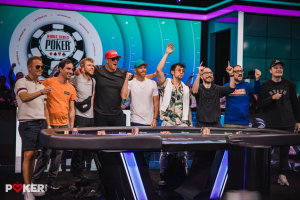
The WSOP Main Event champion will take home $10 million.
All nine finalists have secured at least $1,000,000 in prize money. The champion will take home $10,000,000 and a WSOP Main Event bracelet, while the runner-up will take home $6,000,000.
| Ranking | bonus |
|---|---|
| 1 | $10,000,000 |
| 2 | $6,000,000 |
| 3 | $3,750,000 |
| 4 | $2,750,000 |
| 5 | $2,250,000 |
| 6 | $1,750,000 |
| 7 | $1,500,000 |
| 8 | $1,250,000 |
| 9 | $1,000,000 |
The 1 million simulations provide a set of predictions based on the scoreboard, seating, ICM, and player style, but the real champion will still be determined by every decision made at the table and the community cards.
Jumalon returned to the field with a huge lead, while Mueller and Shaevel received high praise from the model; for Han Feng, the chances of winning with 3% are not outstanding, but a key doubling could quickly rewrite the short code disadvantage.
When the final table resumes on August 3, whether AI data can once again predict the champion as it did in 2016 with Qui Nguyen will be another focus of attention besides this multi-million dollar final.
Want to change Texas Holdem from "can understand" to "can win"?
If you want to learn more about Texas Hold'em, you can continue reading:
The Origins of Texas Hold'em: Why is it the World's Most Popular Poker Variant?
Texas Hold'em Hand Rankings and Showdown Rules (Beginner’s Essentials)
Texas Hold'em Betting teaching: Check / Bet / Call /Raise and Betting Strategy Analysis
The importance of Texas Hold'em position? Why is the back position more advantageous?
How to play Texas Hold'em? Novices learn Texas Hold'em rules, processes and betting teaching in 10 minutes
Texas Hold'em Starting Hands Strategy Guide: Which Hands to Play?
Texas Holdem Starting Hands Chart Tutorial: Complete Starting Hand Chart and Position Strategy
How to play Texas Hold'em? Complete rules and a hand's flow (Preflop / Flop / Turn / River)
Hunter Poker offers comprehensive tutorials, hand analysis, and strategy sharing to help players upgrade from simply "reading the cards" to understanding the range . This allows you to make better decisions in every hand.
▶️ In Facebook Follow Hunter Poker.
📘 In Youtube Follow Hunter Poker.
Want to learn more about Texas Hold'em gameplay and strategies?
Online Texas Hold'em free tournaments typically have no entry fee, making them ideal for beginners to familiarize themselves with the rules and for advanced players to test strategies and gain experience. View full brand profiles to learn about each platform's free tournament schedule, features, and target audience.
Further News Reading
Regional news
The PartyPoker Tour will travel to Castellón, Spain on October 5th.
Regional news
Tsuf Saltsberg staged a comeback to win his first career €3,000 PLO High Roller title.
Regional news
Aido, Astedt, and Schemion have advanced to the GMillion $ final table, where four million-dollar prizes await.
Regional news