



International news
The 2026 WSOP Main Event final table will resume on August 3, with nine players vying for the $10 million first-place prize. PokerNews analyzes the biggest tactical challenges faced by each of the nine finalists, including Lucas Jumalon, Han Feng, and Greg Mueller, focusing on seating, chip stacks, and ICM pressure.

The final table of the 2026 World Series of Poker (WSOP) Main Event, featuring nine players, will resume on August 3rd under the lens of ESPN. All nine players have secured at least $1 million in winnings, but eight major prize jumps await before the $10 million first-place winner is crowned.
After a nearly three-week break, each player has had time to re-analyze seating, chip stacks, opponent tendencies, and ICM pressure. PokerNews' pre-tournament analysis pointed out that the biggest challenges facing the final nine players are not the same: some must guard against three-raises from players to their left, some need to overcome the short-stack dilemma, and chip leader Lucas Jumalon's biggest enemy may be the psychological pressure of his lead.
2026 WSOP Main Event Final Table Seating and Scoreboard
| seat | player | Country/Region | Scoreboard | big blind |
|---|---|---|---|---|
| 1 | Lauri Saaskilahti | Finland | 37,500,000 | 25 |
| 2 | Michael Gagliano | United States | 46,500,000 | 31 |
| 3 | Mario Boos | France | 44,000,000 | 29 |
| 4 | Greg Mueller | Canada | 48,500,000 | 32 |
| 5 | Jamie Shaevel | United States | 56,000,000 | 37 |
| 6 | Han Feng | United States | 25,000,000 | 17 |
| 7 | Rami Hammoud | Canada | 79,000,000 | 53 |
| 8 | Evagoras Evagorou | Cyprus | 22,500,000 | 15 |
| 9 | Lucas Jumalon | United States | 194,000,000 | 129 |
Jumalon's 194,000,000 chips far surpassed his opponents, even exceeding the combined chips of the next five players. Rami Hammoud was second with 79,000,000, while Evagoras Evagorou had the shortest stack at 15 big blinds.

Lauri Saaskilahti: Beware of left-side squeeze when countering the chip leader.
Saaskilahti's right is Jumalon. Positionally, he can act later than the chip leader post-flop, but his 25 big blinds chip depth isn't enough to frequently call and then slowly engage in post-flop battles.
The bigger problem comes from Michael Gagliano on the left. When Saaskilahti flat-calls Jumalon's wide range opener, Gagliano can use position and a larger chip stack to triple-raise and squeeze him out of the pot.
PokerNews suggests a more explicit "three-raise or fold" strategy for Jumalon. Saaskilahti could use small three-raises or all-in to force Gagliano out of the game, while avoiding getting into a multi-way pot by calling.
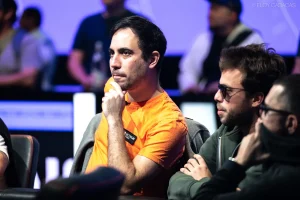
Michael Gagliano: Avoid hitting too big a pot from an unfavorable position
Gagliano, sitting to Saaskilahti's left, certainly had a good position to apply squeeze pressure. However, when it was his turn to act first, Mario Boos and Greg Mueller, both with similar chips, were sitting to his left and could use their positions to call or triple-raise.
His main risk is using too wide a front and middle position to open the pool, only to be continuously penalized by experienced wrestlers behind him.
The analysis suggests that Gagliano tighten his early position range and use smaller defensive bets to control the pot post-flop, avoiding getting involved in large pots from an unfavorable position with marginal hands.

Mario Boos: Beware of the "sandwich effect" created by Mueller.
Boos has 29 large blind spots and still has room to perform forward and backward maneuvers, but he is sitting right between Gagliano and Mueller.
When Boos attempts to attack Gagliano on the right, Mueller on the left might use his position to counterattack. This "sandwich effect" limits Boos's ability to expand his opening range in the middle and increases his risk of being drawn into multi-player pots.
PokerNews suggests that bots can use strong hands to check and set traps on certain boards. For example, after raising pre-flop and getting top pair or overpair, they don't need to immediately continue betting every time; instead, they can let aggressive muellers actively put in the chips.
Greg Mueller: Shaevel on the left limits offensive space.
Three-time WSOP bracelet winner Greg Mueller entered the final table with 32 big blinds, and his poker experience was his main advantage.
However, Jamie Shaevel sits directly to his left and holds a larger big blind of 37 chips. Shaevel has the ability to counter Mueller's attempts to open with a wide range or make creative bluffs, utilizing his position and chip advantage.
Mueller is better suited to put the main pressure on Boos and Gagliano on the right side, but when Shaevel enters the game, he needs to immediately reduce his bluffing frequency and play a more direct value game to avoid being countered.
Jamie Shaevel: Watch out for short-stacked players going all in again.
Shaevel is in third place with 56,000,000 chips and is sitting directly to Mueller's left, giving him a very favorable attacking position.
However, he is backed by two short-stacked players: Han Feng with 17 big blinds and Evagoras Evagorou with 15 big blinds. When Shaevel opens with marginal hands to try and take the blinds and ante, he could be easily overwhelmed by a short-stacked all-in.
This puts Shaevel in a pricing dilemma: he might get enough pot odds after opening the pot, but he has to take on a lot of chip risk with speculative hands.
Therefore, he needs to have a clear plan for every pot opening. When holding a strong hand, he can narrow the bet to induce short stacks to go all-in with a weaker range; when using speculative hands such as suited connectors, he should be prepared to fold immediately after being re-all-in.
Han Feng: The timing of all bets must be chosen correctly for the 17 Big Blinds.
Han Feng entered the final table with 25,000,000 chips, equivalent to 17 big blinds, which is close to the short-stack area where all-in and folding are the main strategies.
His challenge wasn't just choosing which hands to go all-in with, but also deciding who should be in the big blind. Hammoud, to Feng's left, held 53 big blinds, while Jumalon, behind him, had 129 big blinds; both had the potential to widen their calling range.
PokerNews suggests that Feng reduce his all-in bets on Hammoud's big blind openings and instead look for opportunities to triple-raise all-in on Shaevel's openings.
This approach puts pressure back on Shaevel, forcing him to fold with a large number of medium-strength hands, while reducing Hammoud's chances of calling directly with a wide range.
Rami Hammoud: Two short codes form a continuous minefield
Hammoud is ranked second with 79,000,000 chips, but the seating arrangement is quite complicated.
He sat after Han Feng and before Evagoras Evagorou. When Feng went all-in, Hammoud had to decide whether to take the risk of calling with a wider range; when Hammoud opened the pot first, Evagorou could then go all-in again using 15 big blinds.
Hammoud must avoid losing scoreboards while dealing with two short chips, lest their second-place advantage gradually disappear.
The analysis suggests that he could use the high scoreboard to isolate Feng's limping or flat call; however, when action is abandoned to the small blind and Evagorou is in the big blind, it is not advisable to launch an attack with too wide a range.
Evagoras Evagorou: The shortest stack is right next to the chip king.
Evagorou had only 22,500,000 chips, equivalent to 15 big blinds, making him not only the shortest stack in the game, but also sitting directly to his left with chip leader Jumalon.
When Evagorou attempted to steal the blinds, Jumalon had enough chips to expand his calling or all-in range. For short stacks, this was one of the least desirable seating arrangements for the final table.
Since waiting for top starting hands could further erode his chip count from the blinds, PokerNews suggests that Evagorou expand his all-in range from the hijack and cutoff positions, using high-card combinations and pocket pairs to apply pressure.
Even if Jumalon can call more widely, Evagorou still needs to force the chip leader to actually put his chips into the game, rather than letting himself gradually lose his doubling potential while passively waiting.
Lucas Jumalon: The biggest threats are the three-week break and the pressure of leading.
22-year-old Lucas Jumalon held 194,000,000 chips, equivalent to 129 big blinds, establishing a historic final table lead.
Numerically speaking, this was a final table dominated by him; but his huge advantage also meant that everyone would use the break to study his playing style and look for weaknesses in his over-opening of pots or taking unnecessary risks.
The real problem Jumalon needs to solve is not a particular opponent, but how to maintain his aggressiveness after the three-week suspension, while controlling the psychological burden of "must win".
PokerNews advised him to continue using a high-frequency opening strategy to gain the blinds, but to decisively fold weaker opening hands when Saaskilahti or Gagliano counter with a three-raise and all-in. Jumalon doesn't need to win every pot; he just needs to avoid ruining his existing lead with marginal hands.
A list of the biggest tactical challenges for the nine teams
| player | Maximum risk | Main adjustment direction |
|---|---|---|
| Lauri Saaskilahti | Gagliano squeezes him when he counters Jumalon. | Three raises or folds to the chip king |
| Michael Gagliano | The scoreboard on the left is in an unfavorable position. | Tighten the fore-position range and control the bottom pool |
| Mario Boos | Caught between Gagliano and Mueller | Setting a trap by passing with strong cards |
| Greg Mueller | Shaevel creates scoreboard pressure on the left. | Attack the right flank, respect Shaevel's counterattack |
| Jamie Shaevel | All-in bet after 15 to 17 large blinds with short numbers | Strategically select opening pot cards and sizing. |
| Han Feng | All-in was called by a wide range of high-scoring hands. | Prioritize going all in on Shaevel after three bets. |
| Rami Hammoud | Sandwiched between two short-code | Isolate Feng to prevent excessive attacks on Evagorou. |
| Evagoras Evagorou | Jumalon sat directly on the left. | Expand the active all-in range from the rear position. |
| Lucas Jumalon | Post-Trench Psychological and Leading Pressure | Frequent openings, but decisive folding when faced with a counterattack. |
Seating, ICM, and scoreboard will jointly determine the champion.
Final table strategy cannot be based solely on chip rankings. Saaskilahti and Gagliano need to manage the ripple effects of the chip leader; Shaevel and Hammoud must contend with short-stacked all-in moves; and Feng and Evagorou need to find high-quality doubling-up opportunities before the blinds erode.
While Jumalon possesses an overwhelming advantage, he cannot afford to accept too many high-volatility matches in pursuit of complete control. For the other eight players, every all-in and call early on could immediately rewrite the chip structure of the entire final table.
When the nine players returned to the table on August 3, the championship competition was not only a contest of starting hands and community cards, but also a comprehensive test of position, ICM, bet sizing, and mental control.
Want to change Texas Holdem from "can understand" to "can win"?
If you want to learn more about Texas Hold'em, you can continue reading:
The Origins of Texas Hold'em: Why is it the World's Most Popular Poker Variant?
Texas Hold'em Hand Rankings and Showdown Rules (Beginner’s Essentials)
Texas Hold'em Betting teaching: Check / Bet / Call /Raise and Betting Strategy Analysis
The importance of Texas Hold'em position? Why is the back position more advantageous?
How to play Texas Hold'em? Novices learn Texas Hold'em rules, processes and betting teaching in 10 minutes
Texas Hold'em Starting Hands Strategy Guide: Which Hands to Play?
Texas Holdem Starting Hands Chart Tutorial: Complete Starting Hand Chart and Position Strategy
How to play Texas Hold'em? Complete rules and a hand's flow (Preflop / Flop / Turn / River)
Hunter Poker offers comprehensive tutorials, hand analysis, and strategy sharing to help players upgrade from simply "reading the cards" to understanding the range . This allows you to make better decisions in every hand.
▶️ In Facebook Follow Hunter Poker.
📘 In Youtube Follow Hunter Poker.
Want to learn more about Texas Hold'em gameplay and strategies?
Online Texas Hold'em free tournaments typically have no entry fee, making them ideal for beginners to familiarize themselves with the rules and for advanced players to test strategies and gain experience. View full brand profiles to learn about each platform's free tournament schedule, features, and target audience.
Further News Reading
International news
APT Jeju Station | Scott Margereson wins High Roller title, Hongsheng Zhang achieves career-best third place.
International news
Love from Paris: French warriors win hard-fought victory in Marrakech
International news
Nine cards flopped to determine the RGPS Lake Erie Main Event champion
International news