




International news
The 2026 WSOP Main Event heads-up match will feature 22-year-old Lucas Jumalon against Finnish player Lauri Saaskilahti. Both players had less than $200,000 in prize money for their live tournaments before the match, making them the first Main Event heads-up pairing to meet this requirement since 2011.

On August 5, 2026, the World Series of Poker (WSOP) Main Event was on the verge of its final showdown. 22-year-old Lucas Jumalon, with a chip lead, faced off against Finnish player Lauri Saaskilahti. Both players had secured at least $6,000,000, with the winner taking home $10,000,000, a Main Event bracelet, and the World Championship title.
More unique than the chipboard difference was the pre-tournament background of both players. Before entering this Main Event, both Jumalon and Saaskilahti had less than $200,000 in live tournament winnings. This marks the first time since Pius Heinz defeated Martin Staszko in 2011 that two players with less than $200,000 in live tournament winnings have head-to-head titles in the WSOP Main Event.
Two new faces compete for the world championship
PokerNews described this showdown as an extremely rare Main Event heads-up combination in recent years.
Modern major tournaments, influenced by the widespread adoption of strategy software, solvers, and GTO theory, have continuously enhanced the overall competitiveness of top professional poker players. In this environment, it is far more difficult for two players with no prior major live tournament titles or seven-figure prize records to advance from a field of over 9,000 entries to the final two in the Main Event than it was during the early poker boom.
| player | Country/Region | Pre-main event prize money | Best single-transaction record |
|---|---|---|---|
| Lucas Jumalon | United States | $180,888 | $22,945 |
| Lauri Saaskilahti | Finland | $138,453 | $83,116 |
PokerNews summarizes their combined live earnings at approximately $340,000. Whether using approximations or individual figures, their pre-tournament resumes are far below those of the more common heads-up WSOP Main Event champion pairings of recent years.
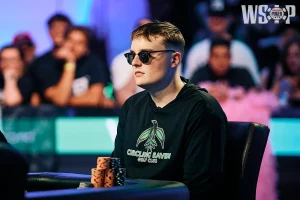
Jumalon aims to become the second youngest champion in history.
Lucas Jumalon from Spokane, Washington, USA, had accumulated $180,888 in live tournament winnings before entering this year's WSOP Main Event.
His previous biggest win was only $22,945, from the $400 buy-in PokerNews Daily Deepstack at the 2025 WSOP. Jumalon won that event, but this prize of less than $23,000 is a far cry from the current Main Event payout of at least $6 million.
If 22-year-old Jumalon can maintain his chip lead and win the title, he will become the second youngest world champion in WSOP Main Event history. He could also increase his career live earnings, previously less than $200,000, to over $10 million within hours.
Saaskilahti's best result comes from EPT Barcelona.
Before entering the 2026 WSOP Main Event, Lauri Saaskilahti had accumulated $138,453 in live tournament winnings, less than Jumalon.
This Finnish player's biggest single prize to date is $83,116, from the PokerStars European Poker Tour (EPT) Barcelona Main Event about a year ago. He finished 14th in that event, demonstrating his ability to run deep in major Main Events, but he has yet to come close to the prize money and stage of a WSOP Main Event champion.
Saaskilahti is now guaranteed at least $6 million, and even if he finishes as runner-up, his prize money will still be more than 40 times his total pre-tournament career earnings.
This is the first time a similar match has occurred since 2011.
The last time the WSOP Main Event heads-up match consisted of two players with less than $200,000 in prize money before the event was in 2011.
Back then, German player Pius Heinz defeated Czech player Martin Staszko to become the world champion. For more than a decade afterward, the final two players in the WSOP Main Event typically included at least one player with experience in major live tournaments, six-figure titles, or a high-stakes tournament resume.
PokerNews points out that while some recreational players lacking significant achievements have indeed advanced to heads-up matches in recent years, they usually face experienced professional players.
For example, 2025 runner-up John Wasnock had no single-game record exceeding $56,000 before the main event, but his heads-up opponent was Michael Mizrachi, a long-time contender for major tournaments. This is different from the situation in 2026 where two new faces entered the final two.
In recent years, many champions have already achieved results in major competitions.
Even though some modern WSOP Main Event champions were not household names in the poker world before winning the title, most of them had already accumulated a certain number of major tournament results.
Both 2024 champion Jonathan Tamayo and 2023 champion Daniel Weinman had won multiple six-figure live prizes before winning the main event.
2017 champion Scott Blumstein wasn't a globally renowned player at the time, but he had already won a tournament in Borgata and earned approximately $200,000. In contrast, neither Jumalon nor Saaskilahti had previously achieved a single-game record at this level.
Similar combinations occurred six times between 2005 and 2011.
It was not uncommon for two players with relatively little live poker experience to compete for the main event title during the poker boom of the 2000s.
According to PokerNews statistics, from 2005 to 2011, there were six WSOP Main Events where both singles players had live tournament winnings well below $200,000 before the event. In some years, some players even considered the WSOP Main Event their first live tournament winnings record.
At the time, online poker was growing rapidly, with a large influx of satellite tournament finishers, recreational players, and players lacking public profiles entering the WSOP. Every year, the Main Event could produce a previously little-known new world champion, and the victories of players like Joe Hachem and Jamie Gold became important representatives of the poker boom era.
With the expansion of the competition, the modern main event is becoming more competitive.
In the 2000s, the WSOP Main Event typically attracted between 6,000 and 7,000 participants, but in recent years it has consistently exceeded 9,000.
In addition to the increased number of participants, modern players can also improve their skills through Solver, training platforms, hand databases, and GTO strategies. Professional players generally believe that the overall level of competition in modern Main Events is higher than in the early days of the poker boom.
With a larger field and more sophisticated strategies, the fact that two players with less than $200,000 in prize money before the main event both advanced to heads-up play is the main reason why PokerNews believes this final battle is so unpredictable.
The main event once again provides a stage for overnight fame.
Both Jumalon and Saaskilahti have rewritten their careers through this Main Event. Regardless of who ultimately wins, both will go from players with less than $200,000 in live tournament winnings to world-class Main Event players with at least $6 million in single-game winnings.
For Jumalon, the championship means becoming the second youngest world champion in history; for Saaskilahti, it's an opportunity to translate his EPT Barcelona experience into the highest honor in poker.
PokerNews pointed out on the eve of the final battle that this heads-up match is the closest to the end of the main event in recent years to the era of the poker boom: two players with no seven-figure prize money or world-class championship experience are competing for $10 million and a place in poker history on the world's biggest stage.
Want to change Texas Holdem from "can understand" to "can win"?
If you want to learn more about Texas Hold'em, you can continue reading:
The Origins of Texas Hold'em: Why is it the World's Most Popular Poker Variant?
Texas Hold'em Hand Rankings and Showdown Rules (Beginner’s Essentials)
Texas Hold'em Betting teaching: Check / Bet / Call /Raise and Betting Strategy Analysis
The importance of Texas Hold'em position? Why is the back position more advantageous?
How to play Texas Hold'em? Novices learn Texas Hold'em rules, processes and betting teaching in 10 minutes
Texas Hold'em Starting Hands Strategy Guide: Which Hands to Play?
Texas Holdem Starting Hands Chart Tutorial: Complete Starting Hand Chart and Position Strategy
How to play Texas Hold'em? Complete rules and a hand's flow (Preflop / Flop / Turn / River)
Hunter Poker offers comprehensive tutorials, hand analysis, and strategy sharing to help players upgrade from simply "reading the cards" to understanding the range . This allows you to make better decisions in every hand.
▶️ In Facebook Follow Hunter Poker.
📘 In Youtube Follow Hunter Poker.
Want to learn more about Texas Hold'em gameplay and strategies?
Online Texas Hold'em free tournaments typically have no entry fee, making them ideal for beginners to familiarize themselves with the rules and for advanced players to test strategies and gain experience. View full brand profiles to learn about each platform's free tournament schedule, features, and target audience.
Further News Reading
International news
All roads lead to London GUKPT Grand Finals: £1.2 million guaranteed prize money
International news
PokerStars on FanDuel bucks the trend and grows, while the US online poker market stagnates.
International news
The youngest South African gold bracelet winner wins the APC Main Event.
International news