


International news
OlyBet Tallinn Main Event: Andreas Backlund Champion wins the title, completing a comeback with pocket aces to take home €37,148. Full review and results analysis of the Nordic poker tournament.
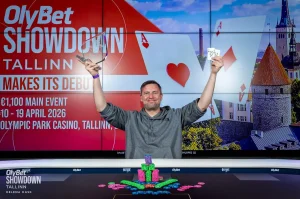 Andreas Backlund won the Tallinn Main Event with a comeback victory thanks to pocket aces.
The 2026 Nordic poker tournament season saw another surge in popularity as the OlyBet Showdown Tallinn, hosted by OlyBet, successfully concluded in Tallinn, the capital of Estonia. The series comprised 43 events (including online and satellite tournaments), attracting nearly 2,000 participants and generating a total prize pool of €596,867, making it one of the most prestigious poker events in the Baltic region.
The most anticipated main event of the year—the €1,100 No-Limit Texas Hold'em (NLH Tallinn Showdown Main Event)—attracted 210 entries, creating a prize pool of €199,500. Andreas Backlund from Finland emerged victorious, defeating fellow countryman Kyösti Isberg in heads-up play to claim the champion's prize of €37,148, achieving his best career result.
Dark Horse Rise: Low-profile Player Achieves Biggest Victory
Prior to this victory, Backlund's total live tournament winnings were only approximately $14,791, with his best result being a PLO tournament win at Kings of Tallinn in 2025, earning approximately $5,477. Compared to many experienced professional poker players, he was not considered a favorite to win the title.
However, in this tournament, he demonstrated exceptional consistency and decisiveness in crucial moments, maintaining a chip lead from Day 3 onwards, and ultimately making it all the way to the final table and completing a comeback.
Key Moment: Pocket A's Assist Completes the Comeback
When the heads-up stage began, Kyösti Isberg held a lead for a time. After negotiations, the two reached an agreement to each secure €34,148 in prize money, with the remaining €3,000 and the championship trophy as their final targets.
The turning point came in a crucial hand when Backlund held pocket aces (AA) against his opponent's A-10. With the flop coming J-10-4, Backlund successfully held his advantage, doubling up to take the chip lead.
It's worth mentioning that in many recent major tournaments, "big pairs" have been frequently reversed, but in this crucial moment, Backlund's pocket Aces held, becoming a key turning point that secured the victory.
The match quickly came to an end, with Backlund defeating their opponent A-9 10-9 to secure the championship.
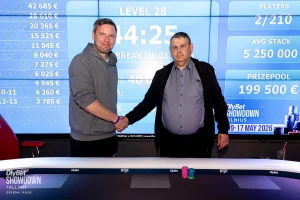
Many players delivered outstanding performances, making the series highly competitive.
Besides Backlund, several other players also performed exceptionally well in this series. Krzysztof Budka won three championships, becoming the biggest winner of the series; Alger Pissarev, Vidar Assersen, and Marci Zeltmatis each won two championships.
Backlund not only won the main event, but also took the €350 Progressive Bounty title, showcasing his all-around skills and becoming one of the brightest stars of the tournament.
The Nordic poker market continues to heat up
In recent years, OlyBet has been actively cultivating the Nordic and Baltic regions, successfully attracting a large number of international players through high-quality tournaments and comprehensive event design. The successful hosting of this Tallinn event once again demonstrates the region's important position in the global poker landscape.
With the continued growth in the size of the competition and the prize pool, the Nordic poker market is expected to become a new major hub after Las Vegas and Asia.
Specific Scenario Retrospective: Key Decisions in Different Situations
Certain scenarios can drastically alter decision-making logic, such as tournament pressure, chip depth, positional structure, range matchups, and betting patterns.
When you enter different situations, the correct approach isn't just about looking at your hand, but about understanding the overall context. The following specific scenarios and core themes are key to influencing wins and losses and long-term profitability:
I. Special Scenarios in the Championship
[ICM Pressure] How to make decisions in the ICM tournament scenario?
[Bubble Phase] Should we be aggressive or conservative during the Bubble phase?
[Final Table] How should key moves be handled?
[Short Code Strategy] How should Short Stack be typed?
[Deep Stack Strategy] What are the differences in how Deep Stack is played?
[Blind Stealing Strategy] How to consistently steal blinds in tournaments?
【Stealing Blinds vs. Counter-Stealing Blinds】Strategies for Countering Blinds in the Bubble Phase
[Middle Chip Dilemma] Why is the middle chip the hardest to beat?
[Pressure Transfer] How to transfer ICM pressure to the opponent?
[Final Table Mindset] How to go from the final table to the championship?
[Chip Management] How to control risk and avoid collapse?
[Complete Tournament Strategy] The entire process from entry to victory
II. Core of the Underlying Strategy
[Position Advantage] How to play in different positions? A complete analysis of BTN / CO / SB / BB
[Range Thinking] Why do expert players look at the range instead of their hand?
[3-bet strategy] When should you raise your bet? How to counter your opponent's opening?
How does bet sizing affect your EV?
[Betting Line] How to design a complete Flop / Turn / River Line?
Fold Equity: How can you win without showing your cards?
III. Practical Decision-Making After the Cards Are Flipped
[C-bet Strategy] When should you continue betting?
[Turn Strategy] Should we fire the second shot?
[River Decision] Should the last street be Value or Bluff?
When should you retaliate?
[Blocker Application] What is a blocking sign? How does it influence decision-making?
[Range Shrinking] How to understand your opponent's range step by step?
IV. Advanced Competition and Professional Mindset
[Exploit Strategy] How to achieve stable profits for different player types?
[GTO vs Exploit] How to choose in actual combat?
[Result Bias] Why do I still lose even when I guess correctly?
[Decision-making process] How do experts make the right decisions quickly?
Why does overconfidence actually lead to more losses?
[Emotional Management] How to avoid Tilt?
How to establish a stable profit-making mindset for long-term EV (Electronic Vehicle) businesses?
V. Common Hand Issues and Practical Problems
[All-in Decision] When should you go all in?
[Missed Card] What should I do if I missed?
[Slow Play Judgment] When should you slow play?
Why do expert players rarely play marginal hands?
[Key Fold] When should you fold?
VI. Basics for Beginners and Traffic Sources
[Starting Hand Strategy] A Complete Guide for Beginners
Texas Hold'em Rules: Complete Gameplay Tutorial (2026 Latest Version)
[Poker Card Rankings] Card Rankings and Comparison Rules
Texas Hold'em Terminology: A Complete Guide from Beginner to Advanced Players
How to win money in Texas Hold'em? A complete analysis of the thought process.
Different scenarios require entirely different decision-making logic. From tournament pressure and chip depth to position, range, and post-flop strategy, each situation demands a different framework for thinking. When you can systematically understand these specific situations, you're no longer just playing by feel, but truly establishing a sustainable and profitable decision-making system.
Further News Reading
International news
Nick Schulman, after winning his ninth WSOP gold bracelet, said: "I never thought I would get to this point."
International news
From cryptocurrency liquidation to a deep run at the WSOP! How did a 22-year-old trader turn his life around into a poker winner?
International news
Eelis Pärssinen wins his second WSOP title and his third gold bracelet, becoming the first Finnish player to achieve this feat.
International news