


Wet Board Poker Strategy It is one of the most crucial card reading skills in Texas Hold'em.
Many players have this feeling after the flop: "This hand seems dangerous," but they can't explain why or how to adjust their strategy.
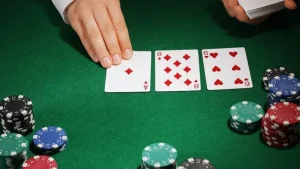
This article will help you truly understand what a "wet board" is, and how to adjust your decisions under such a hand, through practical review and strategy breakdown.
Key takeaway: Dangerous hand = Your opponent has many hands that could potentially overtake you.
The term "dangerous hand" doesn't refer to its complexity, but rather to:The opponent has a high probability of having a lot of draws or already having a strong hand.
1. Many straights are ready to win.
2. Many flush draws
3. Connected Structure
→ These will make it easier for your hand to be overtaken.
What kinds of cards are considered "dangerous"?
Type 1: Flush Draw Board
For example:
1. J♠ 8♠ 2♦
2. A♥ 10♥ 4♣
→ Your opponent may have a flush draw.
Type 2: Connected Board
1. 9♣ 8♦ 7♠
2. Q♦ J♣ 10♠
→ Many straights and ready hands are possible.
Type 3: Combo Draw Board
1. 10♠ 9♠ 8♦
→ It is possible to have both a straight and a flush.
Why do dangerous hands tend to make people lose money?
Mistake 1: Underestimating the opponent's chances of overtaking.
Many players feel: I am in the lead now.
→ But the problem is:Your opponent has many turns/rivals that could allow them to overtake you.
Mistake 2: Lack of protection.
On dangerous hands, if you choose to slow play or check, you are essentially giving your opponent a free opportunity.
Mistake 3: Being overly fixated on opposing views
On the wet board: the value of the Top Pair decreases.
Wet Board Poker Strategy: Hand Review Part 1 - Mistakes of Not Protecting Hand Strength
Scene
1. You hold A♣Q♦
2. Flop: Q♠ J♠ 9♦
You have a perfect pair, but:
1. Straight waiting hand
2. Flush draw
→ If you check, your opponent can see your cards for free.
Wet Board Poker Strategy Hand Recap Part 2: Overly Slow Play Leads to Being Overtaken
Scene
1. You hold 8♠8♦
2. Flipped cards: 8♣ 10♠ 9♠
You have a set, but the cards are:
1. Very wet
2. The opponent has many draws.
→ Playing slowly puts you at risk.
Wet Board Poker Strategy Hand Review Part 3: Making the Wrong Call
Scene
1. You hold K♣Q♣
2. Flop: Q♦ J♠ 10♠
You have a perfect pair, but:
1. A straight already exists.
2. Flush may exist.
→ You should be more cautious if your opponent continues to apply pressure.
Decision-making model: How to play when faced with a dangerous situation?
1. How many draws does the opponent have?
2. Are the cards consecutive?
3. Is a flush possible?
4. Do you need to protect your hand strength?
5. Is the opponent continuing to exert pressure?
→ These factors determine whether you should attack or control.
The core of dangerous hand patterns is "instability".
Wet Board Poker Strategy The essence lies in:
1. Your lead is unstable.
2. The opponent has many opportunities to change the situation.
→ So you need to:More proactive protection + more cautious judgment.
5 essential questions for post-mortem analysis
1. How many hands does this hand have?
2. Do I need to protect my card strength?
3. Am I overestimating my current lead?
4. Does the opponent have many ways to overtake?
5. How is the long-term EV of this playstyle?
In conclusion: A dangerous hand isn't necessarily one you can't play, but rather one you need to "change your approach".
Many players lose money on the wet board not because of bad hands, but because:Playing the right cards with the wrong strategy.
Once you begin to understand the card structure, you'll find your decision-making becomes more consistent.
Key points summary
1. Dangerous hand = High uncertainty
2. Contains numerous draw and continuous sheet structures.
3. Need to protect card strength
4. The value of the top pair has decreased.
5. The key lies in interpreting the cards.
FAQ: Frequently Asked Questions
What are dangerous cards?
→ A hand with a high probability of drawing a winning hand and a chance to overtake the opponent.
Should you always bet on dangerous hands?
→ In most cases, you should attack, but it depends on the situation.
Is a Top Pair still strong in this hand?
→ Relatively weaker, requiring more caution.
Want to change Texas Holdem from "can understand" to "can win"?
The following hand situations are the key moments when most players most often lose money:
A must-read for beginners
These are the basic scenarios where most players make the most mistakes and most often lose money:
[Common Beginner Mistakes] Why do I always lose with AQ? A complete hand replay analysis
[Frequency Error] Should the top move have been executed with a three-street sweep? Real-world analysis.
[Common Dilemma] Should I attack or call if I have a draw on the flop? Strategy Breakdown
[Key Mistake] Why do beginners always lose big pots on the river? Analysis of Reasons
[Basic Concepts] How strong are middle pairs (JJ / TT)? Hand Analysis
Practical decision making
Once you know how to play cards, these decisions will directly determine whether you profit or lose:
[Key Decision-Making] When to Fold When Faced with a Raise? Retrospective Analysis
[Frequently Asked Questions] Why do I lose even after hitting a pair? Hand review and analysis
[Cognitive Error] Why do you always fall just short of winning? Decision Breakdown
[Hand Interpretation] How to play a high Ace hand? Practical strategy analysis
[Pot Control] How to use small pairs? A post-game tutorial.
[Pre-flop Selection] How to play hands like KQ/KJ? Strategy Analysis
[Advanced Mistakes] When should you not play slowly? Hand analysis
Key Insights
What truly sets you apart isn't your hand, but how you understand the situation and the range:
[Card Interpretation] What are "dangerous cards"? Retrospective Analysis
[Core Concept] Why is location so important? Strategy Analysis
[Advanced Techniques] What is "Controlled Pot"? Practical Analysis
Hunter Poker offers systematic Texas Hold'em instruction, hand analysis, and strategy analysis, from basic rules to advanced decision-making, helping players progress from "just looking at their hands" to "understanding ranges and decision-making logic," enabling them to make long-term profitable choices in every hand.