




Texas Hold'em Poker Tutorial Articles
Slow Play Poker Strategy guide: Learn when NOT to slow play in Texas Hold'em, avoid common mistakes, and maximize value with strong hands.
Slow Play Poker Strategy It is a technique commonly used by advanced players in Texas Hold'em, but it is also one of the most easily abused and most likely to lead to huge losses.
Many players believe that slow play can "induce opponents to bet" or "hide the strength of their hand," but they overlook a crucial issue:Should you really slow down?
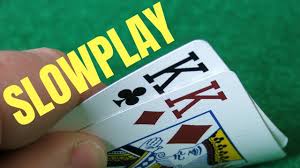
This article will use real-world analysis and decision breakdown to tell you when you "shouldn't play slowly" and why many slow plays actually mean giving up on potential returns (EV).
Key conclusion: Slow playing is not a technique, but rather an "option when conditions are met".
Many players mistakenly believe that slow-paced gameplay is an advanced technique, but in reality:Slow typing is only correct under specific conditions.
1. You need your opponents to actively place bets.
2. You need a safe hand.
3. You need your opponent to have a bluff tendency.
→ If these conditions are not met, slow typing is a waste of value.
Why does typing slowly become an error?
Mistake 1: Giving your opponent a free opportunity
When you check a strong hand, you give your opponent:
1. Free card viewing
2. Opportunity to complete a winning hand
→ This will directly reduce your EV.
Mistake 2: Missed Value
Many players played slowly, and the result was:
1. Opponent's checkback
2. The pot size did not increase.
→ Strong cards were not played to their full potential.
Mistake 3: Misjudging the opponent
The premise of playing slowly is that the opponent will actively place a bet.
However, if your opponent is on the defensive: playing slowly will prevent you from gaining any value.
Slow Play Poker Strategy: Hand Review Part 1 - Don't Slow Play on a Wet Board
Scene
1. You hold 8♠9♠
2. Flop: 10♠ J♠ Q♦ (Straight + Flush Draw)
This is a very strong hand, but at the same time:
1. The board is very wet.
2. The opponent has a large number of draws.
→ In this situation, you should place an active bet instead of playing slowly.
Slow Play Poker Strategy Hand Review Part 2: Opponent on the defensive, shouldn't have played slowly.
Scene
1. You hold A♣A♦
2. Flop: A♠ 7♣ 2♥
You have a set, but your opponent rarely bets actively.
If you choose to check, it is very likely that:
1. Opponent's checkback
2. You missed out on value
Slow Play Poker Strategy Hand Review Part 3: Don't Slow Play in Multi-Part Pots
Scene
1. Three-person pot
2. You hold a strong hand (e.g., a set).
The problem is:
1. More people = more uncertainty
2. More potential winning hands
→ In multi-way pots, you should actively build the pot, rather than slowly play it.
Slow Play Poker Strategy Hand Review Part 4: Opponent's Range Weak, Shouldn't Have Slow Played
Scene
1. You have a strong hand
2. The opponent's range is relatively weak.
If you check: your opponent might just give up.
→ At this point, you should take the initiative to place a bet and capture value.
Decision Model: When Should We Not Play Slowly?
1. Wet board
2. The opponent is on the defensive.
3. Multi-player pool
4. Opponent's range is weak.
5. Need to protect card strength
→ Slow typing is usually an error when these conditions are met.
The essence of slow playing is "delaying value," not "giving up value."
Slow Play Poker Strategy The core is:
1. Get your opponent to invest their own chips.
2. Instead of letting your opponent see their cards for free.
→ If you can't be sure your opponent will bet, then you shouldn't play slowly.
5 essential questions for post-mortem analysis
1. Will the opponent place a bet?
2. Is the hand safe?
3. Are there many winning hands?
4. Am I missing out on value?
5. Is this slow play a positive EV in the long run?
Conclusion: A poorly executed slow play is more costly than a poorly executed attack.
Many players believe that slow-paced gameplay is an advanced technique, but in reality:Incorrect slow playing is the most hidden source of losses.
When you begin to understand when you "shouldn't play slowly," your overall profitability will improve significantly.
Key points summary
1. Slow playing requires certain conditions.
2. Wet hands should not be played slowly.
3. A passive opponent is not suitable for a slow, deliberate approach.
4. In multi-player pots, the player should take the initiative and attack.
5. Slow typing errors will directly result in a loss of EV.
FAQ: Common Issues with Slow Typing
Is playing slowly necessarily bad?
→ No, but certain conditions must be met.
When is it appropriate to play slowly?
→ When the opponent will actively bet and the board is safe.
Why do we lose when we play slowly?
→ Because it gave the opponent a free opportunity or caused them to miss out on value.
Want to change Texas Holdem from "can understand" to "can win"?
The following hand situations are the key moments when most players most often lose money:
A must-read for beginners
These are the basic scenarios where most players make the most mistakes and most often lose money:
[Common Beginner Mistakes] Why do I always lose with AQ? A complete hand replay analysis
[Frequency Error] Should the top move have been executed with a three-street sweep? Real-world analysis.
[Common Dilemma] Should I attack or call if I have a draw on the flop? Strategy Breakdown
[Key Mistake] Why do beginners always lose big pots on the river? Analysis of Reasons
[Basic Concepts] How strong are middle pairs (JJ / TT)? Hand Analysis
Practical decision making
Once you know how to play cards, these decisions will directly determine whether you profit or lose:
[Key Decision-Making] When to Fold When Faced with a Raise? Retrospective Analysis
[Frequently Asked Questions] Why do I lose even after hitting a pair? Hand review and analysis
[Cognitive Error] Why do you always fall just short of winning? Decision Breakdown
[Hand Interpretation] How to play a high Ace hand? Practical strategy analysis
[Pot Control] How to use small pairs? A post-game tutorial.
[Pre-flop Selection] How to play hands like KQ/KJ? Strategy Analysis
[Advanced Mistakes] When should you not play slowly? Hand analysis
Key Insights
What truly sets you apart isn't your hand, but how you understand the situation and the range:
[Card Interpretation] What are "dangerous cards"? Retrospective Analysis
[Core Concept] Why is location so important? Strategy Analysis
[Advanced Techniques] What is "Controlled Pot"? Practical Analysis
Hunter Poker offers systematic Texas Hold'em instruction, hand analysis, and strategy analysis, from basic rules to advanced decision-making, helping players progress from "just looking at their hands" to "understanding ranges and decision-making logic," enabling them to make long-term profitable choices in every hand.
Extended Reading for Teaching
Hand resumption
[Review Methods] How do professional players review their hands?
Hand resumption
[Long-term planning] How to build a long-term profit strategy?
Hand resumption
[Strategy Selection] GTO vs Exploit: Which to choose in actual gameplay?
Hand resumption