




Texas Hold'em Poker Tutorial Articles
Suited Broadway Poker Strategy guide: Learn how to play KQ and KJ in Texas Hold'em, avoid dominated hands, and improve your preflop decisions.
Suited Broadway Poker Strategy This is one of the most easily misunderstood hand strategies in Texas Hold'em pre-flop.
Broadways, like KQ and KJ, look promising and have great potential.However, in actual combat, it often puts players in a difficult situation.
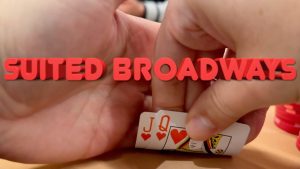
Why do these seemingly strong hands often lose big pots?
The key point is:They are easily dominated by a stronger range.。
This article will guide you through a practical review and strategy breakdown to help you understand the correct way to play KQ/KJ.
Key takeaway: KQ/KJ is a "high-potential, high-risk" hand.
The characteristics of this type of card are:
1. Has the potential to form straights and flushes.
2. Easy to hit the top pair
3. However, it is also easily suppressed by AK / AQ / KQ.
→ It's not that they can't fight, but...Don't hit randomly。
Why do these types of hands often lead to losses?
Mistake 1: Overestimating the value before the rollover
Many players think: KQ is very strong and can hit big.
But when you're facing a 3-bet or a tight range: you're likely already behind.
Mistake 2: Hitting the top pair but being suppressed
For example:
1. KQ vs AK (Chinese K)
2. KJ vs KQ (Chinese K)
→ This is a typical dominated situation.
Mistake 3: Over-aggression or over-calling
Many players will:
1. 3-bet before flipping over
2. Unwilling to give up after turning over.
Suited Broadway Poker Strategy Hand Recap 1: Pre-flop Position Determines Everything
Scene
1. You hold K♠Q♠
2. In the posterior position (BTN)
→ This is a good hand to start with.
However, if: in the first position (UTG)
→ The risk increases significantly.
Suited Broadway Poker Strategy Hand Review Part 2: Decisions Against 3-bets
Scene
1. You hold K♦J♦
2. 3-bet after the start of the game
A common reaction from beginners: That's a good move, I can follow along.
But in reality:
1. You are easily suppressed.
2. Difficult to hit after flipping over
→ In many situations, you should just fold.
Suited Broadway Poker Strategy Hand Replay Part 3: Post-Flop Traps in Middle Hands
Scene
1. You hold K♣Q♣
2. Flop: K♦ 8♠ 3♥
You're right, but:
1. The opponent may have an AK.
2. Even KQ (King and Queen of Spades)
→ Getting the top answer doesn't mean you're safe.
Suited Broadway Poker Strategy Hand Review Part 4: Situations Suitable for Aggression
Scene
1. You hold K♠Q♠
2. Flop: J♠ 10♣ 2♠
This is a strong draw:
1. Straight waiting hand
2. Flush draw
→ In this situation, you can take the initiative to attack (semi-bluff).
Decision model: KQ / KJ - How to play?
1. Position
2. Is it suitable?
3. Opponent's range strength
4. Are you facing a raise/3-bet?
5. Operability after flipping
→ These factors determine whether you should enter the pool.
The core principle of this type of card game is "avoiding being dominated".
Suited Broadway Poker Strategy The core is:
1. Avoid entering a dominated situation.
2. Leverage location advantages
3. Selective attack
→ These types of cards are not meant to be played head-on, but rather to be used to "choose the battlefield".
5 essential questions for post-mortem analysis
1. Am I in a good position?
2. Am I being suppressed by a stronger area of effect?
3. Did I overestimate this hand?
4. Is it easy to hit after flipping over?
5. What is the long-term EV of this hand?
In conclusion: KQ / KJ isn't the problem, the problem is how you play them.
Many players feel that this type of hand is "unstable," but the problem isn't the cards themselves, but rather:It lacks understanding of its risks and limitations.
When you learn to control and choose, these types of cards will become your profit-making tools, not a source of loss.
Key points summary
1. KQ / KJ are high-potential but high-risk hands.
2. Location is very important.
3. Easily suppressed by stronger cards.
4. Be more cautious when facing 3-bets.
5. Control the rhythm after the flip.
FAQ: Frequently Asked Questions
Is KQ a strong hand?
→ It depends on the situation. A good position is a strong hand, but not necessarily under pressure.
Can KJ play?
→ Yes, but you need to be more careful, especially when facing a raise.
Should we attack these types of cards frequently?
→ No, you shouldn't; you need to choose the right time.
Want to change Texas Holdem from "can understand" to "can win"?
The following hand situations are the key moments when most players most often lose money:
A must-read for beginners
These are the basic scenarios where most players make the most mistakes and most often lose money:
[Common Beginner Mistakes] Why do I always lose with AQ? A complete hand replay analysis
[Frequency Error] Should the top move have been executed with a three-street sweep? Real-world analysis.
[Common Dilemma] Should I attack or call if I have a draw on the flop? Strategy Breakdown
[Key Mistake] Why do beginners always lose big pots on the river? Analysis of Reasons
[Basic Concepts] How strong are middle pairs (JJ / TT)? Hand Analysis
Practical decision making
Once you know how to play cards, these decisions will directly determine whether you profit or lose:
[Key Decision-Making] When to Fold When Faced with a Raise? Retrospective Analysis
[Frequently Asked Questions] Why do I lose even after hitting a pair? Hand review and analysis
[Cognitive Error] Why do you always fall just short of winning? Decision Breakdown
[Hand Interpretation] How to play a high Ace hand? Practical strategy analysis
[Pot Control] How to use small pairs? A post-game tutorial.
[Pre-flop Selection] How to play hands like KQ/KJ? Strategy Analysis
[Advanced Mistakes] When should you not play slowly? Hand analysis
Key Insights
What truly sets you apart isn't your hand, but how you understand the situation and the range:
[Card Interpretation] What are "dangerous cards"? Retrospective Analysis
[Core Concept] Why is location so important? Strategy Analysis
[Advanced Techniques] What is "Controlled Pot"? Practical Analysis
Hunter Poker offers systematic Texas Hold'em instruction, hand analysis, and strategy analysis, from basic rules to advanced decision-making, helping players progress from "just looking at their hands" to "understanding ranges and decision-making logic," enabling them to make long-term profitable choices in every hand.
Extended Reading for Teaching
Hand resumption
[Review Methods] How do professional players review their hands?
Hand resumption
[Long-term planning] How to build a long-term profit strategy?
Hand resumption
[Strategy Selection] GTO vs Exploit: Which to choose in actual gameplay?
Hand resumption