

International news
WSOPE 2026 Hands of the Week highlights exciting hands from the Prague Main Event, including four-of-a-kind crushing victories, Kabrhel's elimination, and Kudzmanas's crucial divine call.
 The WSOPE 2026 Prague Main Event featured many key hands and classic matches.
WSOPE 2026 Hands of the Week: Highlights of the Prague Main Event
The 2026 World Series of Poker Europe (WSOP Europe, WSOPE) will be held in Prague, Czech Republic, from March 31 to April 12. This year's event will not only award 15 gold bracelets, but also officially launch a new, unified "WSOP Player of the Year" million-dollar competition mechanism.
The €5,300 Main Event (NLHE European Championship) set a record with 2,617 entries and a total prize pool of €13,085,000. Several pivotal hands influenced the course of the tournament; below are some of the most representative and memorable moments from this week.
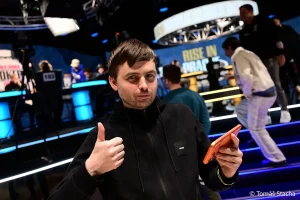
Kabrhel's Time Bank Scandal and Dramatic Exit
In Level 17, Martin Kabrhel, the focal point of the game, once again sparked discussion. With only 22,000 chips remaining, he attempted to influence the pace of the game by extensively using the time bank to delay decisions, a process that lasted for over 10 minutes.
After the referee intervened, he eventually faced off against Luca Stevanato.
- Kabrhel: Q♣ 8♠
- Stevanato: 4♦ 4♣
After the flop, Kabrhel hit a pair and doubled up.
He then defeated Kasperi Ilkka (A♦10♣) with A♠ A♣, completing a second doubling-up and seemingly returning to the game.
However, after only a few hands, he was defeated by a reversal of his hand with 8♦8♥ against A♦10♦, finishing in 278th place and winning a €10,000 prize.
This process, from dragging out the game to doubling the score, and then being quickly eliminated, became one of the most dramatic moments of this year's competition.
Four crushing blows: Okamoto faces an unsolvable predicament.
In Level 27, renowned Japanese player Shiina Okamoto suffered a fatal blow:
Flop: 8♦ J♣ J♥
Turn card: J♦
River card: 7♥
Okamoto held A♥A♠ to form a full house (J full A), but his opponent Vasileios Panagiotidis held J♠10♠ and directly completed four Js.
This was a classic "Cooler" move, almost unavoidable, which led to Okamoto's elimination and the end of the deep tournament.
Obrestad's return to the WSOP ended in 34th place.

Norwegian legend Annette Obrestad returned to the WSOP stage and had a stellar performance in the main event, but ultimately finished in 34th place.
Key Matchup:
- Obrestad:2♦2♣
- Opponent: K♥J♦
After the flop came up with a Jack, Obrestad only had two draws left and ultimately failed to turn the tide, resulting in his elimination.
Despite failing to advance further, her return was still a highlight of this year's competition.
Key Elimination: Steven Jones Defeats with Flush
A crucial match occurred on Day 5 with 24 players remaining:
- Steven Jones: 9♣6♠ (two pairs)
- Rokas Asipauskas: 7♥3♥ (flush)
After completing a flush on the river, Jones called an all-in bet and was ultimately eliminated, finishing in 24th place.
God-like judgment: Kudzmanas' key Hero Call
With only 6 players remaining on Day 6, one of the most brilliant judgments of the tournament took place:
Card display: J♦9♠4♠ / 3♦ / 3♠
After betting on the river, Marius Kudzmanas faced all-in pressure from Hengtao Zhu and, after much deliberation, chose to call.
- Zhu: A♠K♦ (bluff)
- Kudzmanas: 5♣4♣ (two pairs)
This precise Hero Call successfully caught a bluff, eliminating his opponent (6th place, €320,000) and laying the foundation for his subsequent championship victory.
Conclusion: Top-level competitions are a blend of skill and luck.
WSOPE 2026 Main Event proves once again:
- Technology determines long-term win rate
- Psychology and judgment determine critical moments
- Luck influences the final result.
From four-of-a-kind crushing blows to godlike hand readings, every hand can change your destiny, which is precisely what makes poker so fascinating.
Advanced Thinking Review: From "Knowing How to Play Cards" to "Making the Right Decisions"
When you stop just looking at your own hand, what truly sets you apart is how well you understand Range, EV, Blocker, position, and overall betting strategy.
The following advanced thinking methods are key to most players' progress from "occasionally getting it right" to "long-term stable profitability":
[Range Thinking] How to truly apply Range thinking in actual gameplay? Hand review and analysis.
[River Decision Making] How does the Blocker influence River's calling, raising, and folding? Strategy Breakdown
[Result Bias] EV vs Result: Why did we still lose even when we bet correctly? Retrospective Analysis
[Bluff Core] What constitutes proper Bluff? Hand replay analysis
[Semi-Bluff Timing] When is the most profitable time to use a semi-bluff? Strategy Analysis
[Bet Line] How to construct a complete betting line? Practical analysis and review.
[Position Advantage] Why does position directly influence your every decision? Hand Analysis
[SPR Application] How does SPR affect your playing style and pot planning? Strategy Analysis
[Vulnerability Analysis] How to identify vulnerabilities in an opponent's Range vulnerability? Post-mortem analysis and breakdown.
[Marginal Hands Problem] Why do expert players rarely play marginal hands? Decision Analysis
【Lập kế hoạch ba vòng cược】Làm sao thiết kế chiến thuật cho flop, turn và river? Phân tích thực chiến trong poker
[Fold Equity Pressure] How to Create Fold Equity? Hand Replay Analysis
[Area Contraction] How to analyze the process of the opponent's area being compressed? Strategy breakdown
[Strategy Selection] Balance vs. Exploit: Which to Choose in Practice? Retrospective Analysis
[Long-Term Profitability] How to Train a Long-Term EV Mindset? Decision Model Analysis
The biggest difference between advanced players and casual players isn't remembering more terminology, but rather the ability to integrate range, EV, position, blocking cards, and betting lines in every decision. Through these advanced thought processes, you can gradually build a more complete Texas Hold'em decision-making framework.
Further News Reading
International news
A poker coach who plays soccer will face the United States in the World Cup.
International news
Japan has a strong showing at the 2026 WSOP. Here’s why.
International news
Koji Fujimoto defeated a legend on his way to winning the $10k Limit 2-7 Triple Draw Championship.
International news