




Texas Hold'em Poker Tutorial Articles
Bluff Poker Strategy provides an in-depth analysis of what constitutes a proper bluff. Through hand replays, it dissects the core conditions for bluffing, Fold Equity, Range logic, and Blocker applications, helping you build a truly positive EV offensive strategy.
Bluff Poker Strategy It is one of the most misunderstood and most easily abused techniques in poker.
Many players think that Bluff is "deceptive" and "random attacks", but true Bluff is based on precise decision-making on range, EV and logic.
Once you understand what constitutes a proper Bluff, your attacks will no longer be risky, but rather a calculable, long-term profitable strategy.
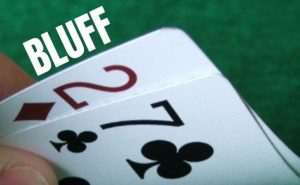
→ Can this move be used to Bluff?
→ Should I try to scare him away?
Core conclusion: Bluff Poker Strategy = Logical, conditional, and purposeful attack.
A proper Bluff must meet the following conditions simultaneously:
1. The opponent has a sufficient fold equity.
2. Your story (betting strategy) is reasonable.
3. Your hand has continuity with the Range.
Bluff isn't about playing randomly; it's about logically forcing your opponent to fold.
Hand situation review
1. You hold A♣ 5♣ in BTN
2. The opponent is defending at BB.
3. Flop: K♦ 9♠ 2♣, you c-bet, your opponent calls.
4. Turn: 7♣, you continue betting, your opponent calls again.
5. River: 3♦
The question then becomes: Should you make a third Bluff shot on the River?
Faulty thinking: Emotional Bluff
Many players will:
→ I feel like I've been betting all along and don't want to give up.
→ I think the opponent should be afraid
→ Decide whether to Bluff based on your gut feeling
This type of bluff is usually negative EV and will result in losses in the long run.
Correct thinking: Starting with Range and Story
You need to analyze:
→ Does your line represent a strong hand (e.g., AK / KQ / set)?
→ How many medium-strength hands in the opponent's range will they fold?
→ Did you block your opponent's strong hand?
Bluff is only convincing when your story is plausible.
Under what circumstances is Bluff correct?
1. The opponent's range is relatively weak.
→ There are a lot of medium-sized cards or air cards
2. You have Fold Equity
→ The opponent has the ability to fold.
3. Your Line account is reasonable.
→ Can represent a strong hand
4. You have a good blocker.
→ Reduce opponents' strong hand combinations
In what situations should you not use Bluff?
→ The opponent is the "calling station" type.
→ Your Line profile is invalid (the story doesn't make sense).
→ Your hand prevented your opponent from bluffing (making him fold less).
→ The hand clearly favors the opponent's Range.
A poorly executed bluff will cause you to lose chips over the long term.
Advanced concept: Bluff is part of Range
Skilled players don't think about Bluff in isolation, but rather:
→ Balance between value and bluff
→ Establish a complete betting range
→ Make it difficult for the opponent to exploit
A strategy without bluffing is easy to read; but too much bluffing will result in direct losses.
How to improve your Bluffing ability in actual combat?
→ Before each Bluff, ask yourself, "Will my opponent concede?"
→ Practice analyzing your opponent's range, rather than guessing a single hand.
→ Establish a reasonable betting line.
→ Thinking from the perspective of Blockers and Combinatorics
Core Decision Conclusions
A true bluff isn't about making you look strong, but about preventing your opponent from continuing.
When your Bluff is built on Range, EV, and logic, it is no longer gambling, but strategy.
Advanced Thinking Review: From "Knowing How to Play Cards" to "Making the Right Decisions"
When you stop just looking at your own hand, what truly sets you apart is how well you understand Range, EV, Blocker, position, and overall betting strategy.
The following advanced thinking methods are key to most players' progress from "occasionally getting it right" to "long-term stable profitability":
[Range Thinking] How to truly apply Range thinking in actual gameplay? Hand review and analysis.
[River Decision Making] How does the Blocker influence River's calling, raising, and folding? Strategy Breakdown
[Result Bias] EV vs Result: Why did we still lose even when we bet correctly? Retrospective Analysis
[Bluff Core] What constitutes proper Bluff? Hand replay analysis
[Semi-Bluff Timing] When is the most profitable time to use a semi-bluff? Strategy Analysis
[Bet Line] How to construct a complete betting line? Practical analysis and review.
[Position Advantage] Why does position directly influence your every decision? Hand Analysis
[SPR Application] How does SPR affect your playing style and pot planning? Strategy Analysis
[Vulnerability Analysis] How to identify vulnerabilities in an opponent's Range vulnerability? Post-mortem analysis and breakdown.
[Marginal Hands Problem] Why do expert players rarely play marginal hands? Decision Analysis
【Lập kế hoạch ba vòng cược】Làm sao thiết kế chiến thuật cho flop, turn và river? Phân tích thực chiến trong poker
[Fold Equity Pressure] How to Create Fold Equity? Hand Replay Analysis
[Area Contraction] How to analyze the process of the opponent's area being compressed? Strategy breakdown
[Strategy Selection] Balance vs. Exploit: Which to Choose in Practice? Retrospective Analysis
[Long-Term Profitability] How to Train a Long-Term EV Mindset? Decision Model Analysis
The biggest difference between advanced players and casual players isn't remembering more terminology, but rather the ability to integrate range, EV, position, blocking cards, and betting lines in every decision. Through these advanced thought processes, you can gradually build a more complete Texas Hold'em decision-making framework.
Extended Reading for Teaching
Hand resumption
[Review Methods] How do professional players review their hands?
Hand resumption
[Long-term planning] How to build a long-term profit strategy?
Hand resumption
[Strategy Selection] GTO vs Exploit: Which to choose in actual gameplay?
Hand resumption