




Texas Hold'em Poker Tutorial Articles
Fold Equity Poker Strategy provides an in-depth analysis of how to create fold pressure. Through hand replays, it explains how bluffing, C-betting, and betting lines influence opponents' decisions and improve long-term EV.
Fold Equity Poker Strategy It's the core ability that allows you to win the pot even when you don't have the best hand.
Many players only bet when they have a good hand, but true masters use pressure to make their opponents fold at the wrong time.
Once you understand how to create Fold Equity, your profit sources will no longer rely solely on finished products.
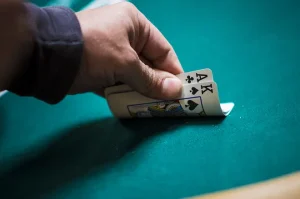
→ I didn't get a license plate, should I give up?
→ The opponent looks strong, is it still worth betting?
But the real question to ask is: Can I get my opponent to fold?
Core conclusion: Fold Equity Poker Strategy = Using pressure to make opponents make mistakes
Fold Equity represents:
→ Opponent's chance of folding
→ Your chance to win the pot directly through betting
When your opponent folds, you profit without even having to show your cards.
Hand situation review
1. You hold 7♠ 6♠ in BTN
2. The opponent is defending at BB.
3. Flop: K♦ 9♣ 2♠ (You lost completely)
4. Opponent checks
The question at this point is:
→ Should C-bet create Fold Equity?
Wrong mindset: Giving up when you have no cards
Many players will:
→ You can't play if you think you didn't hit.
→ Play overly conservatively
→ Giving up a pot that could have been won
This will cause you to miss out on a lot of profit opportunities.
Correct thinking: Evaluating Fold Equity
In this context:
→ The opponent's Range contains a large number of cards that did not hit.
→ You can represent a strong hand (Kx)
→ Pressure can be applied with a small injection.
Conclusion: This is a standard spot where you can place bets.
How to create Fold Equity?
1. Utilize Position
→ It's easier to apply pressure in the back position.
2. Utilize the board.
→ Cards favorable to your Range
3. Utilize betting size (Sizing)
→ The right size makes it difficult for the opponent to continue.
4. Utilize stories (Line)
→ Make your actions seem reasonable
When is Fold Equity at its strongest?
→ Opponent's Range is relatively weak
→ Opponents are more likely to fold under pressure
→ The cards are favorable to your Range
→ You have the ability to apply further pressure (Turn / River)
Fold Equity is not a single action, but rather a total pressure.
When should you not create Fold Equity?
→ The opponent is Calling Station
→ The opponent's Range is very strong
→ Your story is illogical.
→ No follow-up plans
Applying the wrong pressure will simply turn into giving away money.
Advanced concept: Fold Equity + Equity = Maximum EV
The best-case scenario is:
→ Has Fold Equity (opponent will fold)
→ Has a hand with Equity (potential to become a winning hand)
This is the essence of Semi-Bluff.
Common errors
→ Bluff on the wrong board
→ Apply pressure to players who won't fold
→ No Three Streets Plan
These will all cause your Fold Equity to become negative EV.
How to improve Fold Equity in practice?
→ Practice Range Analysis
→ Determine the type of opponent
→ Design a complete betting line (Line)
→ Combining position and card advantage
Core Decision Conclusions
You don't need the strongest hand, you just need to get your opponent to fold.
Once you can consistently produce Fold Equity, your profits will increase significantly.
Advanced Thinking Review: From "Knowing How to Play Cards" to "Making the Right Decisions"
When you stop just looking at your own hand, what truly sets you apart is how well you understand Range, EV, Blocker, position, and overall betting strategy.
The following advanced thinking methods are key to most players' progress from "occasionally getting it right" to "long-term stable profitability":
[Range Thinking] How to truly apply Range thinking in actual gameplay? Hand review and analysis.
[River Decision Making] How does the Blocker influence River's calling, raising, and folding? Strategy Breakdown
[Result Bias] EV vs Result: Why did we still lose even when we bet correctly? Retrospective Analysis
[Bluff Core] What constitutes proper Bluff? Hand replay analysis
[Semi-Bluff Timing] When is the most profitable time to use a semi-bluff? Strategy Analysis
[Bet Line] How to construct a complete betting line? Practical analysis and review.
[Position Advantage] Why does position directly influence your every decision? Hand Analysis
[SPR Application] How does SPR affect your playing style and pot planning? Strategy Analysis
[Vulnerability Analysis] How to identify vulnerabilities in an opponent's Range vulnerability? Post-mortem analysis and breakdown.
[Marginal Hands Problem] Why do expert players rarely play marginal hands? Decision Analysis
【Lập kế hoạch ba vòng cược】Làm sao thiết kế chiến thuật cho flop, turn và river? Phân tích thực chiến trong poker
[Fold Equity Pressure] How to Create Fold Equity? Hand Replay Analysis
[Area Contraction] How to analyze the process of the opponent's area being compressed? Strategy breakdown
[Strategy Selection] Balance vs. Exploit: Which to Choose in Practice? Retrospective Analysis
[Long-Term Profitability] How to Train a Long-Term EV Mindset? Decision Model Analysis
The biggest difference between advanced players and casual players isn't remembering more terminology, but rather the ability to integrate range, EV, position, blocking cards, and betting lines in every decision. Through these advanced thought processes, you can gradually build a more complete Texas Hold'em decision-making framework.
Extended Reading for Teaching
Hand resumption
[Review Methods] How do professional players review their hands?
Hand resumption
[Long-term planning] How to build a long-term profit strategy?
Hand resumption
[Strategy Selection] GTO vs Exploit: Which to choose in actual gameplay?
Hand resumption