

International news
In the GTO Wizard video, Espen Jorstad recounts his journey to the 2022 WSOP Main Event victory, providing an in-depth analysis of ICM decisions and GTO strategies in key hands at the final table.
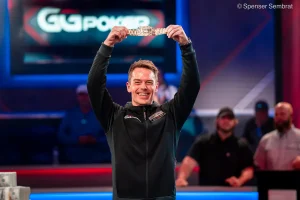 In the GTO Wizard video, Espen Jorstad recounts his journey to the 2022 WSOP Main Event victory, providing an in-depth analysis of ICM decisions and GTO strategies in key hands at the final table.
Espen Jorstad's victory in the 2022 WSOP Main Event was unforgettable. But this win, which brought him $10 million in prize money and a gold bracelet, was not without some tough decisions.
In a video by GTO Wizard, the champion analyzes the impact of the ICM he faced at the final table four years ago. Now is the perfect time to release this video – just days before the 2026 WSOP Main Event final table begins (August 3-5, airing on ESPN and ESPN2).
The difficult situation encountered at the beginning
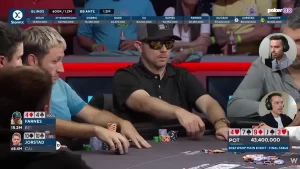
Jorstad started the 2022 final table as the chip leader with 88,600,000 chips, blinds of 600,000/1,200,000, and a big blind ante of 1,200,000. However, this chip lead was quickly put to the test.
Jeffrey Farnes, in early position, raised to 2,400,000 with 4♦4♣ from 35,350,000 effective chips. Action folded all the way to Jorstad on the button, who held 10♠10♣. Jorstad called and explained in the video that he didn't expect Farnes to "open the pot so wide."
The heads-up flop came 4♥7♠9♦, a brutal flop for the chip leader. Farnes continuation bet 2,800,000 with set, and the button called. The turn card was J♠.
This card made the situation a bit more interesting because it gave Jorstad a straight. Farnes checked this time, which induced Jorstad to bet 3,100,000. Farnes then check-raised to 7,900,000, putting the eventual champion in a difficult position.
Jorstad called with only six cards left to play, and the river card, 3♥, was unremarkable. The pot held 29,200,000, with 22,300,000 behind him. Farnes' final bet was 7,100,000, roughly a quarter of the pot. Jorstad ultimately called, receiving bad news and surrendering his chip lead.
"I'm not sure how I feel about calling the turn and river here. I don't know, it feels like the bet size is too small. I only need to be right a very small number of times," Jorstad said.
Jorstad passed middle pair
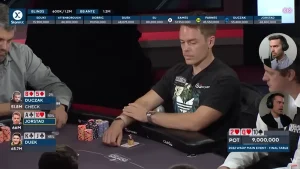
Shortly after, Jorstad faced another interesting situation at the final table. The big blind remained at 1,200,000, and he had 68,400,000 chips. He raised to 2,400,000 from the under-the-gun position at the nine-handed table with A♣10♥.
"I think it's pretty standard," Jorstad said when asked if his raise was a standard opening. "It's definitely close. I would easily fold A-9 and easily open with AJ."
Jorstad said that given he had several similar stacks behind him, including Michael Duek, and that he called from middle position with K♣J♣, there was "a lot of ICM pressure." Aaron Duczak started the hand with 55,400,000 chips and also called from the big blind with 8♦5♦.
The flop came 2♥Q♥10♠, and Duczak missed completely, checking. Jorstad, with almost the same stack as Duek, decided to check his middle pair. However, Duek bet 4,500,000 with a two-top straight draw. His opponent called.
The turn card, 6♠, appeared, but it didn't improve any hand. As Jorstad agreed, both players made the right decision to check. The river card, 3♥, brought a potential flush. Jorstad decided to check again, saying, "I don't think there's much value in blocking a bet." He explained that he felt he could only extract value from small pocket pairs.
Duek missed his draw and, facing an opponent who wasn't showing any aggression, wasn't about to fold a pot that already had 15 big blinds. He bet 7,000,000, a sizing that looked more like a value bet than a bluff. Jorstad then made a bold move, check-raising to 35,000,000. In retrospect, what was Jorstad's perspective on that raise?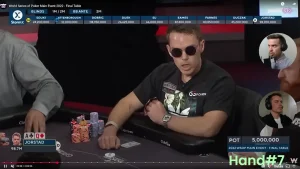
“To be honest, I’m not sure,” he replied. “It’s tempting to just call now because I can see his hand. It’s a situation where I might think the 10 of hearts is actually a better bluffing hand than the Ace of hearts, considering he’ll bet a lot of nut flush draws, and he might be inclined to check with the K-10 of hearts, for example.”
Duek, of course, only had one decision to make: to fold.
Simulations show that the minimum amount should be added.
The next hand was still a nine-handed game, but the situation was slightly different, yet it was another setback for Jorstad on his road to victory. The big blind rose to 2,000,000, and Jorstad held nearly 50 big blinds with 98,750,000 chips.
He held A♣Q♦ on the button, and the pre-flop action folded to him. The blinds were both short-stacked, one with only 12 big blinds and the other with only 6. This was clearly a raise situation, but he faced the question of whether to go all-in or make a standard min-raise. Jorstad chose to raise to 24,000,000, an amount sufficient to cover both blinds. He stated that this action was not considered acceptable in GTO because the simulation showed he should have min-raised in this situation.
Despite this, Philippe Souki folded from the small blind with a terrible hand. However, Adrian Attenborough from the big blind called his final 10,000,000 with K♥J♦. Jorstad was ahead, but Attenborough hit a K on the turn and survived. He still only had 11 big blinds at that point, but he later accumulated chips to eventually finish as runner-up, just behind Jorstad.
Want to change Texas Holdem from "can understand" to "can win"?
If you want to learn more about Texas Hold'em, you can continue reading:
The Origins of Texas Hold'em: Why is it the World's Most Popular Poker Variant?
Texas Hold'em Hand Rankings and Showdown Rules (Beginner’s Essentials)
Texas Hold'em Betting teaching: Check / Bet / Call /Raise and Betting Strategy Analysis
The importance of Texas Hold'em position? Why is the back position more advantageous?
How to play Texas Hold'em? Novices learn Texas Hold'em rules, processes and betting teaching in 10 minutes
Texas Hold'em Starting Hands Strategy Guide: Which Hands to Play?
Texas Holdem Starting Hands Chart Tutorial: Complete Starting Hand Chart and Position Strategy
How to play Texas Hold'em? Complete rules and a hand's flow (Preflop / Flop / Turn / River)
Hunter Poker offers comprehensive tutorials, hand analysis, and strategy sharing to help players upgrade from simply "reading the cards" to understanding the range . This allows you to make better decisions in every hand.
▶️ In Facebook Follow Hunter Poker.
📘 In Youtube Follow Hunter Poker.
Want to learn more about Texas Hold'em gameplay and strategies?
Online Texas Hold'em free tournaments typically have no entry fee, making them ideal for beginners to familiarize themselves with the rules and for advanced players to test strategies and gain experience. View full brand profiles to learn about each platform's free tournament schedule, features, and target audience.
Further News Reading
International news
APT Jeju Station | Scott Margereson wins High Roller title, Hongsheng Zhang achieves career-best third place.
International news
Love from Paris: French warriors win hard-fought victory in Marrakech
International news
Nine cards flopped to determine the RGPS Lake Erie Main Event champion
International news