




International news
2026 WSOP Main Event champion Lucas Jumalon's $10 million prize money will net him approximately $6 million after taxes. This article provides a detailed analysis of the tax burden and actual prize money for the nine finalists.
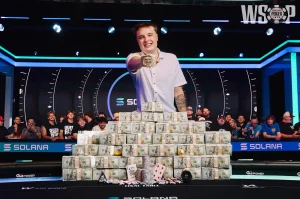 2026 WSOP Main Event champion Lucas Jumalon's $10 million prize money will net him approximately $6 million after taxes. This article provides a detailed analysis of the tax burden and actual prize money for the nine finalists.
Lucas Jumalon won the 2026 WSOP Main Event but didn't actually take home $10 million, while Jamie Shaevel instantly lost more than half of his final table winnings.
No, Shaevel didn't lose his money at the Citibank dice table. He lives in California—the state with the highest state income tax in the US. As for the champion, the IRS also took a large slice of his winnings.
Russell Fox, a federal tax expert at Clayton Financial and Tax in Las Vegas, writes his annual WSOP Main Event final table tax blog post. Each year, he reveals how much of the prize money each participant actually takes home after paying local, state, and federal taxes. Note that these payouts do not include payments to sponsors.
As Fox explained, Shaevel will only pay slightly more than 10% ($157,127) in taxes to his state of residence for his seventh-place $1,500,000 prize. He will also have to pay $598,373 to the IRS, bringing his total tax burden to 50.37%, the highest of the final table.
Canadian athletes have the most advantage
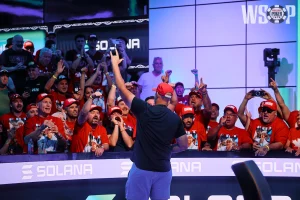
In terms of taxation, the two Canadian players at the final table—Rami Hammoud and Greg "FBT" Mueller—performed the best. Mueller, with an enthusiastic support group of family and friends at the final table, ultimately finished third and won $3,750,000.
On the surface, the gap between third and second place appears quite significant—runner-up Lauri Saaskilahti earned $6,000,000, a difference of $2,250,000. However, after deducting expected taxes, Saaskilahti will ultimately only earn about $600,000 more than the competitor who finished just one place behind.
As Fox wrote, Saaskilahti is a Finnish poker player residing in Spain. Under the US-Spain tax treaty (which prevents double taxation), he is exempt from paying any US income tax. However, he still owes approximately $2,773,000 to the Spanish tax authority, Egencia Tributaria.
On the other hand, Mueller is reportedly a semi-retired poker player, which presents a significant tax difference compared to active professionals. Given his apparent professional status, "FBT" is expected to pay approximately 30% in winnings to the IRS, ultimately receiving $2,628,000 out of a total of $3,750,000.
Another Canadian player, Hammoud, finished sixth and won $1,750,000. He is an amateur poker player from Montreal who works as an analytics manager and is exempt from Canadian income tax. However, he still needs to pay approximately $522,000 to the IRS, roughly 30% of his WSOP winnings.
How much did the poker champion actually win?

Jumalon, a 22-year-old player from Washington state, paid the most taxes, which was expected given his highest prize money. However, according to Fox's calculations, his tax rate of 39.91% is only mid-range for a final table player.
The newly crowned world champion will pay a total of $3,990,826 in federal and self-employment taxes, netting $6,009,174 before paying any sponsors. Jumalon is the second youngest champion in WSOP Main Event history and the first from Washington state. He aspires to become a poker ambassador, so this may not be his last time paying millions of dollars to the IRS.
New Jersey resident and professional poker player Michael Gagliano faces a similar tax bill to Shaevel. The fourth-place finisher, who won $2,750,000, will have to pay federal, self-employment, and state income taxes totaling $1,330,683, or 48.391 TP3T of his winnings—the second-highest total at the final table.
Of the $30,250,000 in prize money won by the nine finalists, $12,273,963 is expected to be used for tax purposes.
2026 WSOP Main Event Final Table After-Tax Prize Money
| Ranking | player | Pre-tax bonus | tax rate | Withholding tax | Net income after tax |
|---|---|---|---|---|---|
| 1 | Lucas Jumalon | $10,000,000 | 39.91% | $3,990,826 | $6,009,174 |
| 2 | Lauri Saaskilahti | $6,000,000 | 46.22% | $2,773,000 | $3,227,000 |
| 3 | Greg Mueller | $3,750,000 | 29.92% | $1,122,000 | $2,628,000 |
| 4 | Michael Gagliano | $2,750,000 | 48.39% | $1,330,683 | $1,419,317 |
| 5 | Han Feng | $2,250,000 | 39.54% | $889,753 | $1,360,247 |
| 6 | Rami Hammoud | $1,750,000 | 29.83% | $522,000 | $1,228,000 |
| 7 | Jamie Shaevel | $1,500,000 | 50.37% | $755,500 | $744,500 |
| 8 | Mario Boos | $1,250,000 | 43.50% | $543,701 | $706,299 |
| 9 | Evagoras Evagorou | $1,000,000 | 34.65% | $346,500 | $653,500 |
| total | $30,250,000 | 40.58% | $12,273,963 | $17,976,037 |
Want to change Texas Holdem from "can understand" to "can win"?
If you want to learn more about Texas Hold'em, you can continue reading:
The Origins of Texas Hold'em: Why is it the World's Most Popular Poker Variant?
Texas Hold'em Hand Rankings and Showdown Rules (Beginner’s Essentials)
Texas Hold'em Betting teaching: Check / Bet / Call /Raise and Betting Strategy Analysis
The importance of Texas Hold'em position? Why is the back position more advantageous?
How to play Texas Hold'em? Novices learn Texas Hold'em rules, processes and betting teaching in 10 minutes
Texas Hold'em Starting Hands Strategy Guide: Which Hands to Play?
Texas Holdem Starting Hands Chart Tutorial: Complete Starting Hand Chart and Position Strategy
How to play Texas Hold'em? Complete rules and a hand's flow (Preflop / Flop / Turn / River)
Hunter Poker offers comprehensive tutorials, hand analysis, and strategy sharing to help players upgrade from simply "reading the cards" to understanding the range . This allows you to make better decisions in every hand.
▶️ In Facebook Follow Hunter Poker.
📘 In Youtube Follow Hunter Poker.
Want to learn more about Texas Hold'em gameplay and strategies?
Online Texas Hold'em free tournaments typically have no entry fee, making them ideal for beginners to familiarize themselves with the rules and for advanced players to test strategies and gain experience. View full brand profiles to learn about each platform's free tournament schedule, features, and target audience.
Further News Reading
International news
All roads lead to London GUKPT Grand Finals: £1.2 million guaranteed prize money
International news
PokerStars on FanDuel bucks the trend and grows, while the US online poker market stagnates.
International news
The youngest South African gold bracelet winner wins the APC Main Event.
International news