




River Blocker Strategy It is one of the most crucial advanced concepts in River's decision-making process.
Many players, when they arrive at River, only look at whether their hand is strong enough, but ignore whether their hand is "blocking" their opponent's strong hands or bluffs.
When you truly understand Blocker, your calling, raising, and folding decisions in River will no longer be based solely on intuition, but rather on more accurate range deduction.
→ Is my hand strong enough to call?
→ Does this bet from the opponent indicate that they are very strong?
Key takeaway: River Blocker Strategy = Rethinking Calling, Raising, and Folding with Blocking Hands
River is not just about hand strength, but the ultimate showdown of range and number of combinations:
1. Which value cards did you block from your opponent?
2. Which bluffs did you block?
3. Is your hand better suited to calling, raising, or folding?
Truly sophisticated River decisions are not just about what cards you have, but about what changes those cards can bring.
Hand situation review
1. You hold A♠ J♠ in BTN.
2. The opponent is defending at BB.
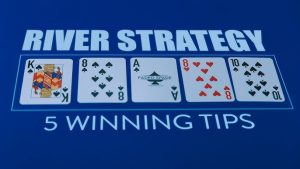
3. The hand lands on River: K♠ 10♣ 4♠ / 7♦ / 2♠
4. The opponent made a large bet on River.
At this point, the question isn't just "Should I call if I have a flush?", but rather:
→ A♠ J♠ What obstacles did this hand pose to the opponent's value range and bluff range?
Misconception: Focusing only on your own hand strength, ignoring the Blockers.
Many players might think:
→ I have a flush, so I shouldn't be weak.
→ They have a large number of subordinates, so they must be very strong.
→ Decide whether to follow based on your feelings
This kind of thinking is too superficial, because the key to River is often not how good your hand is, but which combinations it blocks.
Correct thinking: First, see what you are blocking.
When you hold A♠ J♠, it means:
→ You blocked some of your opponent's strongest flushes.
→ You also blocked some spade draws that could have been used for bluffing.
→ Your hand isn't just a "flush," it's a key hand that can change the composition of your opponent's River Range.
The value of a blocker lies not in its literal definition, but in how it alters the number of combinations an opponent can possess.
River Follow-up Decision Analysis
When your opponent makes a large bet, you need to break it down:
→ What are his value bets?
→ What are his bluffs?
→ Is your hand more suited to blocking value or blocking bluffs?
If your hand:
→ Block many of the opponent's valuable cards
→ No obvious way to stop the opponent's bluffing
This hand is more suitable as a call candidate.
River Betting Decision Analysis
In certain river spots, Blocker can even allow you to raise:
→ You block your opponent's most natural call/3-bet value range
→ You don't have a medium-strength hand that your opponent is likely to fold to.
→ Your image and approach can reasonably represent a strong brand.
Not every blocker is worth using for a bluff raise, but a good blocker can make a River raise more convincing.
River Folding Decision Analysis
Some hands may look good, but they can be terrible bluff-catchers, and the reason is:
→ You blocked your opponent's most likely bluff.
→ You didn't block your opponent's value cards.
→ Your hand has showdown value, but the EV of calling is very low.
In River, the best option for this type of hand is often not to call, but to fold decisively.
Blocker's three core applications in River
1. Choose a better bluff-catcher
→ Prioritize calling with hands that block value and block bluffs less.
2. Choose a better bluff-raise combination.
→ Apply pressure with hands that can weaken the opponent's strong hand combinations.
3. Avoid incorrect hero calls
→ A seemingly good hand should be folded if it blocks too many bluffs.
Why do most players make mistakes when judging River?
Because of them:
→ Only look at your absolute hand strength
→ No changes in the number of opponent combinations were calculated.
→ Ignore the impact of Blocker on value and bluff distribution
→ River is easily swayed by betting size and emotions.
River Street is the one that tests the most detailed reasoning, and Blocker is the most often underestimated decision-making tool here.
Advanced concept: Blockers are not a panacea, but they can significantly improve accuracy.
True masters don't treat Blocker as the only answer, but rather incorporate it into their overall decision-making framework:
→ Betting route on the street ahead
→ Opponent's range structure
→ River's betting size
→ The impact of one's own hand on the number of combinations
Blocker isn't about guessing; it's about helping you make higher EV choices in the River spot near the edge.
How to effectively use the River Blocker Strategy in practice?
→ Don't just look at your own hand strength, you also need to look at what you've blocked.
→ Practice analyzing the opponent's River's value range and bluff range
→ When following the boundary, prioritize bluff catchers with better blockers.
→ When considering a River bluff raise, first confirm whether you are truly blocking a key value combination.
Core Decision Conclusions
The key to River isn't just what cards you get, but which cards your opponents lose with your hand.
When you truly understand Blocker, every call, raise, and fold you make on River will be more logical and closer to long-term profitability than the average player.
Advanced Thinking Review: From "Knowing How to Play Cards" to "Making the Right Decisions"
When you stop just looking at your own hand, what truly sets you apart is how well you understand Range, EV, Blocker, position, and overall betting strategy.
The following advanced thinking methods are key to most players' progress from "occasionally getting it right" to "long-term stable profitability":
[Range Thinking] How to truly apply Range thinking in actual gameplay? Hand review and analysis.
[River Decision Making] How does the Blocker influence River's calling, raising, and folding? Strategy Breakdown
[Result Bias] EV vs Result: Why did we still lose even when we bet correctly? Retrospective Analysis
[Bluff Core] What constitutes proper Bluff? Hand replay analysis
[Semi-Bluff Timing] When is the most profitable time to use a semi-bluff? Strategy Analysis
[Bet Line] How to construct a complete betting line? Practical analysis and review.
[Position Advantage] Why does position directly influence your every decision? Hand Analysis
[SPR Application] How does SPR affect your playing style and pot planning? Strategy Analysis
[Vulnerability Analysis] How to identify vulnerabilities in an opponent's Range vulnerability? Post-mortem analysis and breakdown.
[Marginal Hands Problem] Why do expert players rarely play marginal hands? Decision Analysis
【Lập kế hoạch ba vòng cược】Làm sao thiết kế chiến thuật cho flop, turn và river? Phân tích thực chiến trong poker
[Fold Equity Pressure] How to Create Fold Equity? Hand Replay Analysis
[Area Contraction] How to analyze the process of the opponent's area being compressed? Strategy breakdown
[Strategy Selection] Balance vs. Exploit: Which to Choose in Practice? Retrospective Analysis
[Long-Term Profitability] How to Train a Long-Term EV Mindset? Decision Model Analysis
The biggest difference between advanced players and casual players isn't remembering more terminology, but rather the ability to integrate range, EV, position, blocking cards, and betting lines in every decision. Through these advanced thought processes, you can gradually build a more complete Texas Hold'em decision-making framework.