




International news
Cherish Andrews US Poker Open Victory: After a slump, Andrews made a strong comeback, defeating Adam Hendrix to win the 2026 USPO $5,000 NLH event, taking home the $117,407 and PGT championship titles.
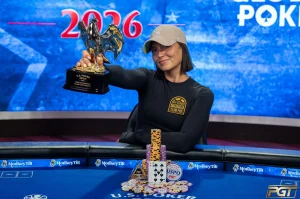 Cherish Andrews won the 2026 USPO $5,000 NLH event, earning $117,407 in prize money.
A decision made on the verge of a slump: almost missing the road to the championship
Cherish Andrews staged a dramatic comeback in the 2026 US Poker Open (USPO) Event #3:$5,000 No-Limit Hold'em (NLH). Surprisingly, she had initially planned to withdraw from the tournament.
Due to a recent severe downswing, Andrews even told friends that she might "temporarily retire" and no longer participate in the competition. However, she ultimately chose to appear on the field, and this decision completely changed the outcome.
High-intensity competition: a top-tier tournament with 115 players.
This event was the final $5,000 buy-in tournament of this year's USPO, attracting 115 players and generating a total prize pool of $575,000, making it one of the most anticipated events in the series.
The final table boasted a star-studded lineup, including Day 1 chip leader Sam Laskowitz, popular poker vlogger Ethan “Rampage” Yau, and several strong players such as Michael Berk and Adam Hendrix. Andrews demonstrated exceptional stability and resilience under such pressure.
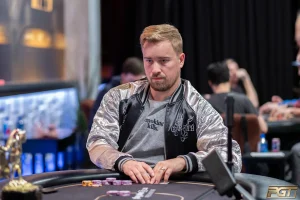
Key moments in the final table: From disadvantage to comeback
During the competition, Michael Berk had a run of bad luck, losing several crucial matches and ultimately finishing in sixth place. "Rampage" Yau also failed to maintain his good fortune from the previous day, being eliminated in his match against Andrews.
As the competition entered the three-person stage, Andrews, Adam Hendrix, and Yifu He engaged in fierce competition. He ultimately finished in third place, while Andrews and Hendrix went on to face off in a one-on-one duel.
Before the Heads-up began, both players reached an ICM agreement, locking in the main prize and continuing their battle for the championship and additional prizes. Although Hendrix initially held a chip advantage, Andrews gradually stabilized his pace and successfully overtook Hendrix.
Decisive Moment: A Key Move Secures Victory
In the final crucial hand of the tournament, Hendrix held pocket eights against Andrews' pocket nines. This hand proved to be the turning point, as Hendrix was unable to turn the tide, and Andrews secured the championship.
She ultimately won $117,407 in prize money, and also secured her second PokerGO Tour (PGT) title.
Champion's words: Perseverance is the key
After the tournament, Andrews said, "Poker is really difficult, but you have to keep showing up." She emphasized that her willingness to continue playing during a slump was key to her success.
She also thanked her partner Brock Wilson and family and friends for their support. It's worth noting that Wilson had predicted she would win again a few days earlier, a prediction that quickly came true.
The best example of going from the bottom to the top
Cherish Andrews' victory is not just a championship story, but also a case study of perseverance and resilience. In the highly unpredictable and high-pressure world of poker, short-term results do not determine everything.
She proved with her performance that as long as you continue to participate and maintain confidence, every time you sit down at the table, there is a chance for a turning point.
Advanced Thinking Review: From "Knowing How to Play Cards" to "Making the Right Decisions"
When you stop just looking at your own hand, what truly sets you apart is how well you understand Range, EV, Blocker, position, and overall betting strategy.
The following advanced thinking methods are key to most players' progress from "occasionally getting it right" to "long-term stable profitability":
[Range Thinking] How to truly apply Range thinking in actual gameplay? Hand review and analysis.
[River Decision Making] How does the Blocker influence River's calling, raising, and folding? Strategy Breakdown
[Result Bias] EV vs Result: Why did we still lose even when we bet correctly? Retrospective Analysis
[Bluff Core] What constitutes proper Bluff? Hand replay analysis
[Semi-Bluff Timing] When is the most profitable time to use a semi-bluff? Strategy Analysis
[Bet Line] How to construct a complete betting line? Practical analysis and review.
[Position Advantage] Why does position directly influence your every decision? Hand Analysis
[SPR Application] How does SPR affect your playing style and pot planning? Strategy Analysis
[Vulnerability Analysis] How to identify vulnerabilities in an opponent's Range vulnerability? Post-mortem analysis and breakdown.
[Marginal Hands Problem] Why do expert players rarely play marginal hands? Decision Analysis
【Lập kế hoạch ba vòng cược】Làm sao thiết kế chiến thuật cho flop, turn và river? Phân tích thực chiến trong poker
[Fold Equity Pressure] How to Create Fold Equity? Hand Replay Analysis
[Area Contraction] How to analyze the process of the opponent's area being compressed? Strategy breakdown
[Strategy Selection] Balance vs. Exploit: Which to Choose in Practice? Retrospective Analysis
[Long-Term Profitability] How to Train a Long-Term EV Mindset? Decision Model Analysis
The biggest difference between advanced players and casual players isn't remembering more terminology, but rather the ability to integrate range, EV, position, blocking cards, and betting lines in every decision. Through these advanced thought processes, you can gradually build a more complete Texas Hold'em decision-making framework.
Further News Reading
International news
APT Jeju Station | Scott Margereson wins High Roller title, Hongsheng Zhang achieves career-best third place.
International news
Love from Paris: French warriors win hard-fought victory in Marrakech
International news
Nine cards flopped to determine the RGPS Lake Erie Main Event champion
International news