

International news
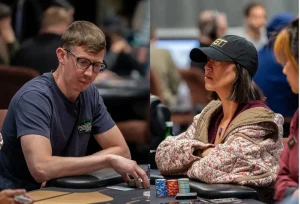
Cherish Andrews and Brock Wilson, the poker couple, have achieved consecutive successes at the U.S. Poker Open, both making it into the money in the #4 and #5 events, dominating the Las Vegas series.
Final table chip count for Tournament #5
"Defeat it just like that."
A poker couple is completely dominating the 2026 U.S. Poker Open (USPO) in Las Vegas. While Kristen Foxen won the #4:$10,000 No-Limit Hold'em event on Wednesday, the couple dominating the series isn't her and Alex Foxen. No, the couple controlling the series is... Cherish Andrews with Brock WilsonBoth of them have won tournaments and made it to the deep rounds in Event #4, and then went on to cash in Wednesday's Event #5: $10,000 No-Limit Hold'em.
Wilson, last month's PokerGO Cup champion, finished fourth in Event #4, earning $66,000, and then finished ninth in Event #5, earning $24,000. Meanwhile, Andrews finished eighth in Event #4, earning $26,400, and advanced in Event #5 with a short stack, continuing to turn her "huge and sad downswing" into the most successful month of her career.
The current series leaderboard shows Wilson and Andrews in second and third place respectively, behind Jeremy Ausmus, who has already secured two runner-up finishes. However, once the points from the #5 tournament are included, the leaderboard will certainly be reshuffled again.
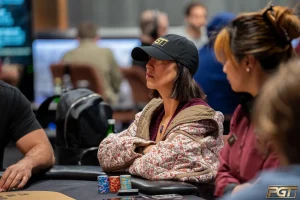
The final table now has six players remaining, including Qinghai Pan, who has been performing well in the PokerGO Cup recently; Justin Zaki, a professional player who has been competing for many years; and Brandon Wilson, who switched from rap to poker – the latter finished the day as the chip leader.
Final table chip count for Tournament #5
| Ranking | player | country | Chip Count | Big Blind |
|---|---|---|---|---|
| 1 | Brandon Wilson | United States | 3,585,000 | 72 |
| 2 | Qinghai Pan | United States | 2,175,000 | 44 |
| 3 | Justin Zaki | United States | 1,585,000 | 32 |
| 4 | Peter Placey | United States | 1,375,000 | 28 |
| 5 | Anil Jivani | United States | 825,000 | 17 |
| 6 | Cherish Andrews | United States | 455,000 | 9 |
"Defeat it just like that."
The second event in this series, the $10,000 buy-in event, attracted 80 entries, bringing the total prize pool to $800,000.
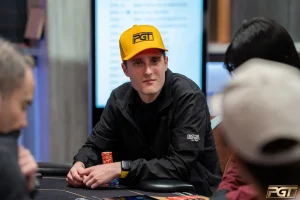
On the first day of the tournament, most of the talk revolved around the side bets between Jeremy Becker, Chino Rheem, Justin Zaki, and the Foxen couple.
"It's you and me, Krissy!" Becker shouted excitedly as he pushed Zaki to the brink of elimination. But it was clearly too early to celebrate—his opponent, holding pocket aces, successfully doubled up his chips and remained competitive in tournaments and side bets.
Becker, who wore what Andrews described as "Michael Jackson pants," may have brought bad luck to himself and Foxen. Foxen was eliminated just a few places away from the money, while Becker was subsequently eliminated in 11th place, leaving Zaki to enjoy the side betting prize alone.
Another highlight of the day occurred during the money bubble. Jesse Lonis accurately predicted Anil Jivani's hand and even generously shared his thought process at the table, providing a free poker lesson for the audience.
"So you're the gorilla," Jivani said to him.
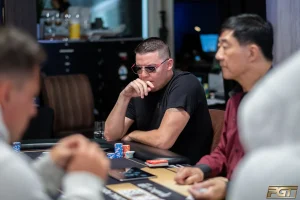
The number 8 may have become Nick Schulman's latest "most hated number." The poker Hall of Famer finished eighth in the final table bubble, his Q beaten by Zaki's pocket eights—and the first card on the flop was an 8.
After that, Lonis lost two more coin tosses, leaving him with very few chips, and was eventually eliminated in his final showdown with Zaki.
Day 2 of the tournament will begin at 11:45 AM local time, starting from Level 19 with blinds of 30,000/60,000/60,000. The tournament will be streamed live on PokerGO, with a one-hour delay between the broadcast and PokerNews' live text coverage.
Specific Scenario Retrospective: Key Decisions in Different Situations
Certain scenarios can drastically alter decision-making logic, such as tournament pressure, chip depth, positional structure, range matchups, and betting patterns.
When you enter different situations, the correct approach isn't just about looking at your hand, but about understanding the overall context. The following specific scenarios and core themes are key to influencing wins and losses and long-term profitability:
I. Special Scenarios in the Championship
[ICM Pressure] How to make decisions in the ICM tournament scenario?
[Bubble Phase] Should we be aggressive or conservative during the Bubble phase?
[Final Table] How should key moves be handled?
[Short Code Strategy] How should Short Stack be typed?
[Deep Stack Strategy] What are the differences in how Deep Stack is played?
[Blind Stealing Strategy] How to consistently steal blinds in tournaments?
【Stealing Blinds vs. Counter-Stealing Blinds】Strategies for Countering Blinds in the Bubble Phase
[Middle Chip Dilemma] Why is the middle chip the hardest to beat?
[Pressure Transfer] How to transfer ICM pressure to the opponent?
[Final Table Mindset] How to go from the final table to the championship?
[Chip Management] How to control risk and avoid collapse?
[Complete Tournament Strategy] The entire process from entry to victory
II. Core of the Underlying Strategy
[Position Advantage] How to play in different positions? A complete analysis of BTN / CO / SB / BB
[Range Thinking] Why do expert players look at the range instead of their hand?
[3-bet strategy] When should you raise your bet? How to counter your opponent's opening?
How does bet sizing affect your EV?
[Betting Line] How to design a complete Flop / Turn / River Line?
Fold Equity: How can you win without showing your cards?
III. Practical Decision-Making After the Cards Are Flipped
[C-bet Strategy] When should you continue betting?
[Turn Strategy] Should we fire the second shot?
[River Decision] Should the last street be Value or Bluff?
When should you retaliate?
[Blocker Application] What is a blocking sign? How does it influence decision-making?
[Range Shrinking] How to understand your opponent's range step by step?
IV. Advanced Competition and Professional Mindset
[Exploit Strategy] How to achieve stable profits for different player types?
[GTO vs Exploit] How to choose in actual combat?
[Result Bias] Why do I still lose even when I guess correctly?
[Decision-making process] How do experts make the right decisions quickly?
Why does overconfidence actually lead to more losses?
[Emotional Management] How to avoid Tilt?
How to establish a stable profit-making mindset for long-term EV (Electronic Vehicle) businesses?
V. Common Hand Issues and Practical Problems
[All-in Decision] When should you go all in?
[Missed Card] What should I do if I missed?
[Slow Play Judgment] When should you slow play?
Why do expert players rarely play marginal hands?
[Key Fold] When should you fold?
VI. Basics for Beginners and Traffic Sources
[Starting Hand Strategy] A Complete Guide for Beginners
Texas Hold'em Rules: Complete Gameplay Tutorial (2026 Latest Version)
[Poker Card Rankings] Card Rankings and Comparison Rules
Texas Hold'em Terminology: A Complete Guide from Beginner to Advanced Players
How to win money in Texas Hold'em? A complete analysis of the thought process.
Different scenarios require entirely different decision-making logic. From tournament pressure and chip depth to position, range, and post-flop strategy, each situation demands a different framework for thinking. When you can systematically understand these specific situations, you're no longer just playing by feel, but truly establishing a sustainable and profitable decision-making system.
Further News Reading
International news
Brutal Full House Cooler Decides $10K Poker Masters Champion
International news
Poker player Lynne Ji denies allegations in alleged domestic dispute stabbing case
International news
Adrian Mateos completes an “unwanted hat trick” at the Poker Masters: three consecutive bubble exits
International news