




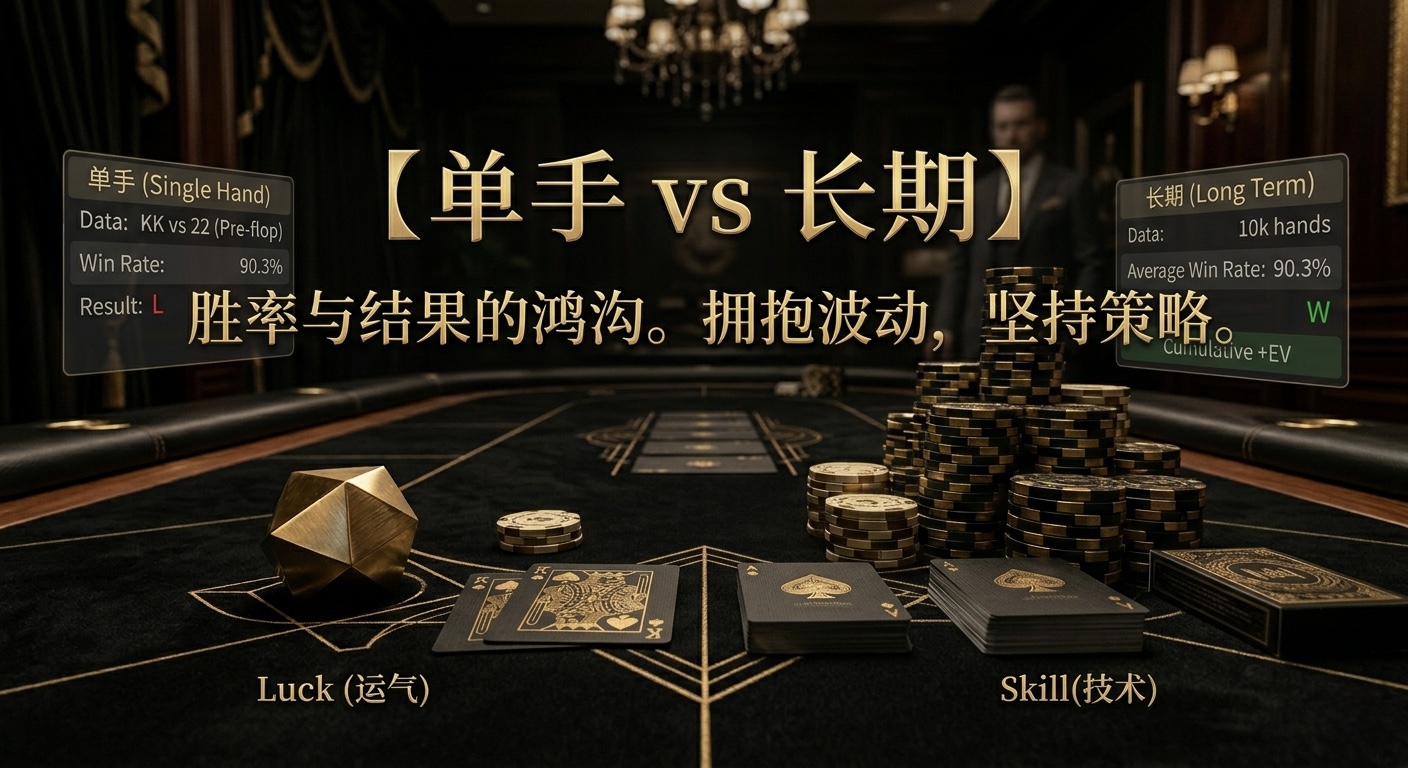
In Texas Hold'em, many players judge skill based on single-hand results, but what truly determines profitability is long-term win rate and EV. Even correct decisions can lead to short-term losses; conversely, incorrect play can result in short-term wins. This article will analyze the differences between single-hand results, variance, and long-term EV to help you develop truly professional-level thinking.

The core of Texas Hold'em isn't luck, but a combination of probability and randomness. Many players misjudge their skill level based on short-term results, but in reality, poker is a highly random, long-term mathematical game. Even with the right decisions, you can still lose due to variance. This article will analyze the relationship between probability, randomness, and EV to help you develop a truly long-term mindset.

Many Texas Hold'em players mistakenly believe that a win rate of 60%, 70%, or even 80% guarantees a win. However, win rate represents a long-term average, not a single result. Variance is an unavoidable part of poker; even correct decisions can lead to short-term losses. This article will delve into the relationship between win rate, variance, and EV to help you develop a true long-term mindset.

Pre-flop all-in is one of the most crucial decisions in Texas Hold'em. Many players misjudge their strategy based on short-term wins and losses, but in reality, every all-in has a fixed win rate. For example, AA against KK is approximately 82%, and AK against QQ is approximately 43%. Understanding these numbers can help you determine which all-ins have a long-term positive EV. This article will summarize common head-to-head win rates and analyze how to apply them in practice.

In Texas Hold'em, many players mistakenly believe that having a strong hand guarantees an advantage. However, in reality, the odds in any two-hand matchup are often not as extreme as they seem. For example, many seemingly strong hands might only have a win rate of around 60% against a random range (%). This article will analyze the concept of random matchups to help you understand average win rate and range thinking, enabling you to make more accurate probability judgments.

A polarized range refers to a betting range primarily composed of the strongest value hands and bluff hands, while medium-strength hands tend to be checked or called. Polarization strategies are widely used in River betting, Overbet, 3-Bet, 4-Bet, and GTO strategies. By polarizing the betting range, it makes it harder for opponents to judge your actual hand strength, while improving the overall strategy's balance. This article will provide a complete overview of the definition of a polarized range, its differences from a linear range, value range, bluff range, blocker, GTO, and practical applications.

A bluff range refers to any combination of hands a player would choose to bet, raise, or go all-in not because they currently have the best hand, but because they hope to profit from their opponents' folds. A truly excellent bluff range is not randomly selected but carefully designed, typically incorporating blocks, draws, or hands with room for improvement, and maintaining balance with the value range to avoid being read by opponents. This article will provide a comprehensive overview of the definition of a bluff range, its differences from a value range, the application of Fold Equity, Polarized Range, GTO, and Exploit, and how professional players build high-quality bluffing strategies.

A value range refers to all strong hand combinations that a player is willing to bet, raise, or go all-in with, and hopes will be called by their opponents. Unlike a bluff range, the core purpose of a value range is to extract value from weaker hands, not to force opponents to fold. Establishing a sound value range is a crucial foundation for value bets, 3-bets, 4-bets, and river betting decisions. This article will provide a comprehensive overview of the definition of a value range, its differences from a bluff range, linear and polarized structures, and the application of GTOs and exploits.
A 3-Bet Range refers to any starting hand a player uses to 3-bet when facing an Open Raise. A complete 3-Bet Range includes not only strong hands like AA and KK, but also hands like A5s and KTs used as bluffs. Professional players constantly adjust their 3-Bet Ranges based on position, opponent's opening range, effective stack, player type, and GTO strategy. This article will provide a comprehensive introduction to 3-Bet Range, Value Range, Bluff Range, Linear Range, Polarized Range, and their practical applications.
A calling range refers to the combination of hands a player chooses to call when faced with a bet or raise from an opponent. A good calling range requires not only strong hands but also consideration of position, pot odds, effective stack, opponent range, and post-flop operability. Establishing a reasonable calling range can avoid over-calling or under-calling, improving long-term profitability. This article will fully introduce the definition of a calling range, the differences between pre-flop and post-flop, GTO and Exploit strategies, and how professional players establish optimal calling ranges.