



International news
Rampage Ethan Yau staged two crucial comebacks at US Poker Open 2026, defeating his opponent with a lucky flop to advance to the final table and compete for the $143,750 first prize.
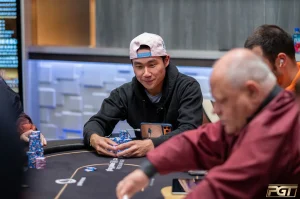 Ethan “Rampage” Yau made two consecutive comebacks to advance to the final table in the 2026 US Poker Open.
Rampage Ethan Yau's Luck Explodes: Dramatic Reversal at US Poker Open 2026
In the 2026 US Poker Open in Las Vegas, popular poker vlogger Ethan “Rampage” Yau He once again became the focus of attention. In Day 1 of Event #3:$5,000 No-Limit Hold'em (NLH), he successfully accumulated chips with two dramatic "suckouts" and ultimately advanced to the final stage as a leader.
This tournament attracted 115 participants, with a total prize pool of $575,000, and the champion will receive $143,750. With Day 1 completed, only 6 players remain to advance, making the competition extremely fierce.
Final table chip count overview
The current chip distribution is as follows:
- Sam Laskowitz – 3,750,000 (47BB)
- Ethan Yau – 3,500,000 (44BB)
- Adam Hendrix – 3,150,000 (39BB)
- Cherish Andrews – 2,025,000 (25BB)
- Yifu He – 1,025,000 (13BB)
- Michael Berk – 925,000 (12BB)
Yau, with a late surge, successfully rose to become the second-largest chip stack, making him one of the favorites to win the championship.
Key Moments: Two Miracles Changed His Fate
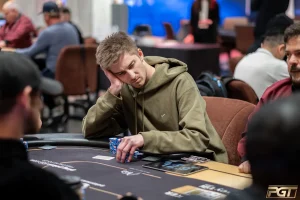
Ethan Yau's journey to the finals in this match was nothing short of dramatic. He was eliminated early on, but his luck turned around after returning to the field, leading to a series of crucial comebacks.
First key doubling
As Yau approached the money, he went all-in with pocket Jacks (JJ), only to be met by Michael Berk's pocket Aces (AA). Statistically, he had almost no chance of winning, but a Jack appeared on the flop, allowing him to complete a set and successfully turn the tide, narrowly escaping defeat and doubling up.
This hand became the first turning point of the entire game.
Second fatal blow
In the final hand of the day, Yau faced Berk head-on once again:
- Yau:AQ
- Berk: AK
Yau missed both the flop and turn, seemingly sealing his fate. However, a miraculous Queen landed on the river, turning the tide once again.
Yau excitedly shouted "WHEW!" on the spot, while Berk had no choice but to leave, becoming one of the biggest victims.
Not just Yau: Luck also smiled on other players.
Besides Yau, professional players Alex Foxen He also had incredible luck during the game, hitting key outs multiple times to win big pots.
It's worth mentioning that Foxen and Landon Tice discussed topics about faith and life that day, even having philosophical conversations such as "love can accomplish everything," adding a lot of fun to the game.
The emergence and advancement of money circles
The bubble burst when Jesse Kertland's KQ was defeated by his opponent's AQ, leaving him out of the prize money. Other players who made it into the money include:
- Justin Saliba
- Jim Collopy
- Dylan Linde
With Day 2 underway, the remaining players will compete for the ultimate championship and a large prize pool.
Conclusion: Luck or skill?
Ethan Yau humorously remarked after the match, "Sometimes, luck is more fun than skill."
In the unpredictable world of poker, skill is certainly important, but luck at crucial moments often determines success or failure. Yau's two consecutive "miracle flops" not only changed his own fate but also made the competition even more talked about.
Whether he can maintain this momentum and win the championship in the upcoming final table match will be a major highlight of this year's US Poker Open.
Advanced Thinking Review: From "Knowing How to Play Cards" to "Making the Right Decisions"
When you stop just looking at your own hand, what truly sets you apart is how well you understand Range, EV, Blocker, position, and overall betting strategy.
The following advanced thinking methods are key to most players' progress from "occasionally getting it right" to "long-term stable profitability":
[Range Thinking] How to truly apply Range thinking in actual gameplay? Hand review and analysis.
[River Decision Making] How does the Blocker influence River's calling, raising, and folding? Strategy Breakdown
[Result Bias] EV vs Result: Why did we still lose even when we bet correctly? Retrospective Analysis
[Bluff Core] What constitutes proper Bluff? Hand replay analysis
[Semi-Bluff Timing] When is the most profitable time to use a semi-bluff? Strategy Analysis
[Bet Line] How to construct a complete betting line? Practical analysis and review.
[Position Advantage] Why does position directly influence your every decision? Hand Analysis
[SPR Application] How does SPR affect your playing style and pot planning? Strategy Analysis
[Vulnerability Analysis] How to identify vulnerabilities in an opponent's Range vulnerability? Post-mortem analysis and breakdown.
[Marginal Hands Problem] Why do expert players rarely play marginal hands? Decision Analysis
【Lập kế hoạch ba vòng cược】Làm sao thiết kế chiến thuật cho flop, turn và river? Phân tích thực chiến trong poker
[Fold Equity Pressure] How to Create Fold Equity? Hand Replay Analysis
[Area Contraction] How to analyze the process of the opponent's area being compressed? Strategy breakdown
[Strategy Selection] Balance vs. Exploit: Which to Choose in Practice? Retrospective Analysis
[Long-Term Profitability] How to Train a Long-Term EV Mindset? Decision Model Analysis
The biggest difference between advanced players and casual players isn't remembering more terminology, but rather the ability to integrate range, EV, position, blocking cards, and betting lines in every decision. Through these advanced thought processes, you can gradually build a more complete Texas Hold'em decision-making framework.
Further News Reading
International news
Nick Schulman夺得第九条WSOP金手链后发声:我从未想过自己能走到今天
International news
From cryptocurrency liquidation to a deep run at the WSOP! How did a 22-year-old trader turn his life around into a poker winner?
International news
Eelis Pärssinen wins his second WSOP title and his third gold bracelet, becoming the first Finnish player to achieve this feat.
International news