




International news
RGPS Cody Hughey staged a stunning comeback in the Downstream Casino Main Event, winning $67,940 and his first RGPS ring, making him a poker star of 2026.
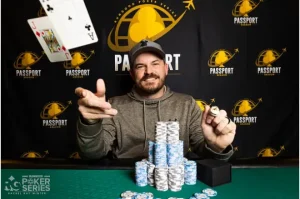 Cody Hughey staged a comeback to win the 2026 RGPS Downstream Casino Main Event.
RGPS Cody Hughey's comeback victory: A classic battle from short yards to champion.
In the 2026 RunGood Poker Series (RGPS) Passport $600 Main Event,Cody HugheyHe staged an impressive comeback to win the championship at Downstream Casino Resort, taking home $67,940 and his first RGPS gold ring.
The tournament was intense from Day 2 onwards, with 87 players returning to compete for the championship. Hughey entered the final day as the overall chip leader, becoming the focus of attention. After nearly 14 hours of fierce competition, he successfully maintained his advantage, completing a thrilling journey from lead to victory.
Final table prize money distribution
The final rankings for this main event are as follows:
- 1️⃣ Cody Hughey (USA) — $67,940
- 2️⃣ William Romine (USA) — $45,236
- 3️⃣ Kyle McConnell (USA) — $33,347
- 4️⃣ William Margo (USA) — $24,857
- 5️⃣ Jeff Copeland (USA) — $18,738
- 6️⃣ Bobby Sanoubane (USA) — $14,286
- 7️⃣ Brandon Elmore (USA) — $11,017
- 8️⃣ Rodney Spriggs (USA) — $8,596
- 9️⃣ Benjamin Rohrs (USA) — $6,785
Key Turning Point: Patience Leads to Championship
Despite entering Day 2 as the chip leader, Hughey's path to victory was not without its challenges. Midway through the tournament, his chip stack plummeted from 3 million to 1.5 million, and he even started the final table in eighth place, facing a precarious situation.
Entering the final four, he was still trailing, far behind the chip leader, William Romine. However, the game took a crucial turn in the three-player stage:
- Successfully doubled Kyle McConnell's investment.
- They then defeated Romine again to gain a chip advantage.
- Consistent performance in multiple key matches
Hughey said after the game, "I just stayed patient because in poker, the situation can turn around at any time."
This stable mindset became the core factor in his successful comeback.
Key Moment: Double Up Wins in Successive Attempts to Secure Victory
In the three-way battle, Hughey gradually found his rhythm, accumulating chips through several key pots and doubling-up opportunities. One of his all-in victories against McConnell is considered the turning point of the entire match.
He then continued to extend his lead and finally defeated Romine in a one-on-one duel to officially win the championship.
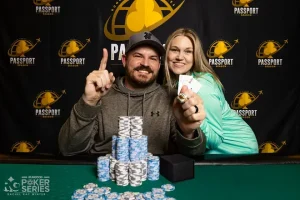
Behind-the-scenes support: Wife witnessed the championship moment
Another touching detail of the match was the presence of Hughey's wife, Brandy, who was there to support him throughout. For her, unfamiliar with the high volatility of poker, the entire match was filled with pressure and tension.
Hughey said, "This is normal for me, but it's a completely different world for her. It was really special to have her there to witness this moment."
A crucial battle between RGPS and local poker culture
Cody Hughey is not only a professional player, but also an important figure in the Tulsa poker scene. He previously held a management position at Hard Rock Tulsa and has been involved in the development of local poker for a long time.
This victory is not only a personal achievement, but also symbolizes the continued expansion of RGPS's influence in the local poker community.
Conclusion: The perfect combination of patience and opportunity
This victory proves once again that skill and mentality are equally important in the world of poker. Hughey patiently waited for his opportunity and ultimately completed the comeback, achieving a significant milestone in his career.
In the future, he is likely to become a regular on RGPS and even a larger stage.
Advanced Thinking Review: From "Knowing How to Play Cards" to "Making the Right Decisions"
When you stop just looking at your own hand, what truly sets you apart is how well you understand Range, EV, Blocker, position, and overall betting strategy.
The following advanced thinking methods are key to most players' progress from "occasionally getting it right" to "long-term stable profitability":
[Range Thinking] How to truly apply Range thinking in actual gameplay? Hand review and analysis.
[River Decision Making] How does the Blocker influence River's calling, raising, and folding? Strategy Breakdown
[Result Bias] EV vs Result: Why did we still lose even when we bet correctly? Retrospective Analysis
[Bluff Core] What constitutes proper Bluff? Hand replay analysis
[Semi-Bluff Timing] When is the most profitable time to use a semi-bluff? Strategy Analysis
[Bet Line] How to construct a complete betting line? Practical analysis and review.
[Position Advantage] Why does position directly influence your every decision? Hand Analysis
[SPR Application] How does SPR affect your playing style and pot planning? Strategy Analysis
[Vulnerability Analysis] How to identify vulnerabilities in an opponent's Range vulnerability? Post-mortem analysis and breakdown.
[Marginal Hands Problem] Why do expert players rarely play marginal hands? Decision Analysis
【Lập kế hoạch ba vòng cược】Làm sao thiết kế chiến thuật cho flop, turn và river? Phân tích thực chiến trong poker
[Fold Equity Pressure] How to Create Fold Equity? Hand Replay Analysis
[Area Contraction] How to analyze the process of the opponent's area being compressed? Strategy breakdown
[Strategy Selection] Balance vs. Exploit: Which to Choose in Practice? Retrospective Analysis
[Long-Term Profitability] How to Train a Long-Term EV Mindset? Decision Model Analysis
The biggest difference between advanced players and casual players isn't remembering more terminology, but rather the ability to integrate range, EV, position, blocking cards, and betting lines in every decision. Through these advanced thought processes, you can gradually build a more complete Texas Hold'em decision-making framework.
Further News Reading
International news
Nick Schulman, after winning his ninth WSOP gold bracelet, said: "I never thought I would get to this point."
International news
From cryptocurrency liquidation to a deep run at the WSOP! How did a 22-year-old trader turn his life around into a poker winner?
International news
Eelis Pärssinen wins his second WSOP title and his third gold bracelet, becoming the first Finnish player to achieve this feat.
International news