
International news
GTO Wizard AI has outperformed GPT-5 and Grok 4 in the latest poker AI benchmark tests, becoming the strongest poker AI model and redefining the future of AI and poker strategy.
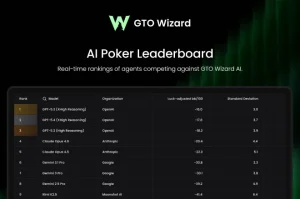 GTO Wizard AI tops the leaderboard, beating GPT-5 and Grok 4 in the latest poker AI test.
GTO Wizard AI Emerges: Poker Artificial Intelligence Enters a New Era
With the rapid evolution of artificial intelligence technology, the poker field has once again witnessed a major breakthrough. The latest benchmark tests show that GTO Wizard AI has successfully outperformed several top large language models (LLMs), including GPT-5 and Grok 4, officially taking the top spot on the poker AI performance leaderboard.
This result has not only attracted attention in the poker community, but has also made "GTO Wizard AI" a popular search term in the fields of AI and gaming recently.
A Retrospective on the Development of Poker AI: From Pluribus to Modern Models
Looking back, artificial intelligence first defeated humans in the world of poker in 2019, achieved by Pluribus, who successfully defeated multiple professional players, ushering in a new era of AI-driven strategy.
Subsequently, various AI models were introduced into the competition, including large-scale language models from technology companies. However, while these general-purpose AIs significantly improved their language and reasoning abilities, they consistently struggled to gain an advantage in high-strategy-density poker games.
What is GTO Wizard AI? A representative of professional poker AI.
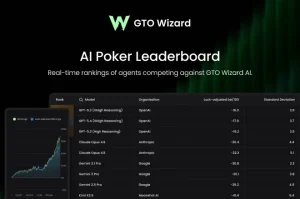
GTO Wizard AI is an artificial intelligence agent model designed specifically for poker. Its core technology originated from Ruse AI, created by Canadian developers Marc-Antoine Provost and Philippe Beardsell, and was acquired and integrated by GTO Wizard in 2023.
Unlike traditional poker bots, GTO Wizard AI does not rely on a pre-computed strategy library. Instead, it trains itself through "deep reinforcement learning" over hundreds of millions of games and can perform real-time analysis and decision-making during the game.
This means that it can dynamically adjust its strategy based on the current hand, rather than applying a fixed solution.
Real-world performance: Achieved an overwhelming win rate against Slumbot
In a 150,000-move test match, GTO Wizard AI defeated Slumbot, the 2018 ACPC champion robot, and achieved an astonishing win rate of 19.4 bb/100.
In comparison, world-class professional players typically aim for a win rate of around 5 bb/100, demonstrating that GTO Wizard AI far surpasses human levels in terms of strategy depth and stability.
If calculated with blinds of $50/$100, the theoretical hourly wage can reach $3,880, demonstrating extremely high profitability.
Latest AI benchmark tests: Completely outperforms GPT and Grok
In the latest poker AI benchmark leaderboard, GTO Wizard AI achieved a comprehensive advantage over several top models:
- GPT-5.3 (OpenAI): -16 bb/100
- GPT-5.4 (OpenAI): -17.8 bb/100
- Claude Opus 4.6 (Anthropic): -20.4 bb/100
- Grok 4 (xAI): Approximately -60 bb/100
Data shows that even the most advanced general-purpose AI models still have a significant disadvantage in high-strategy games like No-Limit Texas Hold'em (NLH).
AIVAT Technology: Cracking the "Luck Factor" in Poker
Poker is inherently highly volatile, and traditionally, hundreds of thousands of hands are needed to draw reliable conclusions.
To address this issue, this test employs AIVAT technology (mutation reduction tool), which can reduce the required sample size by approximately 10 times, making AI performance evaluation more accurate and efficient.
This makes the ranking results more convincing.
API Openness: AI Competition Enters the Open Era
GTO Wizard has announced the opening of its API, allowing developers to submit their own AI models for testing and competition.
The testing rules include:
- At least 2,500 Heads-Up games
- 200bb chip depth
- Maximum of 100,000 lots per month
This move is seen as an important step in promoting transparent competition in AI, and it also means that in the future, AI strength will be demonstrated by data, rather than simply by claims.
Future Outlook: From NLH to PLO
GTO Wizard also revealed that it will launch the Heads-Up Pot-Limit Omaha (PLO) benchmark test in the future to further expand the application of AI in different poker types.
The industry generally believes that:
- Specialized AI will continue to outperform general-purpose models.
- Poker will become an important testing ground for AI's strategic capabilities.
- The battle between AI and humans may be entering a new phase.
Conclusion: The AI poker competition has entered an era of "proving strength".
The rise of GTO Wizard AI marks a significant turning point in the development of poker AI. From defeating humans to suppressing general AI models, specialized AI is redefining the boundaries of competition.
In the future, the strongest AI will no longer be determined by publicity, but by real-world data and leaderboards.
Advanced Thinking Review: From "Knowing How to Play Cards" to "Making the Right Decisions"
When you stop just looking at your own hand, what truly sets you apart is how well you understand Range, EV, Blocker, position, and overall betting strategy.
The following advanced thinking methods are key to most players' progress from "occasionally getting it right" to "long-term stable profitability":
[Range Thinking] How to truly apply Range thinking in actual gameplay? Hand review and analysis.
[River Decision Making] How does the Blocker influence River's calling, raising, and folding? Strategy Breakdown
[Result Bias] EV vs Result: Why did we still lose even when we bet correctly? Retrospective Analysis
[Bluff Core] What constitutes proper Bluff? Hand replay analysis
[Semi-Bluff Timing] When is the most profitable time to use a semi-bluff? Strategy Analysis
[Bet Line] How to construct a complete betting line? Practical analysis and review.
[Position Advantage] Why does position directly influence your every decision? Hand Analysis
[SPR Application] How does SPR affect your playing style and pot planning? Strategy Analysis
[Vulnerability Analysis] How to identify vulnerabilities in an opponent's Range vulnerability? Post-mortem analysis and breakdown.
[Marginal Hands Problem] Why do expert players rarely play marginal hands? Decision Analysis
【Lập kế hoạch ba vòng cược】Làm sao thiết kế chiến thuật cho flop, turn và river? Phân tích thực chiến trong poker
[Fold Equity Pressure] How to Create Fold Equity? Hand Replay Analysis
[Area Contraction] How to analyze the process of the opponent's area being compressed? Strategy breakdown
[Strategy Selection] Balance vs. Exploit: Which to Choose in Practice? Retrospective Analysis
[Long-Term Profitability] How to Train a Long-Term EV Mindset? Decision Model Analysis
The biggest difference between advanced players and casual players isn't remembering more terminology, but rather the ability to integrate range, EV, position, blocking cards, and betting lines in every decision. Through these advanced thought processes, you can gradually build a more complete Texas Hold'em decision-making framework.
Further News Reading
International news
APT Jeju Station | Scott Margereson wins High Roller title, Hongsheng Zhang achieves career-best third place.
International news
Love from Paris: French warriors win hard-fought victory in Marrakech
International news
Nine cards flopped to determine the RGPS Lake Erie Main Event champion
International news