





In Texas Hold'em, information is never complete, but decisions cannot wait. This article delves into common misconceptions players make when facing uncertainty through real-world hand replays and provides a decision-making framework based on range and EV (Earnings Value). When you shift from "finding answers" to "assessing probabilities," your decisions will become more consistent and profitable in the long run.
In Texas Hold'em, the biggest difference between expert players and average players is often not skill, but rather "range judgment intuition." This article delves into how to transform complex range analysis into rapid judgment through hand review, and provides practical training methods to help players build pattern recognition and relative hand strength judgment abilities. When you can compress logic into intuition, your decision-making speed and accuracy will significantly improve, and your overall strategy will become more stable.

In Texas Hold'em, many players lose money not because of flawed strategy, but because emotions cloud their otherwise correct decisions. This article analyzes real-world scenarios to explore how emotions (such as tilt, fear, and anger) alter betting behavior and decision-making quality, and provides specific strategies to help players build emotional control mechanisms. When you can remain rational in any situation and consistently execute the correct process, your overall stability and long-term profitability will significantly improve.

In Texas Hold'em, what truly determines long-term profitability is not a single skill, but a stable and replicable decision-making process. This article systematically breaks down the Poker Decision Making Framework, from hand strength classification, range analysis, and relative advantage assessment to the complete five steps of action and betting sizing, helping players build a consistent and rational decision-making model. When you can repeat the correct process in every hand, rather than relying on emotions and intuition, your decision-making quality and overall profitability will significantly improve.

In Texas Hold'em, confidence is essential, but overconfidence is the root cause of many players' long-term losses. This article, through reviewing actual hands, delves into how the "overconfidence bias" leads players to overestimate their own judgment, underestimate their opponents' range, and engage in excessive aggression in unsuitable situations. When you learn to base your confidence on range and logic, rather than short-term results and feelings, your decision-making stability and overall profitability will significantly improve.

Many players lose money consistently not because of bad luck, but because they repeatedly make negative EV (-EV) decisions. Even if you win occasionally in the short term, as long as you continue to make -EV decisions, you will eventually be mathematically eliminated. This article will fully analyze what negative EV is and why it will slowly destroy your profitability.

Positive Expected Value (+EV) is the core objective pursued by all professional gamers. Top players don't win every hand; they consistently make profitable decisions over the long term. This article will provide a complete analysis of what +EV is, how to determine positive EV, and how professional gamers build a stable profit system through numerous +EV decisions.

Many players know that Expected Value (EV) is important, but the real challenge is: how to actually calculate EV? This article will provide a complete analysis of the core formula of Expected Value, practical EV breakdown, and how to combine Bluff EV with Pot Odds, helping you truly build professional-level mathematical decision-making skills.

Expected Value (EV) is the core mathematical concept in Texas Hold'em and the true basis for all professional players' decision-making. Experts don't just look at the wins and losses of a single hand, but rather at long-term profitability. This article will provide a complete analysis of EV, positive EV, and negative EV, and how professional players use EV to build a stable and profitable system.
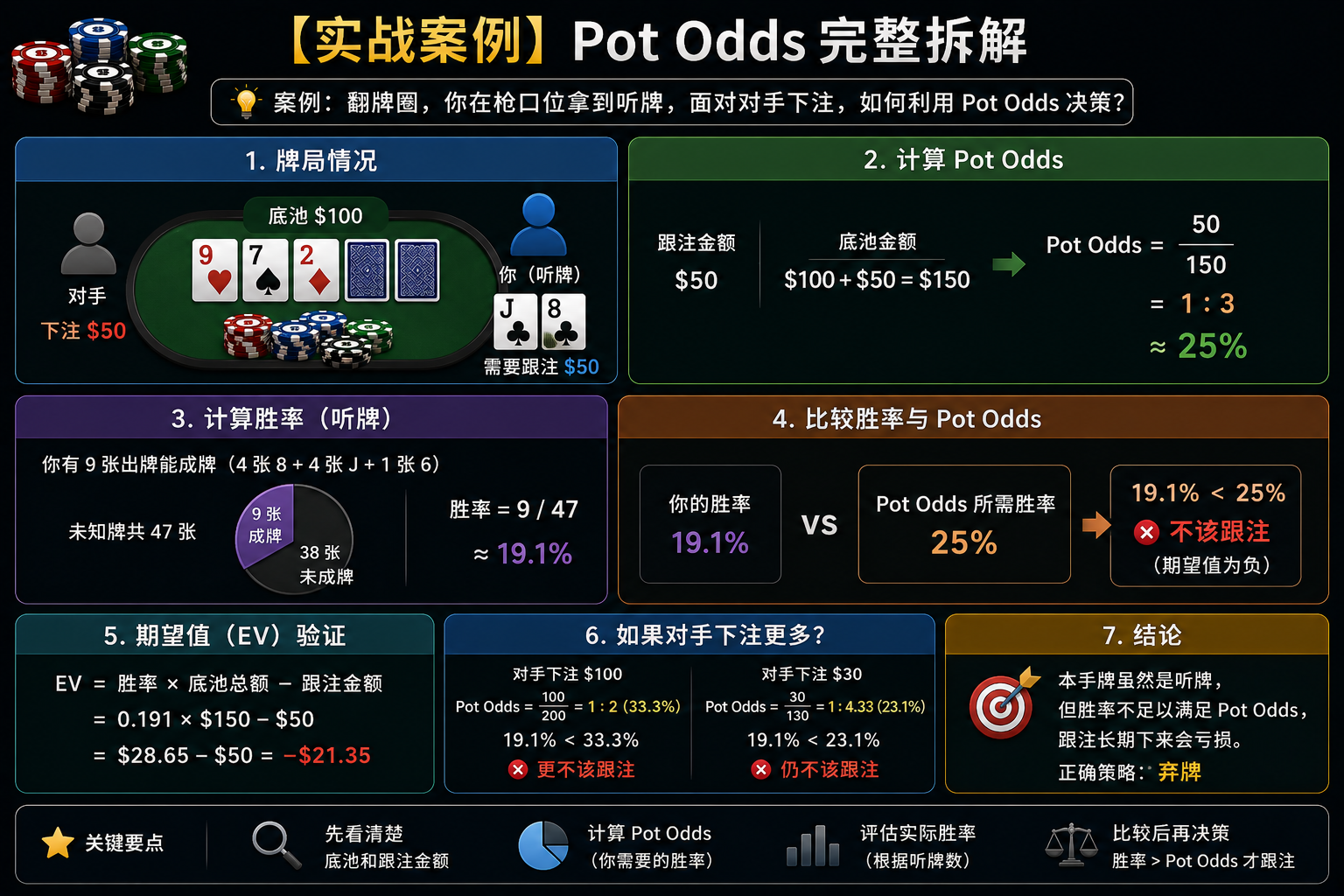
Many players have learned the Pot Odds theory but don't know how to apply it in practice. This article will break down the decision-making process of professional players step by step through complete practical cases, from Outs, Equity, Pot Odds to EV, to help you truly understand advanced mathematical poker.
Small bets refer to bets that are relatively small compared to the current pot size, commonly a quarter or a third of the pot, or other bets less than half the pot. Small bets are usually paired with a wider betting range and a higher betting frequency. They are commonly seen when a player has a range advantage, the board is relatively dry, opponents have many hands without sufficient equity, or when hoping to complete a continuation bet at a lower cost. Small bets do not represent weak hands, nor are they simply about saving chips. They can be used in Value, Bluff, Thin Value, Protection, and Range Denial betting strategies, and are a very important betting tool in modern GTO and Solver strategies.
Bet size refers to the proportion of a player's bet amount relative to the current pot size, such as a quarter pot, a third pot, half pot, full pot, or overpot. Bet size doesn't just determine how many chips to put in; it also affects opponents' pot odds, calling range, folding frequency, value range, bluff range, and the pot size on later streets. Different ranges, board textures, stack sizes, and strategic objectives typically require different bet sizes. This article will provide a complete overview of the definition of bet size, common sizes, and its relationship with value, bluff, GTO, and exploit strategies.
A strategy matrix is a matrix or grid of starting hands that shows the actions to take in a specific situation for different hand combinations, along with the frequency of each action. In Texas Hold'em Solver and GTO analysis, a strategy matrix typically arranges all starting hands in a 13x13 range grid and displays strategies such as Bet, Check, Call, Raise, and Fold through different blocks or proportions. When a hand contains multiple actions, the matrix also presents its mixed strategy and corresponding frequency. This article will provide a complete introduction to the definition, reading method, differences from Range Chart, Solver applications, and practical concepts of the strategy matrix.

A Game Tree is a tree-like structure representing all possible decisions and actions in Texas Hold'em. Starting pre-flop, it extends to the flop, turn, and river. Each check, bet, call, raise, or fold creates a new Node, forming the complete Game Tree. A Solver traverses the entire Game Tree, calculating the optimal GTO (Game Theory Optimal) strategy for each Node. Therefore, understanding the Game Tree is a crucial foundation for learning GTO, Solver, and Node Lock.
EV Loss (Expected Value Loss) refers to the theoretical expected value (EV) of the loss a player incurs due to not making the optimal decision. EV Loss doesn't represent the actual number of chips lost in a hand, but rather measures the difference between the player's performance and the optimal strategy. Even if a hand is ultimately won, EV Loss can still occur if the decision wasn't optimal; conversely, even if the pot is lost, there may be no EV Loss if the decision is correct. This article will provide a comprehensive overview of the definition of EV Loss, Solver analysis, GTO applications, and practical concepts.