




[Result Bias] EV vs Result: Why did we still lose even when we bet correctly? Retrospective Analysis
EV vs. Result: Poker Strategy is one of the most important core concepts in Texas Hold'em. Many players misjudge their decisions based on short-term wins and losses, causing their long-term strategies to deviate from the correct path. This article, through reviewing actual hands, delves into how result bias affects player judgment and explains that EV (Expected Value) is the sole criterion for evaluating decisions. Only when players can move beyond a single result and focus on long-term EV and repeatable correct decisions can they truly build a consistently profitable poker system.
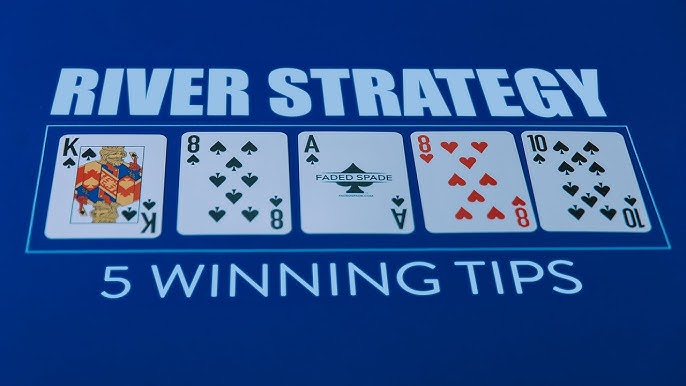
River Blocker Strategy is a crucial part of advanced decision-making in Texas Hold'em, especially in the River phase. Players shouldn't just focus on their absolute hand strength, but also understand whether their hand is blocking their opponents' value hands or bluffs. This article analyzes real-world hand replays to break down how Blockers influence calling, raising, and folding decisions in the River phase, explaining which hands are better suited as bluff-catchers and which combinations are better suited for bluff raises. When you truly master River Blocker Strategy, your River decisions will evolve from intuition to a systematic approach based on range, combination count, and EV.

Range Thinking Poker Strategy is a key skill that advances from single-hand thinking to overall range analysis. This article analyzes how to construct an opponent's range, assess the impact of a hand's range, and make the right decisions in the turn through reviewing actual hands. When players stop guessing at single hands and begin analyzing the overall range, their decision-making becomes more stable and accurate. Range thinking not only improves judgment but is also one of the core skills for achieving long-term stable profitability.
In Texas Hold'em, true profitability doesn't come from a single skill, but from a complete and functional decision-making system. This article integrates four core elements—cognition, psychology, decision-making, and technique—to build the Poker Winning System, helping players transform scattered knowledge into stable profitability. When you can execute a consistent and correct decision-making process in every hand and continuously optimize your strategy, you will truly enter the stage of long-term stable profitability.

In Texas Hold'em, what truly determines long-term success or failure is not a single hand, but rather the overall mindset. This article delves into how to cultivate a "profit-driven mindset" through hand review and strategy analysis, shifting from a results-oriented approach to long-term EV (earnings per unit of value) decision-making. When you can focus on decision quality, accept short-term fluctuations, and continuously optimize your strategy, your overall stability and profitability will significantly improve.

The Independent Chip Model (ICM) is the core decision-making model in tournaments, revolutionizing players' understanding of "chip value." Under ICM pressure, every decision is no longer just about win rate, but about balancing risk and prize distribution. This article delves into key decisions during the bubble and final table, explaining why strong hands sometimes must fold, and how expert players exploit ICM pressure to exploit and maximize long-term profitability.

True professional players don't meticulously calculate formulas for every hand; instead, they develop a rapid EV (Effective Value) assessment model. Experts utilize range, pot odds, fold equity, and situational pressure to make decisions within seconds. This article will provide a comprehensive analysis of professional players' EV models and advanced thinking processes.

Truly advanced Texas Hold'em isn't just about "Call or Fold," but about comparing the economic value (EV) of multiple options. Professional players analyze the long-term payoff of Fold, Call, Raise, and even All-in simultaneously, selecting the action with the highest EV. This article will provide a complete analysis of Decision EV and professional-level optimal decision-making thinking.

True Texas Hold'em isn't about who has the best luck in a single hand, but about who can consistently make positive EV (Earnings Value) decisions over the long term. Many players doubt themselves because of short-term fluctuations, but true professional players always look at the long-term results over tens of thousands of hands. This article will provide a complete analysis of how EV affects long-term profitability and the true mathematical thinking behind professional players.

Many players, even after learning the EV formula, still consistently make incorrect decisions. The real problem isn't the mathematical formula itself, but rather a misunderstanding of Range, Pot Odds, Fold Equity, and Variance. This article will provide a complete analysis of the most common EV mistakes and the true EV mindset of professional players.
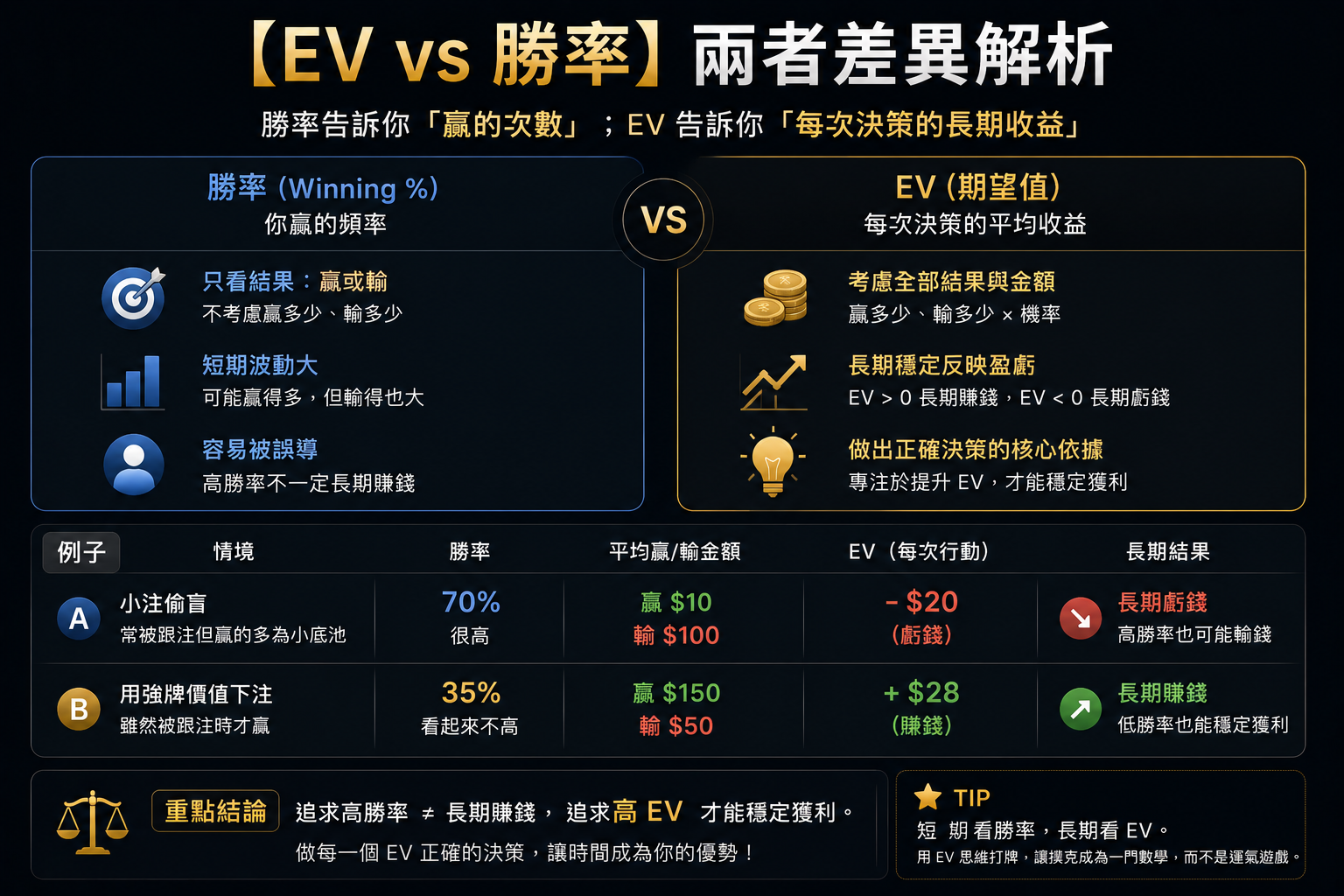
Many beginners confuse "Equity" with "Expected Value" (EV), but these two are completely different. Equity only represents your probability of winning, while EV represents your average winnings over the long term. This article will fully analyze the core differences between EV and equity, and why a high equity does not necessarily mean a high EV.
Minimum Raise refers to the minimum number of chips a player must add to constitute a valid full raise when faced with a bet or raise. In No-Limit Texas Hold'em, the minimum raise is not simply doubling the current total bet amount; it must be at least the equivalent of the previous full raise's raise increment. For example, if player A bets 50 and player B raises to 150, B's raise increment is 100. Therefore, the next player wishing to raise again must raise to at least 250, not just 200. Minimum Raise also affects whether a short-stacked all-in constitutes a full raise, whether subsequent players can re-raise, and whether action is reopened. Understanding this rule can help avoid common betting mistakes in both live and online games.

All-in sizing refers to a bet where a player puts all their remaining effective chips into the pot at once. It's also commonly called all-in, shove, or jam. The all-in size isn't a fixed pot percentage. It can be half the pot, a full pot, an overpot, or even several times the pot, depending on the current pot and the remaining effective stack of both players. All-in sizing can be used to maximize value, create fold equity, complete geometric sizing, reduce the complexity of subsequent decisions, or directly achieve all equity in short-stack situations. Professional players use SPR (Stack-to-Pot Ratio), Range, Board Texture, Blocker, opponent's calling range, tournament ICM, and GTO strategies to determine when to go all-in to create the highest EV.
Geometric sizing refers to a player's pre-planning of the betting size for each street based on the remaining effective stack and the remaining betting streets, ensuring a natural all-in or optimal value bet on the final street. It's not a fixed betting percentage, but rather a multi-street betting strategy. Professional players use geometric sizing to ensure the pot grows at a fixed rate on the flop, turn, and river, preventing the final street from being under-cash due to a small pot or under-cash due to a large pot, thus avoiding missing the optimal betting size. Geometric sizing is one of the most commonly used betting planning methods in modern GTO, Solver, and high-stakes games.

Bluff sizing refers to the bet size a player chooses when bluffing, based on the opponent's fold frequency, board texture, range, blocker, and strategic objective. A good bluff isn't about betting as big as possible, but rather choosing the size that maximizes fold equity. Betting too small may lack pressure, while betting too large may invest too many chips, lowering overall EV. Professional players consider board texture, nut advantage, capped range, blocker, effective stack size, and opponent tendencies to select the most suitable bluff sizing from Small Bet, Half Pot, Pot Size Bet, and Overbet.

Value sizing refers to the betting size a player chooses when holding a leading hand, based on factors such as the weaker hands opponents might call with, the range of both players, the board texture, and the opponent's tendencies. The goal of value betting is not simply "the bigger the better," but rather finding the optimal balance between bet size and the frequency of opponent calls. Betting too small may result in less profit, while betting too large may cause all weaker hands to fold, leading to no payout. Value sizing can range from thin values to full bets and overbets. Professional players choose the most profitable size based on factors such as calling range, range advantage, nut advantage, effective stack size, blocker, and opponent type.