




In Texas Hold'em, many players aren't completely oblivious to the situation; rather, they often only realize they should adjust their decisions after the hand has changed. This article, through reviewing real-world hands, delves into how "reaction delay" leads players to use outdated judgments in the current situation, and explains how to update ranges, hand strength, and strategic direction in a timely manner on each street. When you can perceive changes more quickly and correct your thinking, your decision-making stability and overall profitability will significantly improve.
In Texas Hold'em, many players struggle with the dilemma of "thinking speed vs. thinking quality." This article, through hand review and strategy analysis, explains that these two are not contradictory but rather evolutionary. When you first establish high-quality decision-making logic, and then train to transform it into rapid judgment, your decisions will possess both speed and accuracy. This ability is key for advanced players to achieve consistent profitability.

In Texas Hold'em, intuition is often seen as a hallmark of skill, but many players struggle to discern when to trust it. This article delves into the essence of intuition through hand review, distinguishing between effective and false intuition, and providing a clear framework for judgment. When your intuition is grounded in range analysis, decision-making processes, and long-term EV, your judgments will be faster and more accurate, significantly improving your overall profitability.
In Texas Hold'em, "reading opponents" is often misunderstood as relying on feelings or intuition to judge whether an opponent is bluffing. This article, through reviewing actual hands, delves into how true opponent reading is actually built upon behavioral patterns and range logic. When you can analyze your opponent's betting rhythm, sizing changes, and range consistency, rather than relying on emotional judgment, your decision-making will be more stable and have long-term profitability.

In Texas Hold'em, many players rely on "feelings" to make decisions, but these feelings often stem from emotions and cognitive biases rather than genuine intuition. This article delves into the sources and effects of false intuitions through hand review and explains how to transform feelings into rational judgments based on range and EV. When you can distinguish between intuition and false intuition, your decisions will be more consistent and profitable in the long run.

All-in EV is one of the most extreme and emotionally driven decisions in Texas Hold'em. Many players only look at the strength of their hand, but true professionals analyze pot odds, fold equity, range, and long-term EV. This article will provide a complete analysis of the all-in decision and professional-level shove thinking.
Value EV (Value Betting EV) is the core source of profit in Texas Hold'em. Many players believe that expert players make money through bluffing, but in reality, professional players' biggest profits come from value betting. This article will provide a complete analysis of Value EV, value betting logic, and professional-level profit calculation thinking.
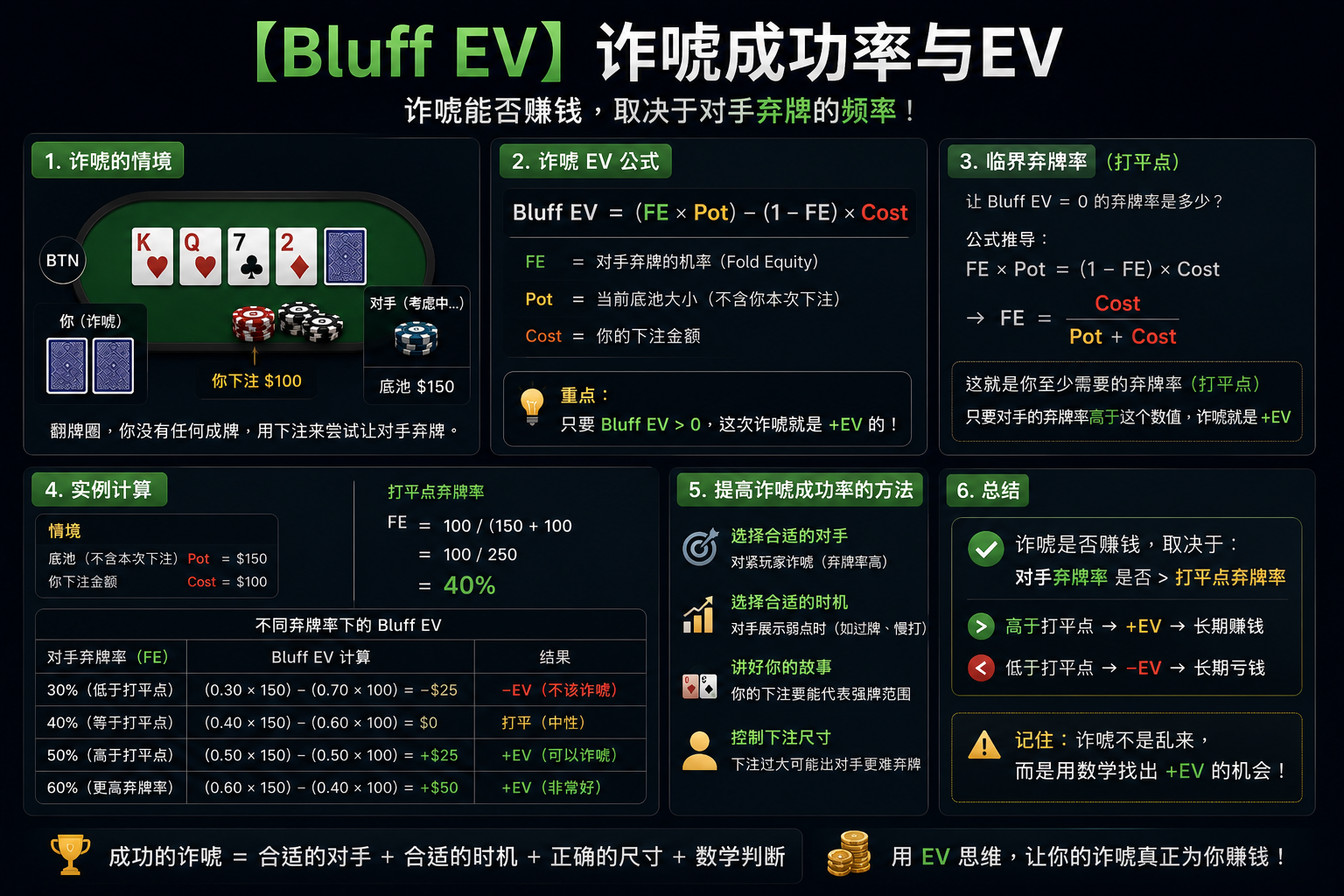
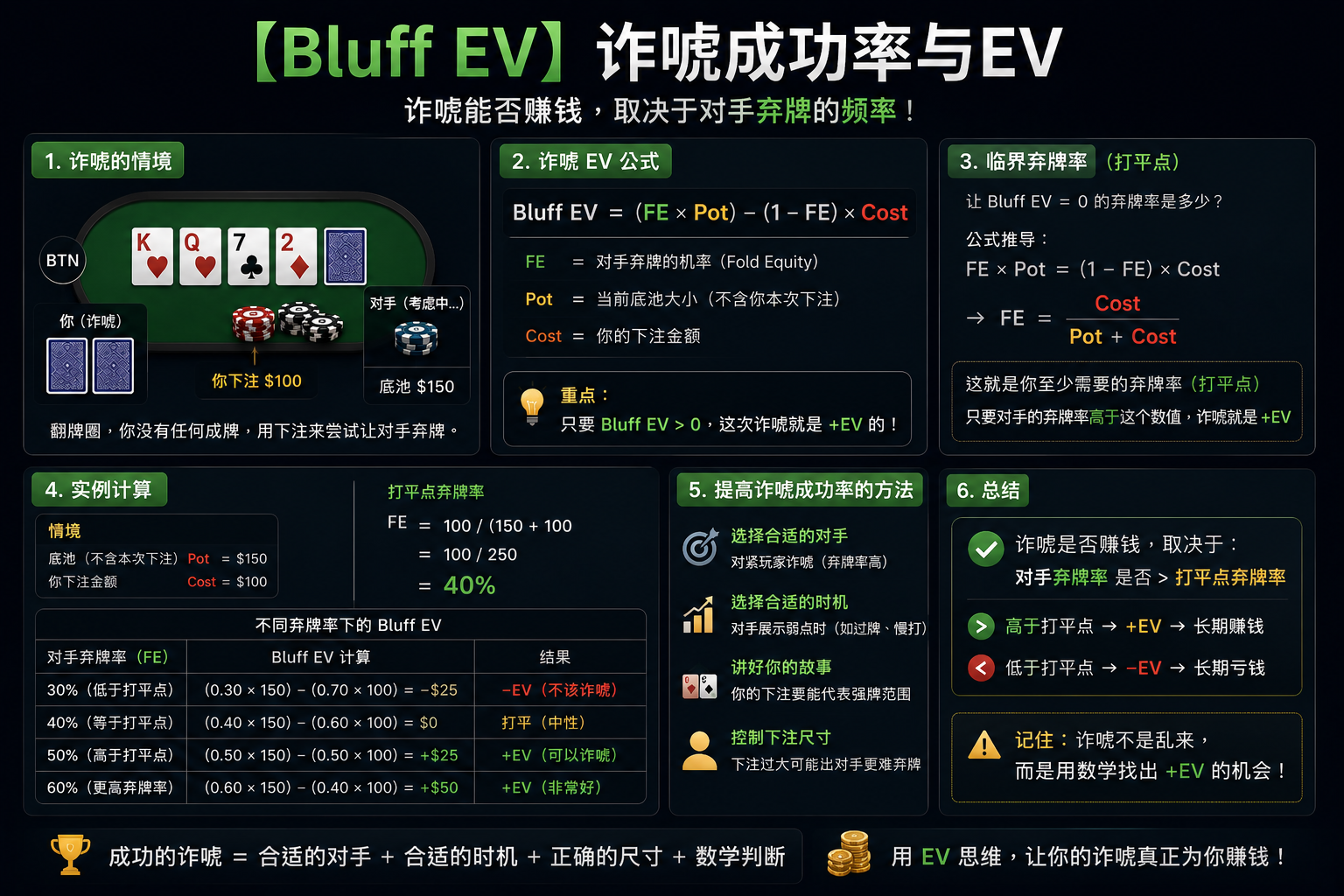
Many players believe that bluffing is merely a psychological game, but true professional players know that bluffing is essentially a game of mathematics and EV (Effective Value). As long as the opponent's folding frequency is high enough, bluffing can still be profitable in the long run, even without a strong hand. This article will provide a complete analysis of the core logic of bluff EV, fold equity, and bluff success rate.
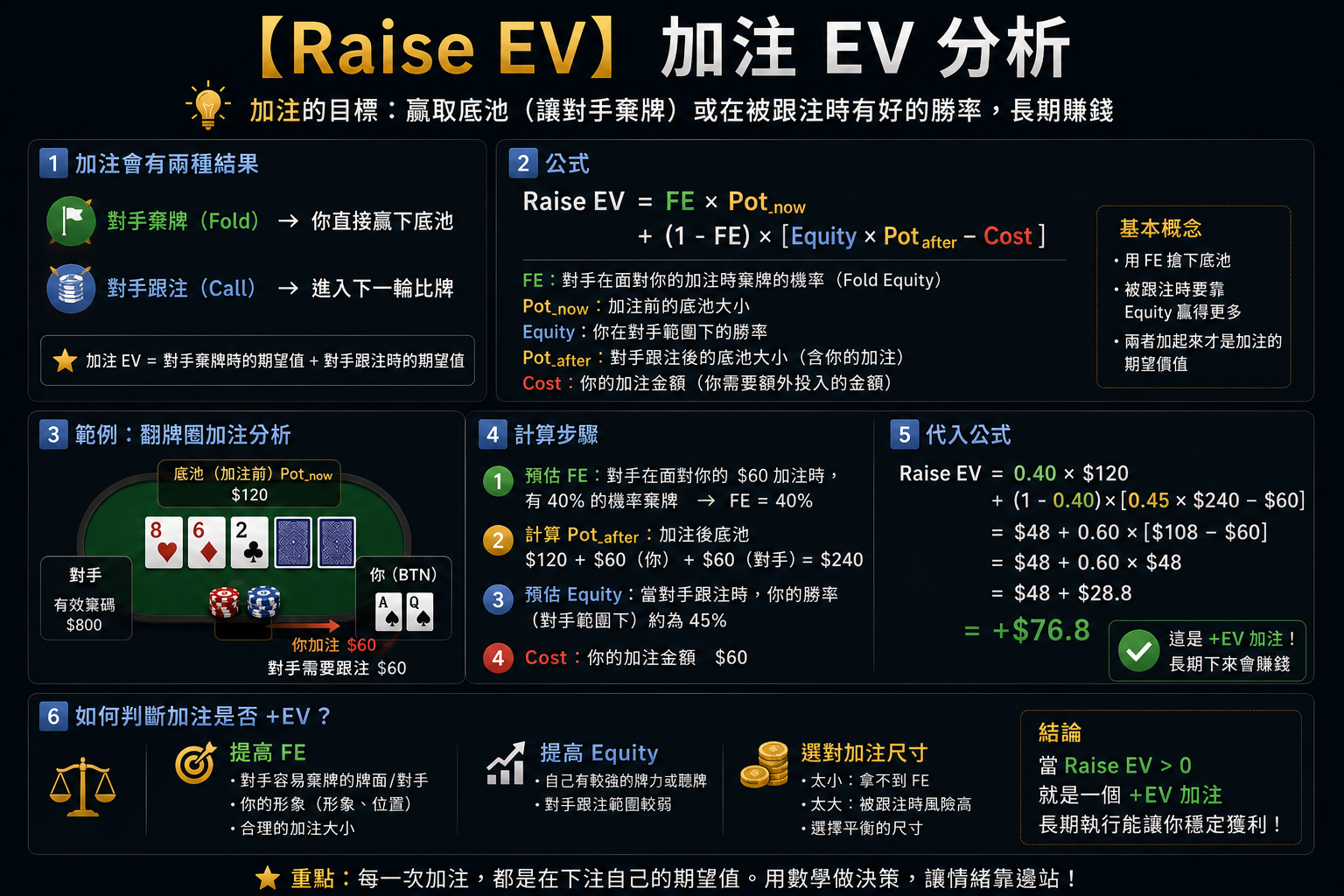
Raise EV is one of the most important offensive mathematical concepts in Texas Hold'em. Many players only know about Call and Fold, but true professionals use Raise to create Fold Equity, compress their opponent's range, and improve long-term EV. This article will provide a complete analysis of Raise EV, Bluff Raise, and professional-level offensive thinking.

Call EV is one of the most important mathematical decisions in Texas Hold'em. Many players call based on gut feeling, but true professionals use Pot Odds, Equity, and Range to quickly determine whether a call is profitable in the long run. This article will provide a complete analysis of how Call EV is calculated and the professional-level thinking behind it.
Value sizing refers to the betting size a player chooses when holding a leading hand, based on factors such as the weaker hands opponents might call with, the range of both players, the board texture, and the opponent's tendencies. The goal of value betting is not simply "the bigger the better," but rather finding the optimal balance between bet size and the frequency of opponent calls. Betting too small may result in less profit, while betting too large may cause all weaker hands to fold, leading to no payout. Value sizing can range from thin values to full bets and overbets. Professional players choose the most profitable size based on factors such as calling range, range advantage, nut advantage, effective stack size, blocker, and opponent type.
Polarized betting refers to a betting range primarily composed of the strongest value hands and bluffs, while medium-strength hands are mostly checked. Polarized betting is often paired with large-size bets such as Pot Size Bet and Overbet, aiming to maximize the value of nuts while applying significant pressure on the opponent's bluff catcher using bluffs. Polarized betting is one of the most important strategies in modern GTO and Solver, and it is also the most frequently used betting method by high-level players in Turn and River betting. This article will provide a complete introduction to the concept of Polarized Betting, its range structure, mathematical foundation, GTO, and exploit applications.
Block betting refers to a player's intentional use of a smaller bet size to prevent opponents from applying pressure with larger bets. Block betting most frequently occurs on the river, typically with medium-strength hands or a Bluff Catcher, aiming to reveal the hand at a lower cost or extract thin value from weaker hands. While its frequency of use has decreased in modern GTO, it remains highly effective against certain players in exploit play. This article will provide a comprehensive overview of the definition, uses, advantages, disadvantages, GTO, and practical applications of block betting.
Overbetting is a bet where the amount wagered exceeds the current pot size. For example, betting 125, 150, or 200 in a pot of 100 is an overbet. Overbetting is typically paired with a highly polarized range, consisting of the strongest value hand and a high-quality bluff. It forces opponents to continue with stronger, more concentrated ranges and puts significant pressure on medium-strength hands and bluff catchers. Overbetting is not just about "betting a lot," but a high-level strategy built on nut advantage, capped range, blocker, storyline, bluff frequency, and effective stack size.
Pot Size Bet (WP) refers to a bet where the amount bet is equal to the current pot size. For example, if the pot is 100, betting 100 is a pot size bet. A pot size bet gives opponents weaker pot odds, forcing them to continue with a stronger, more concentrated range. Therefore, it is often paired with a strong value range, a bluff with a good blocker, and a more polarized betting structure. Pot Size Bet can be used to build large pots, charge draws, pressure capped ranges, or make high-pressure value bets and bluffs on the River. This article will provide a complete introduction to the definition, mathematical basis, range structure, GTO, and exploit applications of pot size bets.